
Rossman–Prospect Avenue Historic District facts for kids
Quick facts for kids |
|
|
Rossman–Prospect Avenue Historic District
|
|

Houses on Prospect Avenue, 2008
|
|

 Location in New York

Location in the United States
|
|
| Location | Hudson, NY |
|---|---|
| Area | 5 acres (2 ha) |
| Built | late 19th-early 20th century |
| Architectural style | Various late 19th and 20th-century styles |
| MPS | Hudson MRA |
| NRHP reference No. | 85003364 |
| Added to NRHP | 1985 |
The Rossman–Prospect Avenue Historic District is a small neighborhood in Hudson, New York. It is a special area where many old houses stand. Most of these homes were built between the late 1800s and early 1900s. This district is one of two historic areas in Hudson.
This neighborhood started when the city built a water pipe, called an aqueduct, through land owned by the Rossman family. The aqueduct led to a reservoir (a place to store water). This was the first time a residential area in Hudson was planned out like this, outside of the main downtown area. In 1985, the district was added to the National Register of Historic Places. This means it is recognized as an important historical site in the United States.
Contents
What Makes the Rossman–Prospect Avenue District Special?
The Rossman–Prospect Avenue Historic District covers about five acres (2 hectares). It is located along two streets: Rossman Avenue and Prospect Avenue. The district sits on the side of Academy Hill, also known as Prospect Hill. This is the highest point in Hudson, about 420 feet (128 meters) high.
Views from Rossman Avenue
Houses on Rossman Avenue climb up the hill. From these homes, you can see amazing views. You can look out over the city of Hudson. You can also see the Hudson River and the Catskill Escarpment (a part of the Catskill Mountains) in the distance.
Nearby Landmarks
To the north of the district is Columbia Memorial Hospital. Beyond that is the larger Hudson Historic District. This is another important historical area in the city. To the west and south, you will find the reservoir and its surrounding wooded areas. East of the district is the residential part of Warren Street, which is Hudson's main street. US 9, a major road, is also nearby.
How Many Buildings Are There?
The district includes some houses on the south side of Prospect Avenue, east of Rossman. It also covers homes on both sides of Rossman Avenue, up to where the houses end. In total, there are 12 land plots with 14 important historical buildings. Two other buildings, which are garages, were built more recently and are not considered part of the historic collection.
Architectural Styles You Can See
The houses in the district show many different building styles. These styles were popular around the late 1800s and early 1900s. Some examples include:
- Queen Anne
- Colonial Revival
- Craftsman Bungalow
- Tudorbethan
How the Rossman–Prospect Avenue District Began
In the mid-1800s, this whole area was the large property of Allen Rossman. He was a local bank director and a county treasurer. At that time, Hudson was growing very fast. Because of this growth, the city often had problems with not having enough water.
Building the Aqueduct
In 1874, the city government decided to get water from the Hudson River. They planned to pump it up to a reservoir behind Prospect Hill. To do this, they needed to build an aqueduct (water pipe) through Rossman's land. The city used a process called eminent domain to get the necessary land for the aqueduct.
Creating a New Neighborhood
Allen Rossman generously gave extra land for a new street. This street, 50 feet (15 meters) wide, was built on top of the aqueduct. He then started planting trees and dividing his property into 13 smaller lots for houses.
The very first house in the district, at 11 Rossman Avenue, was not built until 1887. Allen Rossman passed away shortly after. His family then sold some of the other lots on the west side of the street during the 1890s. Many of these early homes were built in the Queen Anne style. They had simple decorations, similar to other homes in Hudson.
Later Developments and Unique Homes
The lots on the east side of the street were developed in the early 1900s. Many of these houses show the influence of the Arts and Crafts movement. This is especially true for the bungalow-style homes. These bungalows were very well-designed, with details inspired by the Federal and Georgian styles.
The last two houses built in the district were 2 and 4 Rossman Avenue. Number 4 was built for the hospital superintendent. These homes were in the Tudorbethan style, which looks like English country houses. This style was not very common in other parts of Hudson.
Images for kids
-
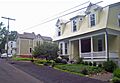
Houses on Prospect Avenue, 2008
