
Salvador arboreal alligator lizard facts for kids
Quick facts for kids Salvador arboreal alligator lizard |
|
|---|---|
| Conservation status | |
Scientific classification  |
|
| Kingdom: | Animalia |
| Phylum: | Chordata |
| Class: | Reptilia |
| Order: | Squamata |
| Family: | Anguidae |
| Genus: | Abronia |
| Species: |
A. salvadorensis
|
| Binomial name | |
| Abronia salvadorensis Hidalgo, 1998
|
|
| Script error: The function "autoWithCaption" does not exist. | |
Script error: No such module "Check for conflicting parameters".
The Salvador arboreal alligator lizard (Abronia salvadorensis) is a special type of lizard. It lives high up in trees. This lizard is only found in two separate places in Honduras. One group lives in the La Paz area. A smaller group lives in the Intibucá area. These lizards are quite rare and need our help to survive.
Contents
Discover the Salvador Alligator Lizard
The Salvador arboreal alligator lizard is a fascinating reptile. It is known for its unique looks and its life in the trees. These lizards are part of a group called Abronia. Many Abronia lizards live in forests in Central America.
What Does It Look Like?
This lizard has a long body and a tail that can be twice as long as its body. Its skin is often green or brownish-green. This color helps it blend in with the leaves and branches. It has special scales that make its skin look a bit bumpy. This helps it grip onto tree bark. Its eyes are usually bright and alert, helping it spot food and danger.
Where Does It Live?
The Salvador arboreal alligator lizard is an arboreal animal. This means it spends most of its life in trees. It prefers cloud forests and pine-oak forests. These forests are found in the mountains of Honduras. They are often cool and misty. The lizard uses the trees for shelter and for hunting. It rarely comes down to the ground.
Its Special Habitat
Cloud forests are very important for these lizards. These forests get a lot of moisture from clouds. This creates a unique environment. It has many different plants and insects. The lizards rely on these specific conditions to live and find food. Losing these forests is a big problem for them.
What Does It Eat?
Like many lizards, the Salvador arboreal alligator lizard is a carnivore. This means it eats other animals. Its diet mainly includes insects and other small invertebrates. It might eat beetles, crickets, or spiders. It uses its quick movements to catch its prey. It often waits patiently for an insect to pass by.
Life Cycle and Reproduction
Not much is known about the exact life cycle of the Salvador arboreal alligator lizard. Most Abronia lizards give birth to live young. This is different from many reptiles that lay eggs. The mother carries the babies inside her body. When they are ready, she gives birth to small, fully formed lizards. These young lizards are ready to climb and hunt soon after birth.
Growing Up in the Trees
Young lizards are very small when they are born. They must quickly learn to survive on their own. They use the same camouflage as their parents. This helps them hide from predators. They also start hunting small insects right away. Growing up in the trees keeps them safe from many dangers on the ground.
Why Is It Endangered?
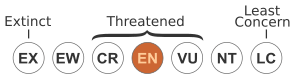
The Salvador arboreal alligator lizard is an endangered species. This means it is at a high risk of disappearing forever. The biggest threat to this lizard is habitat loss. Forests where it lives are being cut down. People clear land for farming or building. This leaves the lizards with nowhere to live.
Protecting This Lizard
Many people are working to protect the Salvador arboreal alligator lizard. Conservation efforts focus on saving its forest homes. This includes creating protected areas. It also means educating people about why these lizards are important. Protecting their habitat helps many other animals too. Every effort helps this unique lizard survive.
See also
 In Spanish: Dragoncito de la Sierra de Morazán para niños
