
Scaly-breasted cupwing facts for kids
Quick facts for kids Scaly-breasted cupwing |
|
|---|---|
 |
|
| From Kedarnath Musk Deer Sanctuary in Uttarakhand, India. | |
| Conservation status | |
Scientific classification  |
|
| Kingdom: | Animalia |
| Phylum: | Chordata |
| Class: | Aves |
| Order: | Passeriformes |
| Family: | Pnoepygidae |
| Genus: | Pnoepyga |
| Species: |
P. albiventer
|
| Binomial name | |
| Pnoepyga albiventer (Hodgson, 1837)
|
|
 |
|
| Script error: The function "autoWithCaption" does not exist. | |

Script error: No such module "Check for conflicting parameters".
The scaly-breasted cupwing is a small bird also known as the scaly-breasted wren-babbler. Its scientific name is Pnoepyga albiventer. This bird belongs to the Pnoepygidae family. You can find it in parts of southern and eastern Asia, from the Himalayas mountains all the way to Indochina.
About the Scaly-breasted Cupwing
Scientists study birds to understand how they are related. The scaly-breasted cupwing has a few close relatives. For a while, the Taiwan cupwing was thought to be a type of scaly-breasted cupwing. Also, what was once called the Chinese cupwing is now considered the same species as the scaly-breasted cupwing.
What Does It Look Like?
The scaly-breasted cupwing is a very small bird. It is about 9 centimeters (3.5 inches) long. This is roughly the length of a credit card. It weighs between 19 and 23 grams. That's about the same as four quarters!
This bird has almost no tail, which makes it look quite round. Its back feathers are an olive-green color. The feathers on its chest look like small scales. This is how it got its name, "scaly-breasted."
Where Does It Live?
The scaly-breasted cupwing lives in southern and eastern Asia. Its natural habitat is in subtropical moist montane forest. This means it likes forests that are warm and wet, high up in the mountains.
You will usually find these birds close to water sources. They might live near streams or damp areas in the forest. During winter, some of these birds move to lower areas. This is called altitudinal migration. They move closer to sea level to find warmer temperatures and more food.
Gallery
-
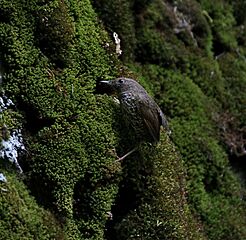
in Kullu - Manali District of Himachal Pradesh, India
-
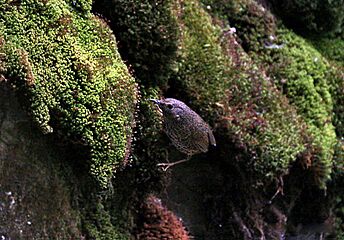
in Kullu - Manali District of Himachal Pradesh, India
-
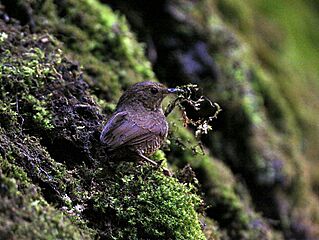
in Kullu - Manali District of Himachal Pradesh, India


