
Secret correspondence of James VI facts for kids
In the late 1500s and early 1600s, an important secret plan was happening behind the scenes of the British monarchy. King James VI of Scotland was quietly talking with the people who worked for Queen Elizabeth I of England. This happened between May 1601 and March 1603, right up until Elizabeth passed away. During this time, it was decided that James, who was a distant relative of Elizabeth, would become the next ruler of England and Ireland. This big secret was only known by a small group of diplomats. When James became king of both England and Ireland, it was called the Union of the Crowns. Before this, starting in 1586, James also received money every year from Elizabeth, known as an annual payment. This helped make their connection stronger.
Contents
How James VI Sought Support for the Throne


Scottish diplomats, including a former musician named James Hudson, a money expert Thomas Foulis, and ambassadors like David Foulis and Edward Bruce, were in touch with the Earl of Essex and his secretary Anthony Bacon.
In 1594, King James VI believed that the Earl of Essex was the best person to help him with Queen Elizabeth. James felt that William Cecil and his son Sir Robert Cecil were working against him. In April 1594, James sent Bruce and James Colville to London. They were there to complain about secret talks between an ambassador and a rebel. James wrote to the Earl of Essex, asking for his help. In letters from July, David Foulis used the code name "Plato" for the Earl of Essex. Foulis was called "Achates," and King James VI was "Tacitus."
Meanwhile, another Scottish diplomat, Richard Cockburn of Clerkington, wrote friendly letters to Sir Robert Cecil. Cecil replied to him in September 1594.
In July 1595, John Maitland, a high-ranking Scottish official, wrote to the Earl of Essex. He wanted to start a regular secret conversation. Essex replied that he only wrote with the Queen's knowledge. He said they would be happy to get letters from Maitland or Cockburn.
Anne of Denmark, the Scottish queen, asked for portraits of the Earl of Essex and his sister, Lady Rich. This request reached Bacon in December 1595. James Hudson repeated the queen's request in August 1596. In 1596, Queen Elizabeth sent a tiny portrait of herself by Nicholas Hilliard to Prince Henry. This was sent through the Earl of Essex and Anthony Bacon. Prince Henry's guardian received it at Stirling Castle.
James Hudson delivered Bacon's letters to King James VI in March 1596. The king was alone with Sir George Home at Holyrood Palace. The king read some letters carefully and laughed at others. He asked Hudson to give his "hearty and loving thanks" back to the senders. Hudson told the king how secretly and carefully the papers were delivered. Hudson then said, "in his majesty's own presence I made a fire-sacrifice of all," meaning he burned the letters to keep them secret.
Anthony Bacon talked about how safe Essex's letters were. He said his letters with David Foulis and Hudson were different from other letters. He called them "letters betwixt private friends," not official letters from a public minister to a king.
The Earl of Mar's Important Trip to London
John Erskine, the Earl of Mar, and Edward Bruce went to London as ambassadors in February 1601. Their goal was to make sure James VI would become the next king of England. The Scottish ambassadors expected to talk with the Earl of Essex. However, he was executed on February 25, 1601, before they even arrived in London.
King James VI then gave his ambassadors new instructions. He told them they should "walk surely between the precipices of the Queen and the people." This meant they needed to be very careful not to upset either the Queen or the English people. He wanted them to have private talks and get support from important towns and ports. Mar and Bruce gained the trust of Robert Cecil. They reached an agreement about James becoming king. But their success was kept a secret.
At a meeting in London, Cecil asked James not to try to get the English Parliament to officially recognize his claim to the throne. He also said that future letters with the Scottish ambassadors should be kept secret from Queen Elizabeth herself. The ambassadors returned to Scotland in May 1601. Until Elizabeth's death on March 24, 1603, two types of letters were exchanged between England and Scotland. There was the usual public communication and the "secret correspondence."
Secret and Public Letters
The secret letters sent to Scotland were written by Robert Cecil and Henry Howard. James's letters were written by Mar, Bruce, and perhaps Mar's relative, Thomas Erskine. Some letters were sent to England as if they were meant for a French duke. This way, they would arrive in England as part of the "diplomatic bag" (official mail). An old historian, Thomas Birch, thought that a Scottish representative in London, James Hamilton, helped send the letters to Scotland. James Hamilton was officially allowed by James VI to live in London starting in August 1600.

The English diplomat Henry Wotton later told a story. He said Queen Elizabeth once noticed mail arriving from Scotland. She demanded to see it. Cecil pretended to open the bag but told the Queen it was dirty and smelled bad. He said she could have the letters after they were aired out. It's not clear if Elizabeth truly knew nothing about Cecil's secret talks.
Henry Wotton himself came to Scotland in September 1601. He pretended to be an Italian named Octavio Baldi. He met James and kept up his act for three months. James talked about Wotton's arrival with Edward Bruce, Sir George Home, and the Earl of Mar. The English official in Scotland, George Nicholson, did not know that the "Italian" was Wotton. Wotton later wrote that his mission was to warn James about a poison plot against him and to bring gifts of antidotes.
Some of the letters used numbers instead of names for people. This was common in secret diplomatic letters. James was '30', Mar was '20', Robert Cecil was '10', Bruce '8', and Northampton '3'. By June 1602, James wrote about how Cecil and his colleague "40" had "so easily settled me in the only right course for my good." He also said they "happily preserved the Queen's mind from the poison of jealous prejudice."
A diplomat named David Foulis wrote to the Earl of Mar in London in December 1601. Foulis did not like a plan involving the Duke of Lennox. He thought the king should threaten the people behind it. Such secret diplomatic efforts, outside the main group of secret letter writers, were not liked by those in the know.
A letter from number "7" mentioned a list of important English ladies sent to King James. This was written when Elizabeth had a "rheum" (a cold or illness) in her arm. She was also losing sleep because she was sad about her former favorite, the Earl of Essex. "7" wanted Foulis to carry King James's letters to London.
A separate "public" exchange of letters between Elizabeth and James continued. A historian named John Duncan Mackie thought that these public letters became friendlier than in previous years. The money Elizabeth paid to James (in cash or jewelry) also continued.
King James VI sent Henry Howard, who later became Earl of Northampton, a jewel with three precious stones, including a ruby. James thought Howard's writing style was too wordy. In May 1602, he wrote that his "own laconic style" (short and to the point) was better than Howard's "ample Asiatic and endless volumes" (long and flowery writing). A historian from the 1800s, Patrick Fraser Tytler, noticed how much Howard flattered James. He also noted how much effort was made to keep others out of these talks. Even though James noticed Howard trying to control his actions, Tytler said their secret cooperation was very successful. "No one had the least suspicion of the understanding that existed between the trio."
According to Godfrey Goodman, King James "wrote and did acknowledge that for some six years before the Queen died he held correspondence with [Cecil], and that he found him a very wise, able, faithful servant."
Keeping Secrets from the Scottish Queen

John Duncan Mackie pointed out that many people did not know about the secret letters. These included the English agent in Scotland, George Nicholson, and James's own secretary, James Elphinstone, 1st Lord Balmerino. One person outside the secret group did find out about the letters. His letter ended up with the Bishop of Durham in March 1602. It mentioned that James VI had been writing to Robert Cecil for six months but still did not like him. The Bishop sent this letter to Cecil. Mackie thought the handwriting of this anonymous letter belonged to William Fowler, a poet and secretary to Anne of Denmark.
Anne of Denmark, the Scottish queen, was very interested in the letters of James Sempill, a diplomat working for her husband. Generally, Anne of Denmark was seen as a problem for the secret letter writers. This was because she did not get along with the Earl of Mar and his cousin, Sir Thomas Erskine. She did not like that Mar was in charge of her son, Prince Henry, at Stirling Castle.
Frances Howard, Countess of Kildare, also tried to start her own secret talks with the Scottish court. The Earl of Northampton tried to stop her. After Queen Elizabeth died, the Countess of Kildare was one of the English noblewomen who came to Scotland to gain Anne's favor. She was later made governess of Princess Elizabeth. Kildare had already impressed James Sempill. In September 1599, her Scottish servant met him in London. The servant said Kildare had spoken in favor of King James becoming the next English king at dinner with a high-ranking official. Sempill wrote that Kildare even passed the paper knife to the queen to open the king's letters. Kildare sent useful information to James VI from Elizabeth's court. She was rewarded for her service when her husband was in trouble.
King James mentioned the idea of the secret letters in a letter to Robert Cecil on August 5, 1608. He half-jokingly referred to Cecil's influence with Anne of Denmark, calling him a guide of a "feminine court." Cecil was again "Master 10," and the Earl of Northampton was "3." James reminded Cecil of the anniversary of a past event, saying it was from the days "when you darest not avow me." Northampton had talked about wanting to get back the queen's favor and trust with Mar in January 1608.
Images for kids
-
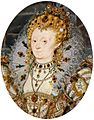
Queen Elizabeth I
-
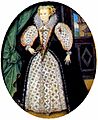
Lady Rich
-
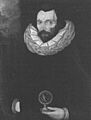
Henry Howard, 1st Earl of Northampton
-
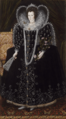
Frances Howard, Countess of Kildare
