
Shabaka (window) facts for kids

Shebeke (pronounced "sheh-beh-KEH") is a special kind of window found in Azerbaijan. These beautiful windows are made with many small pieces of colored glass. Azerbaijani artists create them using tiny wooden parts, all fitted together without any glue or nails!
You can see amazing Shebeke windows in places like the Sheki Khans Palace. Here, they fill entire walls and window spaces. These windows are designed to match the palace's overall look. They are like continuous stained-glass panels that make the palace shine.
Many old stone houses from the 1700s and 1800s in the city of Shusha also featured Shebeke designs. This shows how popular and important this art form was.
Contents
The Art of Shebeke: A Timeless Craft
Shebeke is more than just a window; it's a special part of Azerbaijan's culture. This art form has been used in buildings across Azerbaijan since the 11th and 12th centuries. It's a true masterpiece of decorative art.
Imagine tiny pieces of colored glass held together by small wooden parts. The amazing thing is, these parts fit perfectly without any glue or nails! The secret is how the wooden pieces are shaped. They have little ledges and indentations that lock together, holding the glass firmly in place.
Craftsmen use strong woods like boxwood, walnut, beech, and oak to create these designs. The patterns in Shebeke often look like a lattice or a net. These designs have deep meanings. They can symbolize the Sun, the energy of life, the endless flow of time, and the vastness of the universe.
How Shebeke is Built and Used
Shebeke pieces can be small, just a few centimeters wide, or very large, covering several square meters. Their size depends on what they are used for.
You can find Shebeke in two main ways. First, it can be part of a building, like a door, a window, or even a staircase. Second, it can be a separate item for inside a home, such as a decorative screen, a lamp, a chest, or a cabinet.
The designs in Shebeke are often based on exact geometric shapes. Some common patterns have names like "jafari," "sekkiz," "onalty," and "shamsi." Each pattern adds its own unique beauty to the artwork.
The Talented Shebeke Masters
The amazing art of Shebeke is kept alive by skilled folk masters. These artists pass down their knowledge and techniques through generations. Some famous masters from the past include Mekhti Mekhtiyev and Abbasgulu Sheki from the 19th century.
In the 20th century, masters like Abdulhuseyn Babaev (1877-1961) and Ashraf Rasulov (1928-1997) helped bring Shebeke art back to life. Today, in 2026, the tradition continues to thrive. Ashraf Rasulov's son, Tofig Rasulov (born in 1961), and his grandson, Ilgar Rasulov (born in 1990), are carrying on this family legacy.
Other notable Shebeke artists working today include Soltan Ismailov and Huseyn Mustafazade from Sheki. Jabir Jabbarov from Ordubad and Rafik Allahverdiyev from Shusha are also well-known for their beautiful Shebeke creations.
Bringing Shebeke Back to Life: Restoration Efforts
Over the years, many Shebeke artworks and buildings have needed careful repair. This process is called restoration. In the 1950s and 1960s, master Ashraf Rasulov led the first restoration of the Sheki Khans Palace.
Later, in 2001, the window Shebeke of the Juma and Ambaras mosques in Ordubad were restored. These mosques date back to the 17th and 18th centuries. Master Jabir Jabbarov guided this important work.
From 2002 to 2004, Huseyn Mustafazadeh also helped restore the Palace of Sheki Khans. He worked with a German company to bring the palace's doors, windows, and much of its ceiling back to their original beauty.
Shebeke Across Azerbaijan
The word "shebeke" comes from the Azerbaijani language and means "net" or "lattice." This name perfectly describes the intricate patterns of the art.
Shebeke art has been popular in many Azerbaijani cities. These include Sheki, Shusha, Ordubad, Baku, Ganja, Lankaran, Nakhichevan, and even Derbent in Russia. Sheki is known as the most important center for Shebeke art. Here, you can still see the classic and original style of this tradition.
Many beautiful examples of Shebeke from the 18th and 19th centuries are found in Sheki. The Sheki Khans Palace, built in 1762, is a famous example of this art. While Shebeke is loved across Azerbaijan, its style can vary a little from region to region. For instance, artists in Ordubad often chose simpler shapes and fewer colors. But no matter the region, colorful glass remains a key part of almost all Shebeke creations.
Images for kids
-
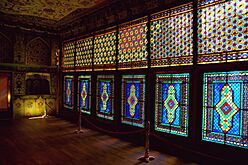
Sheki Khan's Palace exterior
-
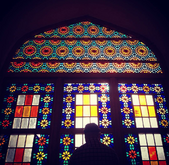
Shebeke in Shah Abbas Mosque, Ganja
-
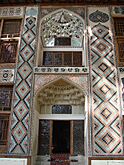
Entrance to Sheki Khan's Palace
-
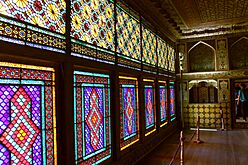
Shebeke in the Consultation Room
-
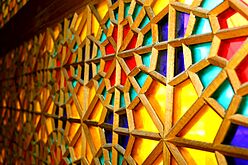
Close-up of Shebeke at Sheki Khan's Palace
-
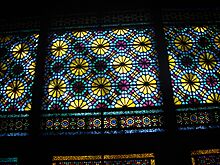
Another view of Shebeke at Sheki Khan's Palace
-
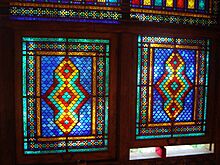
Shebeke details inside the palace
-
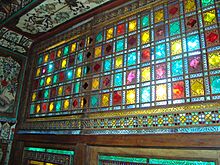
Colorful Shebeke window
-
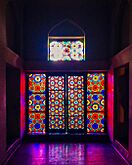
Corridor with Shebeke windows in Sheki Khan's Palace


See Also
- Stained glass
- Culture of Azerbaijan
