
Siege of Dorsten facts for kids
Quick facts for kids Siege of Dorsten |
|||||||
|---|---|---|---|---|---|---|---|
| Part of Thirty Years' War (Hessian War) | |||||||
 The Town of Dorsten in 1641 by Matthäus Merian. |
|||||||
|
|||||||
| Belligerents | |||||||
 Hesse-Cassel Hesse-Cassel |
 Holy Roman Empire Holy Roman Empire |
||||||
| Commanders and leaders | |||||||
| Johann von Geyso Emmanuel Kotz Carl von Rabenhaupt Ernst Albrecht von Eberstein |
 Graf von Hatzfeldt Alexander II of Velen Graf von Hatzfeldt Alexander II of Velen |
||||||
| Strength | |||||||
| 2,000 (infantry, cavalry, artillery), 250 men of the Hessian 1st relief force from Haltern, 2nd relief force incl. 3,000 Swedish cuirassiers withdrawn from Wolfenbüttel (too late for battle) | 20,000 (12 regiments of infantry, 10 regiments of cavalry 30 pieces of heavy artillery) |
||||||
| Casualties and losses | |||||||
| 1,350 killed and wounded | unknown | ||||||
The Siege of Dorsten was an important event during the Thirty Years' War. In this battle, the Imperial Army, led by Melchior von Hatzfeldt, attacked the town of Dorsten. The town was defended by soldiers from Hesse-Cassel. The siege lasted from July 16 to September 19, 1641. In the end, the Hessian soldiers surrendered, and the Imperial Army took control of Dorsten.
The Thirty Years' War was a huge conflict that involved many parts of Europe. It lasted from 1618 to 1648. During this time, different states and empires fought over power and religion.
Hesse-Cassel was a state that had lost some land, including the University of Marburg. To make up for this loss, the King of Sweden, King Gustavus Adolphus of Sweden, promised Hesse-Cassel new lands in Westphalia if they won the war. These lands included parts of the Prince-Bishopric of Münster and the Vest Recklinghausen.
In 1633, Hesse-Cassel took control of Dorsten without a fight. Over the next few years, they made Dorsten a very strong fortress. An earlier attempt by Johann von Götz to take it back in 1636 failed.

The Siege Begins
On July 16, 1641, the Imperial Army started its second attack on Dorsten. This army had about 20,000 soldiers. It was led by Field Marshal Melchior von Hatzfeldt and Alexander II of Velen. They decided to attack Dorsten because some of the Hessian soldiers had left to fight in another battle at Wolfenbüttel.
Hatzfeldt placed his troops south of Dorsten, while Velen set up his forces to the north. The Imperial Army brought 14 cannons to the northeast of the town. Later, more cannons arrived, bringing the total to 30. The Imperial Army also asked nearby towns for lots of supplies, like bread, beer, cattle, and oats, to feed their many soldiers.
Inside the Fortress
The Hessian soldiers defending Dorsten were led by Johann von Geyso and Emmanuel Kotz. They had about 2,000 soldiers. Some of these soldiers had been moved from another town called Kalkar.
Hesse-Cassel tried to send more soldiers to help Dorsten. A small group of 250 men arrived, but other troops, including 3,000 Swedish cuirassiers (soldiers on horseback with armor), arrived too late to join the battle.
The Battle and Surrender
On August 25, the Imperial Army used its cannons to create a large hole in Dorsten's defenses. They fired about 2,000 cannonballs. This destroyed the last barrier protecting the town.
After the hole was made bigger, the Imperial Army planned a big attack. They were going to send 2,000 musketeers (soldiers with muskets) and 1,500 cuirassiers into the town. Seeing this, the Hessian commanders decided to talk about surrendering on September 18.
The siege officially ended on September 19. The remaining Hessian soldiers, about 650 men, along with their families and staff, were allowed to leave Dorsten safely. After the siege, Dorsten was left in ruins.
With Dorsten's surrender, Hesse-Cassel lost a very important fortress. After this, they focused their efforts on other areas, fighting alongside French forces against the Archbishopric of Cologne and the neutral Duchy of Jülich.
Images for kids
-
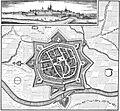
The Town of Dorsten in 1641 by Matthäus Merian.
-
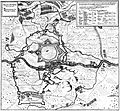
The siege of Dorsten, 1641
See also
