
Silvia Baraldini facts for kids
Quick facts for kids
Silvia Baraldini
|
|
|---|---|

Baraldini in 2008
|
|
| Born |
Silvia Baraldini
December 12, 1947 Rome, Italy
|
| Nationality | Italian |
| Alma mater | University of Wisconsin–Madison |
| Occupation | Activist |
| Known for | Black Power, Puerto Rican independence movements |
Silvia Baraldini was born in Italy on December 12, 1947. When she was 12, her family moved to the United States. There, she became involved in student movements and later became a political activist. She joined groups that supported important causes like the Black Power movement and the fight for Puerto Rican independence.
Silvia Baraldini was known for her activism and for helping others involved in these movements. She was later arrested and spent many years in prison in the United States. In 1999, she was transferred to Italy to finish her sentence. She was released in 2001 and fully pardoned in 2006. Her life story has been shared in documentaries.
Contents
Activism and Early Life
Silvia Pia Baraldini was born in Rome, Italy. When she was 12 years old, her parents moved to the USA. They first lived in the Bronx, New York City, and then in Washington, D.C.. Silvia went to Woodrow Wilson High School. Later, in 1965, she started studying at the University of Wisconsin–Madison. During her time at university, she became a student activist. She joined a group called Students for a Democratic Society (SDS).
Joining Groups for Change
After college, Silvia Baraldini continued her work as an activist. She joined the Prairie Fire Organizing Committee. This group worked to support important social changes. When that group ended in 1976, Silvia and other activists started a new group. They called it the May 19th Communist Organization (M19).
Silvia worked with friends like Susan Rosenberg and Judy Clark. Their goal was to support movements for black liberation. They also supported the FALN, a group that wanted independence for Puerto Rico. Silvia began helping her friend Mutulu Shakur from the Black Liberation Army (BLA). She helped with tasks like renting cars.
In 1977, Silvia Baraldini spoke for protestors outside the court. This was during the retrial of Assata Shakur. Two years later, Silvia helped Assata Shakur escape from jail. Silvia drove one of the cars used to get away.
Helping Others and Bank Robberies
Silvia Baraldini and Assata Shakur introduced another activist, Marilyn Buck, to Sekou Odinga. These four people formed a group called the Family. The plan was for the black members to rob banks. The money from these robberies would then be used to fund their revolutionary causes. The white members, including Silvia, would help them.
The Black Liberation Army members involved were Shakur, Odinga, Mtayari Shabaka Sundiata, Kuwasi Balagoon, and Tyrone Rison. They decided which robberies to do. Silvia Baraldini, Marilyn Buck, Judy Clark, and Susan Rosenberg provided support. They helped by buying firearms and driving the getaway cars. The M19 members stressed that they did not want to hurt people. However, during a robbery on June 2, 1981, a security guard was shot and killed. This happened when the Family robbed an armored car in the Bronx.
On October 20, 1981, the Family tried another armed robbery in Nanuet, New York. This robbery was not successful. Two police officers and a security guard were shot and killed. Police were able to find some of the group members by tracing license plates. Silvia Baraldini married fellow activist Tim Blunk. This was to avoid being sent back to Italy. She spoke for those who were arrested. A year later, she was arrested herself.
Arrest and Time in Prison

On November 9, 1982, Silvia Baraldini was arrested in New York City. This happened near her home on the Upper West Side. Police found a copy of a document from the FALN at her apartment. At her trial, she was first represented by Susan Tipograph. Silvia had worked for Susan as a paralegal before.
Silvia was charged with being part of a plan to commit armed robberies. This was under a law called the Racketeer Influenced and Corrupt Organizations Act (RICO). Silvia Baraldini and Sekou Odinga received the longest sentences. Silvia was sentenced to 43 years in jail. This was for planning the robberies, helping Assata Shakur escape, and refusing to speak to a grand jury.
Many human rights activists felt Silvia's sentence was too long. She also received attention when she was placed in a special prison unit. This unit was called the High Security Unit (HSU). It was located at the Federal Medical Center, Lexington in Lexington, Kentucky. Two other women, Susan Rosenberg and Alejandrina Torres, were also held there.
Life in a Special Prison Unit
The conditions in the HSU were very strict. Prisoners were kept in chains and watched by cameras all the time. They were often searched and had very few books to read. They could not see daylight and had limited time with visitors. Amnesty International, a group that protects human rights, spoke out against the HSU. They asked for it to be closed. Prison officers told the women they would stay in the unit forever. This would happen unless they changed their political beliefs. A documentary called Through the Wire was made in 1989. It was about the experiences of the three women in Lexington.
Silvia Baraldini was held in the HSU for almost two years. Then, a judge said the unit was illegal, and it was closed. While there, she developed uterine cancer. This was later treated at a prison in Minnesota. After that, she was moved to another special unit in Florida.
Returning to Italy
Italy first asked for Silvia Baraldini to serve her sentence in her home country in 1989. They made more requests in 1992, 1993, 1995, and 1997. The United States refused these requests. They said she showed no regret for her actions. In 1991, an Italian judge named Giovanni Falcone visited her in prison. In Italy, more and more people wanted her to be sent home. Italian presidents and prime ministers spoke to US presidents about her case.
After 17 years in US prisons, Silvia Baraldini traveled to Rome in 1999. She was met by her mother and Italian government officials. The Italian government promised she would stay in prison until July 29, 2008. This was the earliest date she could have been released in the US. She was jailed at Rebbibia prison. A year later, she said she had been treated better in US prisons. She even said she wanted to return to the US. She felt she had less freedom in Italy. She also said she was not getting treatment for breast cancer and could only make two phone calls a month.
Life After Prison
In 2001, Silvia was released into house arrest for several months. This was part of an agreement between Italy and the US. It was because of her breast cancer, for which she was getting treatment in Rome. In 2006, she was fully pardoned by the Minister of Justice, Clemente Mastella.
Two documentaries have been made about Silvia Baraldini's life. One is called Ore d'aria – La vita di Silvia Baraldini (Hours outside: The life of Silvia Baraldini). It was released in 2002. Another film, Freeing Silvia Baraldini, came out in 2009. In 2011, a newspaper reported that she was living quietly in Rome. She was working to help migrants through a group called ARCI.
Images for kids
-
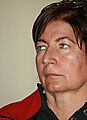
Silvia Baraldini in 2008
-
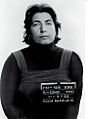
Silvia Baraldini when arrested in 1982
