
Spider crab facts for kids

Spider crabs are marine crabs that belong to a large family called Majoidea. his diverse group also includes the famous decorator crabs, which dress themselves in sea plants and sponges. Spider crabs get their popular name from their unusually long, slender legs and rounded central bodies. They resemble garden arachnids crawling across the ocean floor.
These marine crustaceans live in oceans all around the world. They inhabit warm tropical coral reefs, shallow coastal estuaries, and pitch-black deep-sea trenches. The superfamily contains some of the smallest crabs in the sea, as well as the largest arthropod on Earth.
Contents
- What Are Spider Crabs and How Are They Classified?
- Evolutionary History and Ancient Fossils
- Physical Anatomy and Unique Spider Crab Adaptations
- Amazing Camouflage: The Secret Life of Decorator Crabs
- Notable and Fascinating Spider Crab Species
- Habitat, Diet, and Ecological Role in Marine Ecosystems
- Life Cycle and Reproduction of Spider Crabs
- Conservation, Threats, and Human Importance
- See also
What Are Spider Crabs and How Are They Classified?
Scientific classification helps marine biologists organize living things by evolutionary relationships and physical structures. The superfamily Majoidea belongs to the true crabs, known scientifically as Brachyura. These creatures have a shortened abdomen tucked completely beneath a hard upper shell called a carapace.
British zoologist George Samouelle first established the group name in 1819. Over centuries, scientists have debated how to organize these unique animals. Fossil evidence proves that spider crabs have crawled the seabed since the Cenomanian age of the Cretaceous period. They shared the ancient world with late-stage dinosaurs nearly 100 million years ago.
The Main Families of Superfamily Majoidea
Modern marine registries classify living and extinct spider crabs into several distinct families:
- Epialtidae: Commonly called kelp crabs, these animals typically have smooth, shield-like carapaces. They live in shallow coastal waters and feed heavily on large marine algae.
- Inachidae: A delicate group of slender-legged spider crabs found in both shallow and deep waters across the globe.
- Inachoididae: Small, specialized spider crabs mostly native to warm coastal waters along the Americas.
- Macrocheiridae: A family containing massive deep-water crabs, including the enormous Japanese spider crab.
- Majidae: Known as the "true spider crabs," these animals possess bumpy, spiny shells and strong walking legs.
- Mithracidae: Heavy-bodied clinging crabs often found inhabiting tropical coral reefs.
- Oregoniidae: Cold-water spider crabs that thrive in the chilly northern waters of the Pacific and Arctic oceans.
- Priscinachidae: An extinct family known from ancient fossilized remains discovered in France.
Evolutionary History and Ancient Fossils
The earliest known true spider crab is Priscinachus elongatus. Fossil hunters discovered its remains in Cretaceous rock layers in France. This ancient animal lived in warm prehistoric seas alongside ammonites and marine reptiles.
Spider crabs survived the massive extinction event that wiped out the dinosaurs 66 million years ago. Their bottom-dwelling lifestyle helped them survive extreme environmental shifts. The deep ocean protected them from surface heat, fires, and sudden climate collapses. Over millions of years, they spread across every ocean basin on Earth.
Physical Anatomy and Unique Spider Crab Adaptations
Spider crabs have body plans designed specifically for walking across uneven sea floors. Unlike swimming crabs, they do not possess paddle-shaped back legs. Instead, their bodies focus on camouflage, stability, climbing, and slow-moving defense.
Distinct Body Shape and Walking Legs
A spider crab's body features a compact central carapace that is usually triangular, pear-shaped, or circular. Two forward-facing projections, called the rostrum, form a pointed beak between their eyes. This rostrum helps protect their eye stalks and sensory antennae from predators.
Their legs can grow remarkably long compared to the size of their central bodies. A spider crab has ten limbs in total, classifying it as a decapod. The front pair consists of chelae (claws or pincers). The remaining eight limbs serve as specialized walking legs tipped with sharp, curved hooks.
Exoskeleton and Molting Process
Like all crustaceans, a spider crab wears its skeleton on the outside of its body. This hard shell consists of chitin reinforced with tough calcium carbonate minerals. Because this shell cannot expand, growing crabs must shed it through a process called molting (ecdysis).
During a molt, the crab absorbs water to swell its body and crack open the old shell. It crawls out backwards, soft and vulnerable. It then absorbs more water to stretch its new, larger skin before it hardens. Unlike many other crab groups, adult spider crabs experience a "terminal molt." Once they reach sexual maturity, they stop growing and keep their final shell for life.
Hooked Setae and Natural Velcro
Many spider crabs possess microscopic, curved hairs called setae covering their hard shells and legs. These tiny structures function exactly like synthetic Velcro hooks.
Crabs pluck algae, sponges, and hydroids using their flexible claws. They moisten the materials with specialized mouth secretions and press them firmly against their setae. The hooked hairs grip the living material securely. The attached organisms continue growing on the crab, creating a living suit of armor.
Amazing Camouflage: The Secret Life of Decorator Crabs
Decorator crabs represent one of the most advanced examples of tool use and camouflage in the animal kingdom. They disguise their bodies to hide from sharp-eyed fish, octopuses, and sea otters.
How Decorator Crabs Choose Their Disguises
Decorator crabs do not attach random debris to their bodies. Studies show they carefully choose specific materials based on their exact surroundings. If moved to a new environment, a decorator crab will strip off its old outfit and dress in new local plants.
Some decorator crabs choose toxic sea sponges or stinging sea anemones. By attaching stinging organisms to their legs, they gain both camouflage and chemical defense. Hungry fish learn to avoid these walking gardens entirely.
The Benefits of Living Camouflage
This camouflage provides mutual benefits for both the crab and the attached organisms:
- The crab gains complete visual invisibility against rocky reefs.
- The attached sponges and algae gain mobility and access to fresh, nutrient-rich water currents.
- Predators overlook the crab, mistaking it for an ordinary patch of ocean substrate.
- The crab carries an emergency food supply attached directly to its own back.
Notable and Fascinating Spider Crab Species
The superfamily Majoidea includes hundreds of unique species displaying diverse sizes, shapes, and social behaviors.
The Japanese Spider Crab (Macrocheira kaempferi)
The Japanese spider crab is the undisputed giant of the arthropod world. Native to the deep waters surrounding Japan, this massive animal can boast a leg span of up to 3.8 meters (12.5 feet). Its central body can measure 40 centimeters (16 inches) across, and it can weigh over 19 kilograms (42 pounds).
These gentle giants live at ocean depths ranging from 150 to 600 meters (500 to 2,000 feet). Despite their intimidating size, they are slow-moving scavengers with calm temperaments. They spend their long lives crawling across the deep seafloor, searching for dead fish, decaying matter, and slow invertebrates.
Portly Spider Crab (Libinia emarginata)
Native to the eastern coast of North America, Libinia emarginata is commonly called the portly or nine-spined spider crab. It inhabits shallow bays, muddy estuaries, and sandy coastal waters.
This crab has a rounded, heavily spiked carapace covered in short fuzz. It frequently decorates its shell when young. As it grows larger and develops thick, heavy armor, it often abandons decorating entirely, relying on size and spines for protection.
European Spider Crab (Maja squinado)
Maja squinado is a large, spiny crab found throughout the north-eastern Atlantic Ocean and the Mediterranean Sea. It possesses a heart-shaped carapace covered in sharp, defensive spines and strong, prickly legs.
This species is famous for long seasonal migrations. In autumn, thousands of European spider crabs march from shallow coastal feeding areas to deep offshore waters. They travel together to escape cold winter storms and safely reproduce in deep, stable currents.
Great Spider Crab and the Genus Hyas
The genus Hyas contains cold-water spider crabs found across the North Atlantic, North Pacific, and Arctic oceans. The great spider crab (Hyas araneus) thrives in icy waters off Canada, Greenland, and northern Europe.
These crabs possess fiddle-shaped shells and tough walking legs. They play a vital ecological role in sub-Arctic marine food webs, serving as primary prey for large Atlantic cod, halibut, and seals.
Australian Giant Spider Crab Aggregations
In the shallow waters off southern Australia and Tasmania, thousands of great spider crabs gather each year in winter. They march out of deep water to form massive, writhing pyramids several crabs deep.
Scientists believe these giant piles protect individual crabs while they undergo their mass molt. When hundreds of thousands of crabs shed their hard shells simultaneously, grouping together protects the soft, defenseless animals from hungry stingrays, seals, and sharks.
-
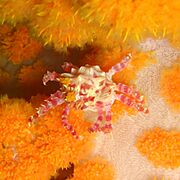
Hoplophrys oatesi, an Epialtidae
-
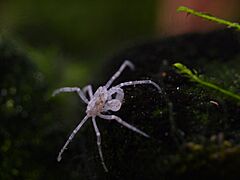
Limnopilos naiyanetri, a Hymenosomatidae
-
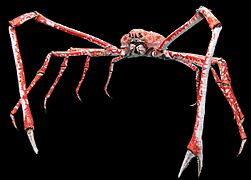
Macrocheira kaempferi, an Inachidae
-
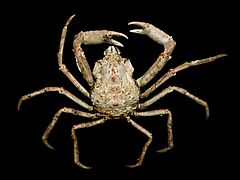
Hyas coarctatus, an Oregoniidae

.jpg)


Habitat, Diet, and Ecological Role in Marine Ecosystems
Spider crabs occupy almost every marine habitat on Earth. Understanding their ecology reveals how these crustaceans help maintain balanced ocean environments.
Diverse Ocean Habitats
Spider crabs adapt successfully to wildly different marine biomes:
- Coral Reefs: Small species hide within coral branches, grazing on nuisance algae that could smother delicate corals.
- Kelp Forests: Kelp crabs climb giant kelp stipes, feeding on upper fronds and hiding in thick canopy leaves.
- Muddy Estuaries: Portly spider crabs burrow into soft mud near river mouths, scavenging organic debris.
- Abyssal Depths: Giant deep-sea spider crabs roam flat, dark plains thousands of feet beneath surface light.
Feeding Habits and Diet
Spider crabs are primarily omnivorous scavengers and detritivores. Because they move slowly, they rarely chase down fast-swimming prey. Instead, their diet consists of:
- Fallen carrion and dead fish that sink to the seabed
- Marine algae, sea lettuce, and kelp
- Slow-moving or sessile invertebrates, including worms, clams, and sea snails
- Sponges, bryozoans, and hydroids growing on submerged rocks
By clearing dead matter from the sea floor, spider crabs act as the ocean's cleanup crew. They recycle vital nutrients back into the marine food web.
Life Cycle and Reproduction of Spider Crabs
The life cycle of a spider crab is a multi-stage journey of transformation from microscopic larva to armored bottom-dweller.
Mating and Egg Brooding
Adult spider crabs reproduce sexually, usually during warmer seasons or specific tidal cycles. Male crabs possess specialized transfer structures, while females have an abdominal flap designed to hold thousands of eggs.
After fertilization, the female carries her bright orange or red egg mass tucked beneath her abdomen. She actively cleans and aerates the developing eggs with fresh water currents for several weeks until they are ready to hatch.
Planktonic Larval Stages
When the eggs hatch, the young do not emerge looking like miniature crabs. Instead, they enter the open water column as microscopic, free-swimming larvae called zoeae.
- Zoea Stage: The tiny larva floats among ocean plankton, feeding on microscopic algae and small organisms. It has huge eyes and a long dorsal spine to deter predators.
- Megalopa Stage: After several molts, the zoea transforms into a megalopa. This stage resembles a tiny lobster with functioning claws and swimming legs.
- Settlement: The megalopa drops out of the water column to the seabed. It completes its final larval molt, transforming into a true juvenile spider crab.
Conservation, Threats, and Human Importance
Spider crabs play important roles in human industry, scientific research, and marine conservation.
Commercial Fishing and Cuisine
Several larger spider crab species support valuable commercial fisheries. In Europe, Maja squinado is considered a culinary delicacy and is caught using specialized baited pots and tangle nets. Strict fishing regulations, including catch limits and minimum shell sizes, help prevent overfishing and protect breeding populations.
Environmental Threats and Climate Change
Like many marine creatures, spider crabs face growing environmental challenges:
- Ocean Acidification: As seawater absorbs excess carbon dioxide, it becomes more acidic. This makes it difficult for juvenile crabs to build strong calcium carbonate shells.
- Rising Water Temperatures: Warming seas force cold-water species, like Arctic spider crabs, to migrate deeper or further north to survive.
- Habitat Destruction: Bottom-trawling nets can destroy fragile seafloor habitats, sponge gardens, and rocky reefs where spider crabs feed and hide.
Marine protected areas (MPAs) and sustainable fishing guidelines help safeguard these ancient crustaceans, ensuring they continue crawling across our ocean floors for generations to come.
See also
 In Spanish: Majoidea para niños
