
Majidae facts for kids
Quick facts for kids Majidae |
|
|---|---|
 |
|
| Eurynoma aspera | |
Scientific classification  |
|
| Unrecognized taxon (fix): | Majidae |
| Subfamilies | |
|
|
Majidae is a fascinating family of marine crabs commonly known as spider crabs or decorator crabs. These unique crustaceans are famous for their long, spindly legs and their ability to disguise themselves using seaweed, sponges, and small sea creatures. Found in oceans all around the world, spider crabs play a vital role in marine ecosystems by cleaning the sea floor and providing shelter for other tiny organisms.
Contents
What Are Spider Crabs?
Spider crabs belong to the large scientific group called decapods, which means "ten-footed" animals. This family includes around 200 living species organized into roughly 52 different groups known as genera.
Unlike typical crabs that have round or oval bodies, spider crabs usually have a teardrop-shaped or triangular shell called a carapace. This shell is longer than it is wide and often narrows to a distinct point at the front, known as a rostrum.
Their long legs make them look very much like land spiders walking underwater. While some species are tiny, measuring only a few centimeters across, others can grow to impressive sizes with massive leg spans.
Anatomy and Unique Physical Features
Spider crabs have adapted remarkable body structures that help them survive on the ocean floor. Their bodies combine heavy armor with specialized tools for walking, feeding, and hiding.
The Protective Exoskeleton
Like all crustaceans, spider crabs have an external skeleton called an exoskeleton. This tough outer casing is made of chitin and hardened with calcium carbonate.
The shell acts like a suit of armor against hungry fish and octopuses. In addition, the surface of their shell is covered with tiny hooked hairs called setae.
These specialized hooked hairs act just like natural Velcro. They allow the crab to attach pieces of its environment directly onto its back to create effective camouflage.
Long Spindly Legs
Spider crabs have ten jointed limbs attached to their main body section. The front two limbs carry pincers, while the remaining eight are walking legs.
- The first pair of limbs are called chelipeds, which feature claws used for feeding, defense, and holding objects.
- The other four pairs are walking legs, often extraordinarily long and thin compared to the central body.
- The tips of the legs feature sharp, curved points that help the crab grip onto slippery rocks and coral reefs.
These elongated legs allow spider crabs to step easily across rugged underwater terrain, deep trenches, and tangled kelp forests.
Eyes and Sensory Organs
Spider crabs rely on complex sensory structures to navigate murky ocean waters. Their eyes sit on short stalks near the front point of the carapace.
Because their vision is somewhat limited, spider crabs depend heavily on chemical and tactile senses. They have tiny antennae between their eyes that can detect scent trails and vibrations in the water.
Sensory hairs located on their walking legs and mouthparts also help them taste food and feel changes in water currents.
The Art of Underwater Camouflage
One of the most amazing behaviors found in nature is how many spider crabs decorate themselves to hide in plain sight. These species are widely celebrated as "decorator crabs."
How Decorator Crabs Dress Up
Decorator crabs use their flexible front claws to carefully snip off pieces of marine life from their surroundings. They pick up items such as:
- Living red, green, and brown algae
- Colorful marine sponges
- Tiny colonial animals called bryozoans
- Small sea anemones and hydroids
- Shell fragments, pebbles, and sand
The crab coats each piece in specialized mucus produced by its mouth glands. Then, it carefully rubs the item against the hooked setae on its shell until it sticks firmly in place.
Why Decoration Matters for Survival
This natural disguise serves two major purposes: visual concealment and chemical camouflage.
Predators swimming overhead often look right past a decorated crab, mistaking it for an ordinary patch of reef or rock.
Additionally, sponges and sea anemones release natural chemicals that taste bad or even sting potential attackers. By wearing living animals, the crab gains a chemical shield that deters predators like large fish and sharks.
When a decorator crab moves to a new habitat with different colors, it will often strip off its old outfit and redecorate with materials that match the new environment.
Habitat and Global Distribution
Spider crabs live in nearly every marine environment across the globe, from tropical coral reefs to freezing polar seas.
Shallow Coastal Waters and Tide Pools
Many smaller spider crabs inhabit shallow coastal zones, intertidal areas, and sunny coral reefs. In these sunlit waters, they hide among dense beds of seagrass, kelp forests, and rocky crevices.
Shallow-water species use abundant seaweed to build dense camouflage coats. They spend their daylight hours sitting motionless, waiting for dusk before actively foraging for food.
The Deep Ocean Floor
Other members of the family Majidae make their homes in deep offshore waters. Some deep-sea species live hundreds of meters below the surface where no sunlight can reach.
In these dark environments, heavy camouflage is less necessary because light is extremely low. Deep-sea spider crabs tend to develop longer legs and spiky shells to deter deep-water predators.
Diet and Feeding Habits
Spider crabs are primarily opportunistic scavengers and omnivores, meaning they eat a wide variety of plant and animal material.
What Do Spider Crabs Eat?
Spider crabs spend much of their time slowly picking through sediments on the ocean floor. Their flexible claws can grasp delicate morsels or scrape food off hard rocks.
Their typical diet includes:
- Marine algae and decaying seaweeds
- Dead fish and fallen organic matter
- Slow-moving invertebrates like worms and snails
- Small clams, mussels, and tiny crustaceans
- Sponges and soft coral polyps
Ecological Role as Ocean Cleaners
By consuming dead and decaying plant and animal matter, spider crabs perform an essential cleanup service for the marine ecosystem. They prevent the buildup of decaying debris and help recycle nutrients back into the food web.
Furthermore, their foraging activities stir up the seabed sediment. This process, called bioturbation, oxygenates the sand and helps tiny burrowing creatures thrive.
Reproduction and Life Cycle
The life cycle of a spider crab involves several distinct developmental stages, beginning with tiny floating larvae and ending with a mature adult.
Egg Production and Brooding
Female spider crabs carry their fertilized eggs underneath their wide abdominal flap, keeping them safe, clean, and well-aerated. A single female can carry thousands of eggs at one time.
The mother uses specialized paddle-like appendages to gently wave water over the eggs. This provides a steady supply of oxygen until the embryos are ready to hatch.
The Planktonic Larval Stage
When the eggs hatch, the young crabs do not look like their parents at all. Instead, they enter the water as microscopic swimming larvae called zoea.
During the zoea stage:
- The larvae drift freely with ocean currents as part of the plankton.
- They feed on microscopic algae and smaller planktonic creatures.
- They undergo several molts, shedding their skin to grow larger.
After several weeks, the zoea transforms into a transitional stage called a megalopa. The megalopa has developed tiny legs and begins seeking a suitable spot on the ocean floor.
Molting and Reaching Adulthood
Once the young crab settles on the seabed, it molts into a miniature version of an adult spider crab.
Because their hard exoskeleton cannot expand, growing crabs must periodically shed their shells through a process called molting, or ecdysis. The crab absorbs water to swell and crack open the old shell, then climbs out wearing a soft new skin underneath.
While the new shell hardens over several days, the crab is very vulnerable to predators and hides carefully. Once spider crabs reach their final adult size, they stop molting permanently and can focus all their energy on reproduction and survival.
Scientific Classification and Subfamilies
Taxonomists divide the family Majidae into five distinct subfamilies, grouping related genera based on shell shape, claw structure, and leg proportions.
Subfamily Eurynolambrinae
This subfamily contains unique crabs that have broad, flattened shells that resemble chipped stones or pieces of slate.
- Eurynolambrus is a well-known genus found in the waters around New Zealand.
Subfamily Majinae
The Majinae represent the classic spider crabs. They typically possess long legs, triangular shells, and pronounced rostral horns.
- Maja includes famous species such as the European spider crab (Maja squinado), prized for its large size and spiny shell.
- Leptomithrax includes species common in the southern oceans around Australia and New Zealand.
- Schizophrys features crabs adapted to tropical reef habitats throughout the Indo-Pacific.
Subfamily Micromaiinae (Extinct)
This is an entirely extinct subfamily known only through fossil records dating back millions of years.
- Fossils of genera like Micromaia show that spider crabs have maintained their characteristic body plan since prehistoric times.
Subfamily Mithracinae
Members of Mithracinae are often called clinging crabs or reef spider crabs. They tend to have stouter bodies and very strong walking legs suited for gripping wave-swept coral reefs.
- Mithraculus includes the popular emerald crab (Mithraculus sculptus), frequently kept in marine aquariums to control nuisance algae.
- Micippa features flattened, boxy shells heavily decorated with living debris.
- Mithrax consists of large, robust crabs found along rocky Atlantic shores.
Subfamily Planoterginae
This small subfamily features specialized body shapes adapted for living in specific microhabitats on the sea bottom.
- Planotergum includes crabs with distinctively flattened carapaces.
Genera
The roughly 200 living and over 50 extinct species are divided among 52 genera across 5 subfamilies:
Eurynolambrinae Števčić, 1994
- Eurynolambrus H. Milne-Edwards & Lucas, 1841
Majinae Samouelle, 1819
- Ageitomaia Griffin & Tranter, 1986
- Anacinetops Miers, 1879
- Choniognathus Rathbun, 1932
- Cyclax Dana, 1851
- Entomonyx Miers, 1884
- Eurynome Leach, 1814
- Jacquinotia Rathbun, 1915
- Kasagia Richer de Forges & Ng, 2007
- Kimbla Griffin & Tranter, 1986
- Leptomithrax Miers, 1876
- Maiopsis Faxon, 1893
- Maja Lamarck, 1801
- Majella Ortmann, 1893
- Microhalimus Haswell, 1880
- Naxia Latreille, 1825
- Notomithrax Griffin, 1963
- Paraentomonyx T. Sakai, 1983
- Paramithrax H. Milne-Edwards, 1837
- Pippacirama Griffin & Tranter, 1986
- Prismatopus Ward, 1933
- Schizophroida T. Sakai, 1933
- Schizophrys White, 1848
- Seiitaoides Griffin & Tranter, 1986
- Temnonotus A. Milne-Edwards, 1875
- Teratomaia Griffin & Tranter, 1986
- Thersandrus Rathbun, 1897
- Tumulosternum McCulloch, 1913
- Wilsonimaia † Blow & Manning, 1996
Micromaiinae † Beurlen, 1930
- Micromaia † Bittner, 1875
- Mithracia † Bell, 1858
- Pisomaja † Lőrenthey, in Lőrenthey & Beurlen, 1929
Mithracinae MacLeay, 1838
- Ala Lockington, 1877
- Antarctomithrax † Feldmann, 1994
- Coelocerus A. Milne-Edwards, 1875
- Cyclocoeloma Miers, 1880
- Cyphocarcinus A. Milne-Edwards, 1868
- Leptopisa Stimpson, 1871
- Macrocoeloma Miers, 1879
- Micippa Leach, 1817
- Microphrys Milne-Edwards, 1851
- Mithraculus White, 1847
- Mithrax A. G. Desmarest, 1823
- Nemausa A. Milne-Edwards, 1875
- Paranaxia Rathbun, 1924
- Picroceroides Miers, 1886
- Stenocionops A. G. Desmarest, 1823
- Teleophrys Stimpson, 1860
- Thoe Bell, 1836
- Tiarinia Dana, 1851
Planoterginae Števčić, 1991
- Hemus A. Milne-Edwards, 1875
- Planotergum Balss, 1935
Gallery
-
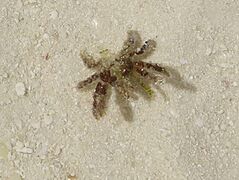
Cyclocoeloma cf. tuberculata
-
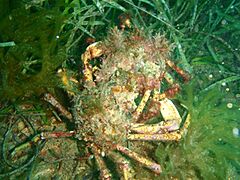
Leptomithrax gaimardii
-
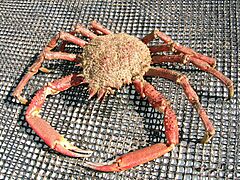
Maja squinado
-
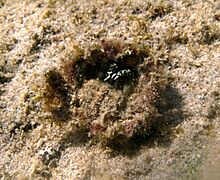
Micippa platipes (on its back)
-
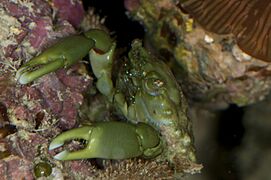
Mithraculus sculptus
-
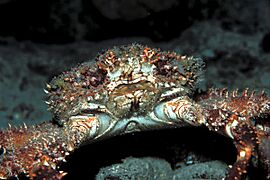
Mithrax pilosus
_Landaagiraavaru.JPG)


