
Stealth ship facts for kids

A stealth ship is a special kind of ship designed to be very hard to find. It uses clever building tricks, called stealth technology, to hide from things like radar, people looking with their eyes, sonar (which uses sound in water), and infrared sensors (which detect heat).
These ships use ideas from stealth aircraft, like the stealth jets you might have heard about. But ships also have their own unique ways to hide, such as making less noise in the water and reducing the trail they leave behind. Even though making ships hard to spot with radar is a newer idea, sailors have been trying to hide their ships for hundreds of years!
Contents
How Stealth Ships Hide from Radar


When engineers design a stealth ship, they mostly worry about radar beams coming from other ships, planes, or even missiles flying low over the water. These radar beams usually come from near the horizon. To hide from them, stealth ships are built without flat, vertical sides. Vertical surfaces are like mirrors for radar, sending the signal right back to where it came from!
Instead, stealth ships have angled sides that gently slope inwards or outwards. This makes radar beams bounce away in different directions, not back to the source. They also avoid sharp corners that can reflect radar very well. Even round parts like smokestacks or gun turrets are often hidden or shaped differently. Any open spaces that face upwards are also removed or covered, as they can be very visible to radar.
Some ships use a special hull shape called a tumblehome hull. This means the sides of the ship slope inward from the waterline, making the ship look narrower at the top. Another design is the small-waterplane-area twin hull (SWATH), which helps make the ship more stable, especially with a tumblehome shape. These smart design ideas were first developed in the 1980s, inspired by how stealth airplanes are built.
The Sea Shadow was an early US Navy ship that explored stealth technology. It used both tumblehome and SWATH features. A more modern example is the Zumwalt-class destroyer. Even though it is much bigger than other destroyers, its radar signal is said to be as small as a fishing boat! It also makes very little noise, like a quiet submarine. Its angled shape and special materials help it hide.
The Swedish Navy's Visby-class corvette is another great example. It is designed to be hard to spot visually, by radar, by sound, and by heat. Its hull is made from a special mix of carbon fiber and plastic, and its smooth, angled design makes it very hard to detect. The Royal Navy's Type 45 destroyer also uses similar ideas to reduce its radar signature. The Taiwan Navy's Tuo Chiang-class corvette is a fast stealth ship designed to be hard to find near coastlines.
Hiding More Than Just from Radar
_20220904.jpg)
Being a stealth ship means more than just being hard to see on radar. It also means being quiet and cool!
Making Less Noise
Sound travels much better in water than in air. So, making a ship quiet is super important for stealth. Engineers use special exhaust systems that muffle engine sounds. They also design propellers in unique ways or use "pump-jets" to push water, which makes less noise. Even the shape of the ship's hull can help reduce the sound it makes as it moves through the water.
Controlling Electronic Signals
Modern warships send out a lot of electronic signals. These include radar waves, radio messages, and even small amounts of energy from the ship's electrical systems. All these signals can be used to track a ship. Stealth ships have a special "EMCON" mode (which stands for Emission Control). In this mode, they switch off many of their electronic signals. The downside is that the ship then has to rely on listening devices and cannot easily send messages far away.
Reducing Heat
Ships also give off heat, especially from their engines. This heat creates a "heat signature" that can make a ship stand out in the ocean, even in fog or smoke. Special cameras that see infrared light can easily spot these heat signatures. To hide this, stealth ships mix hot engine exhaust gases with cold air to cool them down before they leave the ship. Sometimes, exhaust is even vented into the water, though this can make more noise. For the ship's hull, cool water can be spread across its surface to reduce its heat.
Visual Camouflage
Making a ship hard to see with the eyes is the oldest form of stealth! Sailors have used visual tricks for thousands of years. While still useful, visual camouflage is less important now because long-range radar can spot ships from very far away.
What Stealth Ships Are Made Of
The materials used to build a ship also play a big role in how well it can hide from radar.
Smaller stealth ships often use special materials called composites, like fiberglass and carbon fiber. These materials are very good at blocking radar signals, which helps make the ship's radar signature even smaller. However, composites can be more fragile than metal.
For larger ships, or ships that might face combat, stronger metals like steel and and aluminum alloys are usually used. To help these metal ships hide, they can be coated with a special paint or material that absorbs radar waves. This coating can be expensive and needs to be tough enough to handle salty seawater.
Famous Stealth Ships
Many countries around the world have developed or are developing stealth ships. Here are a few notable examples:
- Sea Shadow (United States): This experimental ship was a pioneer in stealth technology, testing many of the ideas used in modern stealth designs.
- Zumwalt-class destroyer (United States): These large destroyers are known for their extremely low radar signature, making them appear much smaller on radar than they actually are.
- Visby-class corvette (Sweden): These corvettes are designed to be stealthy against radar, visual, acoustic (sound), and infrared detection, using advanced composite materials.
- Type 45 destroyer (United Kingdom): Similar to the Visby class in its radar-reducing design, but built with traditional steel.
- Tuo Chiang-class corvette (Taiwan): A fast, multi-mission corvette designed with a low radar cross-section to operate effectively near coastlines.
- La Fayette-class frigate (France): These frigates were among the first to widely incorporate stealth features into their design.
- Type 055 destroyer (China): A large, modern destroyer with a continuous, sleek superstructure designed to reduce various signatures, including radar, noise, and heat.
Images for kids
-
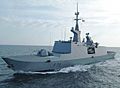
French frigate Surcouf of the La Fayette class
-
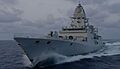
INS Dunagiri of the Nilgiri class frigates
-
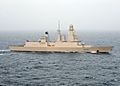
Horizon-class frigate of the French Navy and Italian Navy
-
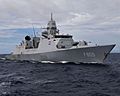
Dutch frigate Evertsen of the De Zeven Provinciën class
-
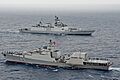
Gepard-class frigate and Shivalik-class frigate
-
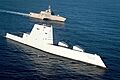
One of the largest class fully stealth ship is Zumwalt-class
-
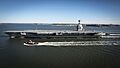
One of the largest class stealth ship is Gerald R. Ford-class

_during_sea_trials.jpg)
_underway_in_the_Arabian_Sea_on_31_May_2009_(090531-N-9988F-406).jpg)


.jpg)
_underway_on_8_April_2017.JPG)
See also
 In Spanish: Barco furtivo para niños
