
Sula hanging parrot facts for kids
The Sula hanging parrot (Loriculus sclateri) is a small, colorful bird. It's a type of parrot that lives only in certain forests. You can find it on the Banggai and Sula Islands in Indonesia. These parrots are special because they often hang upside down while they eat!
Quick facts for kids Sula hanging parrot |
|
|---|---|
 |
|
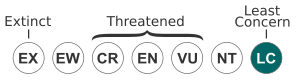
| Conservation status | |
Scientific classification  |
|
| Kingdom: | Animalia |
| Phylum: | Chordata |
| Class: | Aves |
| Order: | Psittaciformes |
| Family: | Psittaculidae |
| Genus: | Loriculus |
| Species: |
L. sclateri
|
| Binomial name | |
| Loriculus sclateri Wallace, 1863
|
|
| Script error: The function "autoWithCaption" does not exist. | |
Script error: No such module "Check for conflicting parameters".
Contents
What Does the Sula Hanging Parrot Look Like?
The Sula hanging parrot is a small bird. It is about 14 centimeters (5.5 inches) long. This is a bit bigger than the Moluccan hanging parrot, which is about 11 centimeters (4.3 inches).
Scientists used to think it was a type of Moluccan hanging parrot. But now, they see it as its own unique species. This is because of its different colors and size.
Colors and Patterns
Most Sula hanging parrots are green. They have bright red feathers on their chin and rump (the lower back). They also have red on the front edge of their wings.
There are two main kinds, or subspecies, of this parrot. One is called L. s. sclateri and lives on the Sula Islands. The other is L. s. ruber from the Banggai Islands.
- L. s. sclateri can have mustard-orange or red feathers on its back. The red feathers often have orange edges.
- L. s. ruber has a red back with very little orange. Its red rump is also much brighter.
Where Do Sula Hanging Parrots Live?
The Sula hanging parrot lives on many islands in Indonesia. You can find them across the Sula Islands and on Banggi Island. They also live on Peleng, Melilis Island, Labobo Island, and Seho Island. They are found on other small islands nearby too.
However, these parrots do not live on Bengkulu Island or Sulawesi. They are only found in their specific island homes.
Their Favorite Places to Live
These parrots usually live in areas below 450 meters (about 1,476 feet) above sea level. They like different kinds of forests and open areas.
- They live in old-growth forest (very old, natural forests).
- They also live in secondary forest (forests that have grown back after being cut down).
- You can find them near farms with scattered trees.
- They also live in plantations (areas where trees are grown for crops).
- Forest edges are also good places for them.
Life and Habits of the Sula Hanging Parrot
Sula hanging parrots are usually seen alone or in small groups. They are very active birds.
Nesting and Reproduction
Pairs of Sula hanging parrots build their nests in tree holes or old tree stumps. They like narrow, long holes with small openings.
When building a nest, the female parrot is very clever. She tucks small twigs and other materials under her wing. Then, she flies them back to her nesting site.
Breeding happens at certain times of the year. The first season is usually from January to April. A second season can happen from July to September.
Courtship and Eggs
During breeding season, the male parrot performs a special dance. This is called a courtship display. He does this to attract a female.
- The male walks and hops towards the female.
- He makes a soft, warbling sound.
- He stretches his neck to show off a blue patch on his throat.
- He also raises his rump to display his tail feathers.
The male parrot also feeds the female during courtship. This is called courtship feeding. After mating, the female lays 2 to 4 eggs. She sits on the eggs for about 20 days to keep them warm. During this time, the male brings her food. The eggs are usually 15 to 18 millimeters long.
Baby parrots are called fledglings. They leave the nest when they are about 32 days old. They become fully independent from their parents in about 10 to 11 days.
Protecting the Sula Hanging Parrot
Like many other birds in the Loriculus group, the Sula hanging parrot faces threats. These threats can make it harder for them to survive.
- Deforestation: Forests where they live are being cut down. This happens to make space for farms, mining, and logging (cutting down trees for wood). This means the parrots lose their homes.
- Illegal Pet Trade: These parrots are also threatened by the illegal wildlife trade. People sometimes catch them to sell as pets. This removes birds from their natural environment.
Protecting their forest homes is very important for the future of the Sula hanging parrot.
