
Swynnerton's robin facts for kids
Quick facts for kids Swynnerton's robin |
|
|---|---|
 |
|
| Conservation status | |
Scientific classification  |
|
| Kingdom: | Animalia |
| Phylum: | Chordata |
| Class: | Aves |
| Order: | Passeriformes |
| Family: | Muscicapidae |
| Genus: | Swynnertonia Roberts, 1922 |
| Species: |
S. swynnertoni
|
| Binomial name | |
| Swynnertonia swynnertoni (Shelley, 1906)
|
|
| Script error: The function "autoWithCaption" does not exist. | |
| Synonyms | |
|
|
Script error: No such module "Check for conflicting parameters".
The Swynnerton's robin (scientific name: Swynnertonia swynnertoni) is a small bird. It belongs to the passerine bird group, which includes many common songbirds. This special robin is part of the Muscicapidae family, known as Old World flycatchers. It's the only species in its own unique group, called Swynnertonia. Both its common name and scientific name honor Charles Francis Massy Swynnerton, an expert on insects.
Contents
What is Swynnerton's Robin?
Swynnerton's robin was first officially described in 1906 by an English ornithologist (bird expert) named George Ernest Shelley. He found the first example of this bird in the Chirinda Forest in what is now Zimbabwe. Later, in 1922, another expert named Austin Roberts decided this bird was so special it needed its own unique group, or genus, called Swynnertonia.
Different Types of Swynnerton's Robin
There are two main types, or subspecies, of Swynnerton's robin:
- Swynnertonia swynnertoni swynnertoni: This type lives in the mountains of eastern Zimbabwe and western Mozambique.
- Swynnertonia swynnertoni rodgersi: This type is found in the Udzungwa Mountains in Tanzania.
Why is it Called Swynnerton's Robin?
This bird is named after Charles Swynnerton, a British entomologist (insect scientist). He was the one who first discovered the bird before it was officially named. The subspecies S. s. rodgersi is named after Dr. W. Alan Rodgers, who helped scientists understand how important its home, the Mwanihana Forest, was for wildlife.
How to Identify Swynnerton's Robin
Swynnerton's robin looks a bit like the white-starred robin, but it has some key differences. It has a white crescent shape on its upper chest. This white crescent has a black line underneath it. Its grey tail also lacks the yellow patches seen on the white-starred robin.
Female Swynnerton's robins look a little different from males. Females have duller feathers and a greenish-olive color on their head and face. Young birds have yellow-brown spots on their head and back. Their chest crescent is a pale grey-brown. These birds are small, usually about 13 to 14 centimeters (about 5 to 5.5 inches) long.
What Does Swynnerton's Robin Sound Like?
The song of Swynnerton's robin is a three-note whistle. People describe it as "zit zitt slurr" or "tsee-tuu-tuu." The last note might be lower than the first two. When the bird is alarmed, it makes a quiet chattering sound, like "trrrrrt."
Where Does Swynnerton's Robin Live?
Swynnerton's robin lives in specific areas of eastern and southern Africa. In Tanzania, there are two groups: one in the Udzungwa Mountains and a smaller one in the East Usambara Mountains. In Mozambique, they are found on Mount Gorongosa and Mount Mabu. In Zimbabwe, they live in the Chirinda Forest and other small forest areas near the Mozambique border.
This bird mostly lives in mountain forests, usually between 850 and 1,850 meters (about 2,800 to 6,000 feet) high. However, in the East Usambara Mountains, they can be found in lower evergreen forests, from 130 to 550 meters (about 425 to 1,800 feet). They like dense plants and thick bushes, especially near streams. In the Chirinda Forest, they are often found near Dracaena fragrans plants.
Life Cycle and Habits
Swynnerton's robin mainly eats insects. They have been seen eating beetles, wasps, bees, ants, flies, crickets, grasshoppers, spiders, and even millipedes. Sometimes, they also eat fruit or even small frogs.
Reproduction and Nests
Swynnerton's robins lay their eggs between October and January, with most eggs laid in November and December. Their nest is shaped like an open cup. They build it from dead leaves, other plant parts, and moss. They line the inside with dark fibers from the base of Cyathea tree ferns.
Nests are often built at the bottom of Dracaena fragrans leaves. They might also be in a hollow tree stump, in the fork of a shrub, or on tangled liana stems. A female robin usually lays 2 or 3 eggs. Only the female sits on the eggs, and they hatch in about two weeks.
After the chicks hatch, the female keeps them warm for about 7 to 9 days. During this time, the male bird brings food for both the female and the young. After about two weeks, the female also starts looking for food, and the young birds leave the nest when they are about 14 days old.
Social Behavior
Except when they are raising their young, these birds are usually found in pairs. During the dry season, they sometimes follow columns of Dorylus driver ants. They catch insects that the ants disturb as they move.
Why is Swynnerton's Robin Vulnerable?
Swynnerton's robin lives in only a few specific places. The forests where it lives are shrinking and becoming separated. This means there are fewer places for the birds to live, and their numbers are likely going down.
The main threats to these birds include:
- Forest clearing: People cutting down forests.
- Disturbance: Human activities that bother the birds in their habitat.
- Invasive species: Non-native plants, like the ginger Hedychium, that can take over the robin's habitat.
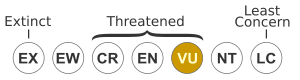
Because of these threats, the International Union for Conservation of Nature has listed Swynnerton's robin as a Vulnerable bird. This means it is at high risk of becoming endangered if conservation efforts are not successful.
Images for kids
-
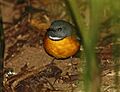
A Swynnerton's robin perched on a branch.
