
Tesla, Inc. facts for kids
 |
|

Gigafactory Texas, Tesla's headquarters, just outside of Austin, Texas
|
|
|
Formerly
|
Tesla Motors, Inc. (2003–2017) |
|---|---|
| Public | |
| Traded as | |
| Industry |
|
| Founded | July 1, 2003 in San Carlos, California, US |
| Founders |
|
| Headquarters | Gigafactory Texas,
,
United States
|
|
Number of locations
|
|
|
Area served
|
Worldwide |
|
Key people
|
|
| Products |
|
|
Production output
|
1.66 million vehicles |
| Services |
|
| Revenue | US$94.83 billion |
|
Operating income
|
US$4.36 billion |
| US$3.79 billion | |
| Total assets | US$137.8 billion |
| Total equity | US$82.14 billion |
| Owner | Elon Musk (20%) |
|
Number of employees
|
134,785 |
Tesla, Inc. is an American company that builds electric cars and clean energy products. The company has its main headquarters in Austin, Texas. Tesla designs smart cars powered entirely by batteries, along with large clean energy systems for homes and towns. It also creates clean equipment like solar panels, sunny solar shingles, and giant energy storage units.
The company was founded in July 2003 by two clever engineers, Martin Eberhard and Marc Tarpenning. They called it Tesla Motors to honor the brilliant Serbian-American inventor Nikola Tesla. Nikola Tesla discovered amazing things about electricity, including the induction motor. In 2004, business leader Elon Musk provided key funding to help design and build their first cars. Musk quickly became the leader of the company and later took over as the chief executive officer (CEO).
Over time, Tesla grew into one of the most famous car companies in modern history. Instead of using gasoline, all Tesla vehicles rely on rechargeable lithium-ion battery cells. Over several years, Tesla released the sporty original Roadster, the luxury Model S, and the roomy Model X. Later, they built the smaller Model 3 and the Model Y crossover SUV. They also created a giant cargo carrier called the Tesla Semi and a stainless steel pickup named the Cybertruck.
Today, Tesla is one of the most valuable corporations on the stock market. It helped make electric cars widely popular across the globe. Along with building cars, Tesla operates large battery factories named Gigafactories. The company also develops software for driving assistance, large computer brains, and intelligent machines like the Optimus robot.
Contents
History of Tesla and How It Grew
How Tesla Was Started (2003–2004)
Martin Eberhard and Marc Tarpenning officially started Tesla Motors on July 1, 2003. They lived in San Carlos, California and wanted to build electric cars that were fun and efficient. Eberhard wanted Tesla to be an automobile builder that acted like a modern computer technology company. They focused heavily on electric battery packs, smart software, and durable motors.
Soon after, engineer Ian Wright joined the founding group to build new designs. In early 2004, the small team needed financial support, so they sought investment money. Businessman Elon Musk, who had made a fortune from internet finance company PayPal, invested $6.5 million. Musk became the chairman of the board of directors and guided the company's big plans. In May 2004, engineer J. B. Straubel joined Tesla to serve as the lead chief technical officer.
Through a legal agreement made in 2009, five team members received recognition as official co-founders. These five leaders were Eberhard, Tarpenning, Wright, Musk, and Straubel. Together, they began sketching designs for a groundbreaking electric sports car.
The Original Roadster Sports Car (2005–2009)
.jpg)
Tesla planned to start by building an expensive, high-speed car for early car fans. The team hoped profits from that sports car would fund less expensive vehicles later. Musk helped raise more cash during several rounds of business funding. Notable investors joined in, including Google founders Larry Page and Sergey Brin, as well as Jeff Skoll from eBay.
Building a whole new electric car was difficult and took years of trial and error. The company modified a light sports car chassis borrowed from the British carmaker Lotus Elise. In late 2007, Eberhard stepped down as leader, and executive Ze'ev Drori took charge briefly. In October 2008, Musk took over as the permanent chief executive officer of Tesla.
Production of the very first Roadster began inside an old Chevrolet building in Menlo Park. The Roadster amazed engineers because it used thousands of tiny cylindrical battery cells linked together. It became the first road-legal electric car capable of traveling more than 200 miles on a single charge. Although Tesla made only about 2,500 Roadsters, the car proved that battery power was fast and practical.
Growing with Model S, Model X, and Autopilot (2010–2015)

In 2010, the company received an important loan from the U.S. Department of Energy. This crucial loan helped the company set up large-scale assembly lines to build family-friendly clean cars. Tesla repaid every penny of this federal loan ahead of schedule. That same year, Tesla became a public company through an initial public offering on the NASDAQ exchange. It was the first American automaker to do so since Ford Motor Company in 1956.
Tesla purchased a closed automobile plant in Fremont, California formerly called the NUMMI plant. The site became the busy Tesla Fremont Factory, filled with robotic assembly tools. In June 2012, Tesla began deliveries of its sleek four-door sedan, the Model S. The Model S won major automotive trophies, including the prestigious Motor Trend Car of the Year. It became the first electric car to top new vehicle sales lists across entire countries like Norway.
In 2014, Tesla announced an intelligent driver-assistance system known as Tesla Autopilot. Autopilot used external cameras, radar, and computers to help cars steer inside highway lanes. In 2015, Tesla introduced the Model X, a large electric SUV with upward-swinging doors. That same year, Tesla launched the home battery called the Powerwall and business storage named the Powerpack.
Mass Production and Energy Expansion (2016–2018)
In late 2016, Tesla purchased solar energy installer SolarCity for $2.6 billion. Combining clean power generation with battery storage created a new division called Tesla Energy. In 2017, the corporation officially shortened its name from Tesla Motors, Inc. to Tesla, Inc. This change showed that Tesla was now an energy company as well as a car maker.
Tesla announced the smaller, family-friendly Model 3 sedan to reach everyday drivers. Hundreds of thousands of excited customers put down deposits to order the car. Making thousands of cars each week proved very hard, leading to a tough period called "production hell." Automated robots jammed, slowing the factory lines down rather than speeding them up. Tesla overcame these challenges by fixing assembly setups and adjusting robotic tools. By 2018, the Model 3 became the best-selling electric car across the entire world.
Worldwide Factories and New Inventions (2019–present)

Tesla soon enjoyed four consecutive profitable quarters, allowing it to join the famous S&P 500 stock index. It was one of the largest and most valuable businesses ever added to that index. Tesla continued building giant production complexes around the world to deliver cars more quickly. In 2019, construction finished on Gigafactory Shanghai in China, which quickly produced Model 3 cars.
In 2020, Tesla launched its compact SUV, the Model Y. Two more massive manufacturing centers opened in 2022: Gigafactory Berlin in Germany and Gigafactory Texas near Austin. In December 2021, Tesla moved its official global corporate headquarters to Austin, Texas. At the end of 2023, Tesla delivered the very first futuristic stainless steel Cybertruck pickups.
Major car companies like Ford and General Motors agreed to use Tesla's charging plug design. This charging design is officially called the North American Charging Standard. Meanwhile, global competition grew quickly, especially from Chinese electric car makers like BYD. In 2025 and 2026, Tesla worked on self-driving prototypes like the Cybercab and the Optimus robot.
Electric Vehicles Made by Tesla
Current Cars and Trucks in Production
Tesla Model 3
_IMG_9488_(cropped).jpg)
The Model 3 is an all-electric mid-size car with a curved fastback roof style. It comes in either single-motor rear-wheel drive or two-motor all-wheel drive configurations. Designed to be affordable, the Model 3 quickly became a huge commercial hit when deliveries started in 2017. Inside the vehicle, most dials and switches were replaced by a single large dashboard touchscreen. It was the first electric car to pass one million total sales worldwide.
Tesla Model Y
_MYLE_Festival_2025_DSC_9565.jpg)
The Model Y is a versatile crossover SUV built on the same base as the Model 3. It offers seating for five or seven passengers and provides lots of cargo room for trips. Deliveries of the Model Y started in early 2020, and drivers liked its high seating position. In 2023, the Model Y outsold traditional gasoline cars like the Toyota Corolla worldwide. That milestone marked the first time an all-electric car became the top-selling automobile globally.
Tesla Semi
.jpg)
The Tesla Semi is a heavy-duty semi-truck designed to haul massive cargo loads over highways without burning diesel. Tesla built the cabin with the driver sitting right in the center for great road visibility. The electric truck has three strong motors that give it plenty of towing power on steep hills. It can travel around 500 miles on a full battery charge before needing to recharge. Initial trucks were delivered to snack and drink company PepsiCo to deliver food supplies cleanly.
Cybertruck

The Cybertruck is an unusual full-sized pickup truck with sharp angles instead of curved body lines. Its outer skin is built from thick, unpainted stainless steel plates to resist dents and rust. Deliveries of the pickup started in late 2023 from the big factory in Texas. It features steer-by-wire technology, meaning electronic wires turn the wheels instead of a solid mechanical shaft. The truck can carry heavy cargo beds and tow trailers while driving quickly across varied terrains.
Future Vehicle Concepts
Tesla Cybercab

The Cybercab is a small, two-passenger concept car designed to operate as a self-driving taxi. The prototype has butterfly doors that swing upward, but it has no steering wheel or pedals inside. Passengers simply step inside, tell the car where they want to go, and let computers do the driving. Tesla designs these automated vehicles to work with an app-based ridehailing service called the Tesla Network.
Next-Generation Roadster
.jpg)
Tesla revealed a concept for a second-generation Roadster high-performance sports car. The design includes three powerful electric motors, an all-wheel drive system, and a removable glass roof panel. Tesla engineers designed the concept to accelerate from zero to sixty miles per hour in under two seconds. Musk also suggested an optional package created with rocket company SpaceX that uses gas thrusters.
Tesla Robovan
The Tesla Robovan is a large electric passenger van concept revealed in late 2024. It looks like a futuristic train carriage on wheels, with covered sides and automatic sliding doors. The inside is roomy enough to carry up to twenty people or haul large amounts of cargo. Tesla designed the Robovan to run autonomously, serving as public transport for cities, airports, and sports venues.
Retired Earlier Models
First-Generation Roadster
The original Roadster was built from 2008 to 2012 as Tesla's very first production car. It was an open-top two-seater assembled on a frame made by British carmaker Lotus. The small car proved that electric motors could produce thrilling acceleration and practical travel distances. Elon Musk even launched his own red Roadster into outer space aboard a SpaceX Falcon Heavy rocket.
Tesla Model S

The Model S was a luxury five-door full-size car that launched in 2012. It had a sleek liftback hatch and placed its heavy battery underneath the floorboards. This placement gave the sedan a low center of gravity, which helped it stay balanced through tight turns. Over the years, the Model S received software upgrades and new cabin screens. Tesla decided to retire the Model S in 2026 to focus manufacturing efforts on smart robots.
Tesla Model X

The Model X was a large family SUV first delivered to buyers in 2015. It featured clever rear doors known as falcon-wing doors that lifted upward toward the sky. These special doors used ultrasonic sensors so they would not bump into low garage ceilings or neighboring vehicles. Like the Model S sedan, Tesla stopped building the Model X in 2026 to shift factory resources toward robotics.
High-Tech Features and Clean Energy
Advanced Battery Engineering

The most important part of any electric car is its lithium-ion battery pack. A car battery pack is made up of thousands of individual cells bundled together under the floor. Tesla works with big battery makers like Panasonic, CATL, and LG Energy Solution to supply these power units. Keeping the batteries flat beneath the cabin seats gives passengers more room and protects the vehicle in collisions.
Tesla has used different cell sizes over its history:
- 18650 cells: These small cylinder cells were the size of flashlight batteries and powered the original Roadster and Model S.
- 2170 cells: These slightly bigger cylindrical cells were designed for the Model 3 and Model Y to hold more energy.
- 4680 cells: These large cylinder cells measure 46 millimeters wide and 80 millimeters tall, packing much more power.
- Prismatic cells: These are rectangular blocks made of lithium iron phosphate (LFP). They cost less to produce because they avoid expensive metals like nickel and cobalt.
To supply materials for batteries, Tesla established partnerships with mining companies like Piedmont Lithium for mineral ores like spodumene. Tesla also built its own large lithium processing facility near Robstown, Texas.
Powerful Electric Motors
Tesla vehicles turn electricity into motion using two primary kinds of electric motors:
- Induction Motors: An induction motor uses an electric current flowing through metal coils to create a rotating magnetic field. This spinning field turns a copper rotor without parts constantly grinding together. This setup provides strong power and was used in the first Roadster and early Model S cars.
- Internal Permanent Magnet Motors: Tesla uses an internal permanent magnet motor with reluctance properties in newer vehicles like the Model 3. Engineers place permanent magnets inside an iron rotor surrounded by an outer stator. This design wastes very little battery energy during slow city driving and high-speed highway cruising.
Over-the-Air Software Updates
Tesla cars act like computers on wheels. Most older car companies required owners to visit a repair shop to fix small computer glitches. Tesla uses wireless software updates over home Wi-Fi or cellular connections. When a car downloads an update overnight, it can wake up the next morning with new features. Updates have added faster acceleration, better navigation maps, new dashboard games, and improved battery charging speeds.
Autopilot and Driver Assistance
Tesla cars feature complex driver assistance tools called Autopilot and Full Self-Driving (Supervised). These systems use eight high-definition digital cameras placed around the exterior of the car. Powerful onboard computers process video streams using artificial intelligence to identify cars, pedestrians, traffic cones, and road lines.
Even though the systems are called Autopilot, drivers must keep their eyes on the road and hands on the wheel. Autopilot can steer, speed up, and slow down inside highway lanes automatically. Full Self-Driving helps navigate city streets, follow stoplights, and take turns. Human drivers remain fully responsible for the car and must take control whenever an unexpected hazard occurs.
Optimus Humanoid Robot

In addition to passenger cars, Tesla is developing a humanoid robot called Optimus. Optimus has arms, hands, legs, and a torso shaped like a human being. It uses the same artificial vision and computer brains that guide Tesla cars through traffic. Tesla designed Optimus to perform dull, heavy, or repetitive tasks inside factories. In early 2026, Tesla announced plans to clear factory space in California to produce thousands of these helpful robots.
Clean Energy Products and Charging Networks
Solar Roofs and Solar Panels
.jpg)
Through its Tesla Energy division, Tesla builds clean power systems for homes, schools, and business buildings. Traditional solar panels can be installed right on top of an existing shingle roof to generate electricity. Tesla also makes the Tesla Solar Roof, which replaces regular roof shingles with tough, glass solar shingles. Sunlight strikes the dark glass tiles, knocking electrons loose to generate electricity through the magic of photovoltaic energy.
Powerwall and Megapack Energy Storage
Sunshine is not available at night, so clean solar energy needs to be stored for later use. The Powerwall is a home storage battery that mounts cleanly against a garage or basement wall. It stores extra power generated by solar panels during the sunny afternoon. If a heavy storm cuts off town power, the Powerwall instantly turns on to keep home lights and refrigerators running.
For whole towns and electric utilities, Tesla builds giant battery containers called the Megapack. A single Megapack can store enough electricity to power hundreds of neighborhood homes for hours. When energy demand spikes on hot summer afternoons, Megapacks push clean stored power into the local electrical grid. This stops power companies from having to burn dirty coal or fossil fuels to generate extra electricity.
The Supercharger Network

To make long-distance electric driving easy, Tesla built a worldwide network of Supercharger stations. Superchargers are high-voltage direct current fast charging units placed along major highways, shopping plazas, and rest stops. A driver plugs the thick cable into the car port, and the station delivers electricity rapidly. In just fifteen to twenty minutes, the battery can gain up to two hundred miles of driving range.
Tesla also installs "Destination Chargers" at hotels, amusement resorts, and restaurants. Destination chargers use regular alternating current and recharge vehicles slowly while drivers sleep or eat dinner. Major hotel companies like Hilton Worldwide have partnered with Tesla to install thousands of chargers across North America. In recent years, Tesla opened its Supercharger stations to electric cars made by other automobile companies as well.
Factories Around the World
Tesla makes its vehicles, batteries, and solar equipment across several massive manufacturing centers called Gigafactories.
| Year Opened | Factory Name | Location | Country | What It Produces |
|---|---|---|---|---|
| 2010 | Tesla Fremont Factory | Fremont, California | United States | Model 3, Model Y, and robotics |
| 2016 | Gigafactory Nevada | Storey County, Nevada | United States | Battery cells, Powerwall, and Semi trucks |
| 2017 | Gigafactory New York | Buffalo, New York | United States | Solar Roof glass tiles and Superchargers |
| 2019 | Gigafactory Shanghai | Shanghai | China | Model 3 and Model Y vehicles |
| 2022 | Gigafactory Berlin | Grünheide | Germany | Model Y vehicles and battery packs |
| 2022 | Gigafactory Texas | Austin, Texas | United States | Model Y, Cybertruck, and 4680 batteries |
At the Tesla Fremont Factory in California, Tesla took over an older vehicle assembly plant and filled it with robotics. In 2016, Tesla opened Gigafactory Nevada in the desert to manufacture batteries alongside partner Panasonic. The Gigafactory New York facility in Buffalo produces solar energy products and charging equipment as part of the Buffalo Billion economic program.
Gigafactory Shanghai was built quickly in 2019 and serves customers throughout Asia and Europe. In 2022, Tesla opened its first European factory near Berlin, Germany, known as Gigafactory Berlin-Brandenburg. The massive Gigafactory Texas plant in Austin covers thousands of acres and houses the company's executive offices and Cybertruck lines.
Fun Facts About Tesla
- Nikola Tesla's Tribute: The company was named to honor Serbian-American inventor Nikola Tesla, who pioneered the alternating current system.
- Car Names Spell a Word: Tesla's main car models were named to spell a playful word: Model S, Model 3 (shaped like an E), Model X, and Model Y spell "SEXY"!
- Frunk Storage: Because electric cars do not have large gasoline engines under the hood, Tesla cars have a front trunk called a "frunk."
- Giant Die-Casting: Tesla uses giant casting machines called Giga Presses that stamp whole vehicle frames out of liquid metal like a toy waffle maker.
- Camping and Dog Modes: Tesla software has fun settings like "Dog Mode," which keeps the air conditioning running safely for pets, and "Camp Mode," which keeps heat running all night for sleeping in the car.
- Tesla in Space: In 2018, Elon Musk launched his very own cherry-red original Tesla Roadster into orbit around the Sun on a SpaceX rocket, complete with a mannequin driver named Starman!
Images for kids
-
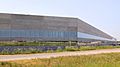
Gigafactory Texas in Austin, the global headquarters of Tesla
-
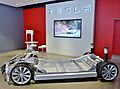
A Tesla vehicle chassis showing the battery pack built into the floor
-
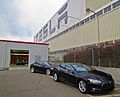
Brand new Model S cars lined up at the Fremont Factory
-
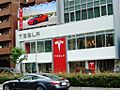
An early Tesla showroom in Tokyo, Japan
-
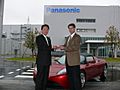
Battery partnership between Panasonic and Tesla leaders
-
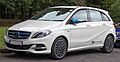
A Mercedes-Benz electric car that used a Tesla battery pack
-
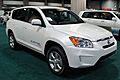
Toyota RAV4 EV developed in an early partnership with Tesla
-
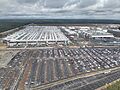
Gigafactory Berlin in Germany viewed from above
.jpg)


Related Pages
- Automobile
- Electric vehicle
- Elon Musk
- Lithium-ion battery
- Nikola Tesla
- Renewable energy
- Solar energy
See also
 In Spanish: Tesla, Inc. para niños
- List of automobile manufacturers of the United States
- List of Easter eggs in Tesla products
- List of production battery electric vehicles
- Plug-in electric vehicles in California
- Plug-in electric vehicles in the United States
