
Last Supper facts for kids
The Last Supper was a very important meal that Jesus shared with his closest followers, called apostles, in Jerusalem. This happened just before he was crucified. Christians remember this special meal every year, especially on Holy Thursday. The Last Supper is the basis for a Christian ceremony called the Eucharist, also known as "Holy Communion." Most experts agree that Jesus did have a final meal with his disciples, and it's a key part of his life story.
Contents
Understanding the Last Supper

The Bible doesn't use the exact words "Last Supper." However, many Christians use this term for the event. Another common name is "Lord's Supper." This name refers both to the meal Jesus shared and to the "Holy Communion" or "Eucharist" ceremony. "Eucharist" means "thanksgiving" in Greek.
Some Christian groups, like the Eastern Orthodox Church, call it the "Mystical Supper." This name also refers to both the historical meal and their church service.
Stories from the Bible
The story of Jesus' last meal with his apostles is found in all four main books of the New Testament called the canonical gospels. These books say the meal happened during the week of Passover, a few days after Jesus arrived in Jerusalem. It was before he was crucified on Good Friday.
The earliest mention of the Last Supper is in a letter from Paul called the First Epistle to the Corinthians. The Gospels of Matthew, Mark, and Luke also tell the story. The Gospel of John adds some unique details.
What Happened Before the Meal?
The Bible stories explain that after Jesus entered Jerusalem, he met with different people and Jewish leaders. Then, he and his disciples shared this important meal. After the meal, Jesus was betrayed, arrested, put on trial, and then crucified.
During the meal, Jesus prepared his disciples for his upcoming departure. He also made some important predictions.
Jesus Predicts a Betrayal
In Matthew 26:24–25, Mark 14:18–21, Luke 22:21–23 and John 13:21–30, Jesus told his apostles that one of them would betray him. Even though each apostle said it wouldn't be them, Jesus insisted that the betrayer was present. He said it would be terrible for the person who betrayed the Son of Man.
In Matthew 26:23–25 and John 13:26–27, Judas Iscariot is named as the traitor. In John's Gospel, Jesus showed who it was by dipping a piece of bread and giving it to Judas. As soon as Judas took the bread, he left.
The First Holy Communion
The three Synoptic Gospels describe the Last Supper as a Passover meal. During this meal, Jesus started the tradition of the Eucharist. He took bread, gave thanks, broke it, and gave it to his disciples. He said, "This is my body given to you."
Then, he took a cup of wine, gave thanks, and shared it. He said, "Drink from it, all of you; for this is my blood of the covenant, which is poured out for many for the forgiveness of sins." In some accounts, he also told them, "Do this in remembrance of me." This act is very important to Christians. It is seen as the beginning of Holy Communion.
The Gospel of John does not describe Jesus sharing the bread and wine in the same way. However, it has a section called the "Bread of Life Discourse" in John 6:58–59. This part of John's Gospel talks about Jesus being the "bread of life." Many scholars believe this connects to the meaning of the Eucharist.
Peter's Promise and Denial
In Matthew 26:33–35, Mark 14:29–31, Luke 22:33–34 and John 13:36–38, Jesus also predicted that Peter, one of his closest disciples, would deny knowing him three times. This would happen before a rooster crowed the next morning.
Later, after Jesus was arrested, Peter did deny knowing him three times. When he heard the rooster crow, he remembered Jesus' words and felt very sad.
Special Moments in John's Gospel

The Gospel of John includes some unique parts of the Last Supper story. One is when Jesus washed the feet of his apostles in John 13. Peter didn't want Jesus to do this, but Jesus explained that it was important. This act showed humility and service.
After Judas left, Jesus gave his remaining disciples a new command. He told them, "A new command I give you: Love one another. As I have loved you, so you must love one another." He said that by loving each other, everyone would know they were his followers.
Jesus also gave a long speech to his disciples, known as the Farewell Discourse. In this speech, he prepared them for his departure. He called them "friends and not servants." This sermon is a key source of Christian teachings about Jesus. It includes a special prayer, sometimes called the "High Priestly Prayer" in John 17:1–26. In this prayer, Jesus asks God to bless his disciples and all who would believe in him.
When and Where it Happened
The Date of the Meal

Historians believe Jesus was crucified between the years AD 30 and 36. The Last Supper happened the evening before his crucifixion. While the exact date is debated among scholars, it is generally understood to have taken place during the Passover festival. Some theories suggest it might have been on a Wednesday evening in AD 33, based on different ancient calendars. However, the church tradition of Maundy Thursday places it on the evening before Good Friday.
Where the Meal Took Place

Tradition says the Last Supper happened in a place now called The Room of the Last Supper. This room is on Mount Zion, just outside the old walls of Jerusalem. The Bible says Jesus told two disciples, Peter and John, to find "a man carrying a jar of water." This man would lead them to a house with "a large upper room furnished and ready" where they could prepare the Passover meal.
Archaeological findings suggest that the area on Mount Zion had a large community of Essenes, an ancient Jewish group. Some scholars think there might be a connection between Jesus and this group.
Another possible location is Saint Mark's Syrian Orthodox Church in Jerusalem. This church has an older room, now underground, which fits the description of a first-century upper room better.
Lessons from the Last Supper

The Last Supper teaches us important lessons. For example, when Jesus washed his disciples' feet, he showed the value of humility. He taught by example, showing how important it is to serve others.
During the Farewell Discourse, Jesus called his followers "friends" in John 15:15. This shows that those who follow Christ and take part in the sacrament of the Eucharist become his friends. Jesus promised to be present in the Eucharist, just as he was with his disciples at the Last Supper.
John Calvin, an important Christian thinker, believed the Last Supper was a key part of Christian faith. He saw Jesus' actions as an example for us. He taught that we should give thanks to God for His great love when we celebrate Holy Communion.
How Christians Remember It

The institution of the Eucharist at the Last Supper is remembered in many ways. For Roman Catholics, it's one of the Luminous Mysteries of the Rosary. Many Christians see it as the start of the New Covenant, a new agreement between God and people. This new covenant was mentioned by the prophet Jeremiah.
Church services like the Mass in the Catholic Church and the Divine Liturgy in the Eastern Orthodox Church celebrate the Sacrament of the Eucharist. The word "Eucharist" comes from a Greek word εὐχαριστία (eucharistia) meaning "thanksgiving."
In early Christianity, people also had ritual meals called "agape feasts" or "love feasts." These were full meals shared by the community, often on Sundays. They helped people remember Jesus' resurrection and other important events.
Connection to Passover

The Last Supper happened during the Jewish festival of Passover. This festival remembers when the ancient Israelites were freed from slavery in Egypt. Over time, some Christian groups have started to use parts of the Jewish Passover Seder customs in their own ceremonies. They do this to help remember the Last Supper. However, the Passover Seder traditions have changed a lot since Jesus' time.
The Last Supper in Islam
The fifth chapter in the Quran, Al-Ma'ida (The Table), contains a reference to a meal (Sura 5:114). This meal was sent down from God to ʿĪsá (Jesus) and his apostles (Hawariyyin). However, the Quran does not say this meal was related to Jesus' death. In Islam, it is believed that Jesus was not crucified. Some scholars think this meal was meant to strengthen the apostles' faith for challenges ahead.
Did it Really Happen?
Most scholars and historians agree that Jesus did have a final meal with his disciples. They see it as a real event that fits within the story of Jesus' life. Some early Christian communities also celebrated a meal similar to the Last Supper. This shows how important it was to them.
The Last Supper in Art
The Last Supper has been a very popular subject for artists throughout history. Pictures of it can be found in ancient Roman catacombs. By the Renaissance, it was a favorite topic for Italian artists.
There are three major themes in the depictions of the Last Supper:
- Jesus announcing his betrayal: These paintings are often dramatic and full of emotion.
- The start of the Eucharist: These depictions are usually calm and spiritual.
- Jesus saying goodbye to his disciples: In these scenes, Judas Iscariot has often left. They often show a sad mood as Jesus prepares to leave.
The most famous painting of the Last Supper is by Leonardo da Vinci. It is known for its beauty and balance. Other famous artists like Tintoretto and Salvador Dali have also created their own unique versions of this important event. Tintoretto's painting shows many people around the table, while Dali's combines traditional Christian ideas with modern art styles.
Images for kids
-
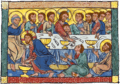
Miniature depiction from c. 1230
-
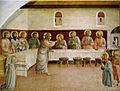
Communion of the Apostles, by Fra Angelico, with donor portrait, 1440–41
-
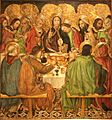
Last Supper, by Jaume Huguet, c. 1470
-
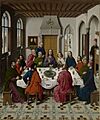
The Last Supper, by Dieric Bouts, 1464–1468
-
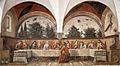
Domenico Ghirlandaio, 1480, depicting Judas separately
-
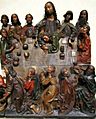
Last Supper, sculpture, c. 1500
-
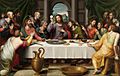
The first Eucharist, depicted by Juan de Juanes in The Last Supper, c. 1562
-
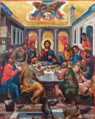
The Last Supper, by Michael Damaskinos, c. 1591
-
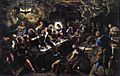
The Last Supper, by Tintoretto, 1592–1594
-
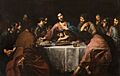
Valentin de Boulogne, 1625–1626
-
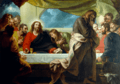
The Last Supper (Dark side of the Eucharist), by Benjamin West, mid 18 century
-
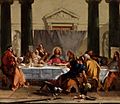
Last Supper by Tiepolo, c. 1760
-
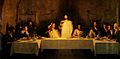
The Last Supper, by Bouveret, 19th century
-
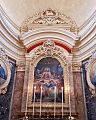
The Last Supper by Lazzaro Pisani, 1917, the altarpiece of Corpus Christi Parish Church in Għasri, Malta
-
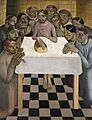
Last Supper, by Gustave Van de Woestijne, 1927


,_1786_by_Benjamin_West.png)


.jpg)

See also
 In Spanish: La Última Cena para niños
- Book of the Secret Supper
- Friday the 13th
- Life of Jesus in the New Testament
- List of dining events
