
Townsend's dwarf salamander facts for kids
Quick facts for kids Townsend's dwarf salamander |
|
|---|---|
| Conservation status | |
Scientific classification  |
|
| Kingdom: | Animalia |
| Phylum: | Chordata |
| Class: | Amphibia |
| Order: | Urodela |
| Family: | Plethodontidae |
| Subfamily: | Hemidactyliinae |
| Genus: | Parvimolge Taylor, 1944 |
| Species: |
P. townsendi
|
| Binomial name | |
| Parvimolge townsendi (Dunn, 1922)
|
|
| Script error: The function "autoWithCaption" does not exist. | |
| Synonyms | |
|
|
Script error: No such module "Check for conflicting parameters".
Townsend's dwarf salamander (scientific name: Parvimolge townsendi) is a tiny type of salamander. It belongs to a group called Plethodontidae, which are special because they don't have lungs! These salamanders breathe through their skin and the lining of their mouths. This specific salamander is the only known species in its group, called Parvimolge.
You can only find Townsend's dwarf salamander in a special part of Mexico. It lives in the northern Sierra Madre de Oaxaca mountains, in the states of central and southern Veracruz. These salamanders live at elevations between 900 and 1900 meters (about 2,950 to 6,230 feet) above sea level.
Contents
Where Townsend's Dwarf Salamanders Live
Townsend's dwarf salamanders like to live in certain places. Their natural habitats are cloud forests and oak forests. These forests are often misty and have many trees.
Finding Them in Nature
You can usually find these salamanders living inside bromeliad plants. Bromeliads are plants that grow on trees and collect water in their leaves. Sometimes, the salamanders also live on the ground among the leaves and plants.
Adapting to New Places
These salamanders can also live in shaded coffee plantations. Coffee plantations are farms where coffee plants are grown. As long as the air stays moist and cool, the salamanders can survive there.
Protecting Townsend's Dwarf Salamander
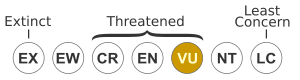
Townsend's dwarf salamander has never been very common. Sadly, its numbers have dropped a lot over the years. Scientists have only seen it once since 1997, even though they have tried hard to find more.
What Threatens Them?
The biggest danger to these salamanders is habitat loss. This means their homes in the forests are being destroyed. Scientists need more information to understand all the reasons why their numbers are going down.
The Chytrid Fungus Threat
About 40 years ago, a dangerous chytrid fungus called Batrachochytrium dendrobatidis spread in the areas where these salamanders live. This fungus has caused big problems for many amphibians, including Townsend's dwarf salamander. It can make amphibians sick and even kill them.
Recent Discoveries
Because it was so hard to find, some people thought this species might be extinct. However, surveys done in the 2010s found that it is still present in many areas. In some places, it was even found to be quite common! This gives hope for the future of Townsend's dwarf salamander.
