
Trust No Fox on his Green Heath and No Jew on his Oath facts for kids
| Author | Elvira Bauer (1915 – after 1943) |
|---|---|
| Original title | Trau keinem Fuchs auf grüner Heid und keinem Jud auf seinem Eid |
| Illustrator | Elvira Bauer |
| Country | Nazi Germany |
| Language | German |
| Genre | Children's book, picture book, nursery rhymes |
| Publisher | Stürmer-Verlag (Stürmer Publishing House), Nuremberg |
|
Publication date
|
1936 |
| Media type |
Trust No Fox on his Green Heath and No Jew on his Oath! A Picture Book for Old and Young (Original title in German: Trau keinem Fuchs auf grüner Heid und keinem Jud auf seinem Eid! ein Bilderbuch für Gross und Klein) was a children's picture book published in November 1936 in Nazi Germany. The book was written and illustrated by Elvira Bauer, who was a kindergarten teacher and an art student. She also supported the Nazi Party. This book was one of three children's books published by Julius Streicher, who edited a newspaper called Der Stürmer. This newspaper was known for spreading very harmful ideas about Jewish people. Streicher later faced serious consequences for his actions after the war.
The book used exaggerated and often negative drawings, called caricatures, along with simple rhymes and colorful pictures. It tried to teach children—and adults—what the Nazi Party unfairly claimed Jewish people were like. The book showed Jewish people in a very negative way, describing them as untrustworthy. It presented them as the opposite of what the Nazis called "Aryans," which was their idea of an "ideal" German person. Books like this were a form of propaganda. They were used to teach young people in Germany the unfair and untrue ideas the Nazis had about different groups of people.
Trust No Fox on his Green Heath was very popular. It had seven different printings, and at least 70,000 copies were made. After Elvira Bauer moved to Berlin in 1943, there are no known records of what she did later in life.
Contents
Understanding a Controversial Children's Book
This book is an important example of how the Nazi Party tried to influence young minds. It shows how propaganda can be used to spread harmful ideas.
The Story Behind the Book
The Nazi Party and its leader, Adolf Hitler, took complete control of the German Parliament, called the Reichstag, in 1933. This allowed Hitler to create laws that limited the rights of different groups of people. These included laws that were unfair to Jewish people, such as the Nuremberg Laws passed in 1935.
In 1933, the Reich Ministry of Public Enlightenment and Propaganda was created. This ministry was in charge of spreading the Nazi Party's messages. It ordered the creation of many publications, including books, newspapers, radio shows, and speeches, that were unfair to Jewish people. Joseph Goebbels, who was the propaganda minister, said this new ministry would help unite the government and the people. The Nazi Party believed that by using propaganda, they could make all German people support their beliefs.
By 1935, Jewish people in Germany were treated unfairly and had fewer rights than others. This happened because of the laws the Nazi Party passed and because of how many non-Jewish people felt. Throughout the 1930s, there were many boycotts of Jewish businesses. This showed how widespread the unfair feelings against Jewish people were in Germany. These unfair ideas were even made into laws, and people were not punished for acting on them. Many of these negative ideas about Jewish people were already present in Germany before the Nazis came to power.
The Nazis also created laws about publishing. For example, the "editorial law" (Schriftleitergesetz) meant that all publications were checked by the Reich Chamber of Culture. People who were not considered "Aryan" by the Nazis were not allowed to work as journalists. This made the unfair ideas against Jewish people even stronger among non-Jewish Germans. By the end of the 1930s, Germany had created a system where some parts of public life were only for "Aryans," giving them special advantages.
After World War II, during the Nuremberg Trials where major German war criminals were judged, Trust No Fox on his Green Heath was used as proof of the harmful ideas spread in Nazi Germany.
The Book's Misleading Title
The book's German title, Trau keinem Fuchs auf grüner Heid und keinem Jud bei seinem Eid, translates to "Don't trust a fox whate'er you do, nor yet the oath of any Jew." This title comes from an old saying that was unfairly used to spread negative ideas about Jewish people. This saying was sometimes linked to Martin Luther, a famous historical figure. The main idea of the saying was to suggest that Jewish people could not be trusted.
Animal Symbols and Their Meanings
Elvira Bauer used different animals in the book to represent Jewish people in a negative way. The two animals used most often were the fox and the crow.
The Sly Fox in Propaganda
In some old stories, the fox was seen as a symbol of the devil. In Nazi Germany, foxes were often shown as sneaky and clever. This made them seem to fit the unfair ideas spread in propaganda against Jewish people. Foxes were also thought to carry diseases like rabies. By linking the fox to Jewish people, the book tried to suggest that Judaism was like a disease. The fox was a common symbol in German propaganda. There were even films like Reynard the Fox that tried to connect foxes with Jewish people.
Crows and Negative Ideas
Crows were another animal often shown alongside Jewish people in the book. Crows were sometimes linked to evil or the devil's work. By connecting crows with Jewish people, the book tried to imply that Jewish people were involved in bad things.
See also
- Der Giftpilz
- Children's propaganda in Nazi Germany
- Reich Ministry of Public Enlightenment and Propaganda
Images for kids
-
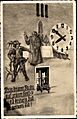
A Nazi propaganda postcard from the 1930s showing a mural in Nuremberg illustrating an old anti-Jewish saying: "Don't trust a fox whate'er you do, nor yet the oath of any Jew."

