
Victory Over Blindness facts for kids
Quick facts for kids Victory Over Blindness |
|
|---|---|
| United Kingdom | |
.jpg)
Victory Over Blindness
|
|
| For the wounded of the First World War and to commemorate its centenary | |
| Unveiled | 16 October 2018 |
| Location | |
| Designed by | Johanna Domke-Guyot |
The Victory Over Blindness sculpture is a special artwork in Manchester, England. It was created by an artist named Johanna Domke-Guyot. You can find it outside the main entrance of Manchester Piccadilly station. This sculpture was made to remember 100 years since the end of the First World War.
The sculpture shows seven figures who are blind, helping each other walk. These figures look like real soldiers who lost their sight during the war. What's cool about this sculpture is that it's not on a tall base. The figures are at eye level, so people walking by can feel like they are right there with them. The Blind Veterans UK charity asked for this sculpture to be made, and it was shown to the public in October 2018. It's thought to be the only memorial that shows soldiers who were wounded in the First World War.
Why This Sculpture Was Made
The idea for a lasting memorial to mark 100 years since the First World War was supported by Network Rail and Transport for Greater Manchester. The area outside Piccadilly station is often used for temporary art, like the Bee in the City art trail in 2018. This made it a great spot for the sculpture.
The first version of this sculpture was made in 2015. It celebrated 100 years of the Blind Veterans UK charity. That first sculpture is now at the charity's training center in Llandudno. A cement copy of the sculpture was first shown in 2017 at the National Memorial Arboretum in Staffordshire. With help from the Gosling Foundation, Blind Veterans UK was able to get the sculpture placed in Manchester.
The sculpture was officially shown to the public on October 16, 2018. The Countess of Wessex was there for the event. She gave a short speech, saying that it's important to remember not only those who died in the war, but also those who came back changed by their experiences.
What the Sculpture Shows
The Victory Over Blindness sculpture shows seven life-sized figures. They are guiding each other, just like in an old photograph the artist saw. That photo showed soldiers from World War I who had lost their sight in battle, helping one another.
Usually, statues are placed on tall bases. But for this sculpture, the artist wanted the figures to be on the ground. This way, people can easily connect with them. It helps us remember that the sacrifices made by soldiers in World War I should never be forgotten.
The artist, Johanna Domke-Guyot, said that she wanted people to be able to touch the figures. She wanted it to feel like "a people's piece." Each of the seven figures looks like a real World War I veteran who became blind because of their time on the front lines.
People have really liked the sculpture. They have called it "moving" because of its important message. They also said it was "striking" because it connects with people at eye level.
Images for kids
-
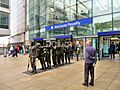
The sculpture from a different angle.
-
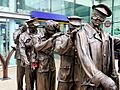
The sculpture outside Manchester Piccadilly Station.
-
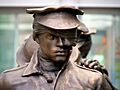
A close-up view of the figures.
-
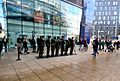
Another view of the sculpture.
.jpg)
.jpg)
.jpg)
.jpg)
