
We Wanted a Revolution: Black Radical Women, 1965-1985 facts for kids
We Wanted a Revolution: Black Radical Women, 1965–85 was a special art show at the Brooklyn Museum in New York City. It ran from April 21 to September 17, 2017. This exhibition celebrated the amazing art created by Black women over twenty years, from 1965 to 1985.
The show featured forty artists and activists. Their artwork focused on important issues like fighting against unfair treatment based on race, gender, or who you love. It also highlighted the struggle against poverty and inequality. The exhibition aimed to show how these artists used their creativity to push for a more fair and equal world.


Contents
About the Art Show
The exhibition, We Wanted a Revolution: Black Radical Women, 1965–85, was put together by the Elizabeth A. Sackler Center for Feminist Art at the Brooklyn Museum. It was part of a bigger year-long series called A Year of Yes: Reimagining Feminism at the Brooklyn Museum. This series celebrated ten years of the Elizabeth A. Sackler Center.
The show displayed many different kinds of art. These included conceptual art (art that focuses on ideas), performance art, films, videos, prints, photos, and paintings. Even though the art styles were very different, they all shared a common goal. They wanted to make the voices of Black female artists heard. They also wanted to show the challenges Black female artists faced in the art world and in society. The exhibition had nine different sections, each focusing on a special theme or type of art.
Artists and Art Movements
This section highlights some of the artists and art groups featured in the exhibition. These artists used their work to express powerful messages and bring about change.
Spiral and The Black Arts Movement
Spiral was a group of Black artists active from 1963 to 1965. It was started by Romare Bearden, Norman Lewis, Hale Woodruff, and Charles Alston in 1963. The Black Arts Movement was a time when Black artists created art to support Black power and culture.
Emma Amos (born 1938)
Emma Amos was an African American painter and printmaker. She was born in Atlanta, Georgia. Her art often explored identity and culture.
- Flower Sniffer, 1966
- Sandy and Her Husband, 1973
Elizabeth Catlett (1915–2012)
Elizabeth Catlett was a Mexican-American sculptor. Her art often focused on the experiences of Black women. She was born in Washington, D.C.
- Homage to My Young Black Sisters, 1968
Jeff Donaldson (1932–2004)
Jeff Donaldson was an African-American artist. He was a key figure in the Black Arts Movement.
- Wives of Shango, 1969
Jae Jarrell (born 1935)
Jae Jarrell created art that often combined fashion and activism.
- Ebony Family, 1968
- Urban Wall Suit, 1969
Wadsworth A. Jarrell (born 1929)
Wadsworth A. Jarrell was also part of the Black Arts Movement. His work often had strong political messages.
- Revolutionary, 1971
Faith Ringgold (born 1930)
Faith Ringgold is famous for her story quilts and paintings. Her art often deals with race, gender, and history.
- Early Works #25: Self-Portrait, 1965
Prints and Posters
This section showed how artists used prints and posters to share their messages widely. These works were often bold and direct, making them powerful tools for activism.
Emma Amos (born 1938)
- Summer 1968, 1968
Kay Brown (1932–2012)
- Sister with Braids, late 1960s – early 1970s
- Willowbrook, 1972
Elizabeth Catlett (1915–2012)
- Malcolm X Speaks for Us, 1969
- Harriet, 1975 (referring to Harriet Tubman)
Barbara Jones-Hogu (born 1938)
Barbara Jones-Hogu was known for her powerful prints that encouraged Black pride and unity.
- I'm Better Than These ..., 1970
- Nation Time, 1970
- Unite, 1971
Carolyn Lawrence (born 1940)
- Uphold Your Men, 1971
Samella Lewis (born 1924)
Samella Lewis is an artist, art historian, and educator.
- Family, 1967
- Field, 1968
"Where We At" Black Women Artists
"Where We At" Black Women Artists Inc. was a group founded in 1971. It was created to support and promote Black women artists. They wanted to make sure their voices were heard and their art was seen.
Kay Brown (1932–2012)
- Kick of Life, 1974
- She Sees No Evil; She Hears No Evil; She Speaks No Evil, 1982
Carole Byard (1941–2017)
- Yasmina and the Moon, 1975
Dindga McCannon (born 1947)
- Revolutionary Sister, 1971
- Morning After, 1973
Black Feminism
This section explored the ideas of Black feminism, which focuses on the unique experiences of Black women. It highlights how race, gender, and class all affect a person's life. Many thinkers and artists contributed to these ideas. Some important people involved in these discussions were:
- James Baldwin (1924–1987)
- Audre Lorde (1934–1992)
- Barbara Smith (born 1946)
- Toni Morrison (born 1931)
- Alice Walker (born 1944)
- Michele Wallace (born 1952)
- Faith Ringgold (born 1930)
- Bettye Saar (born 1926)
Art World Activism
This part of the exhibition showed how artists and activists worked to change the art world itself. They fought for more fairness and representation for Black artists and women artists. Groups like the Black Emergency Cultural Coalition and Women Artists in Revolution played a big role in these efforts. They pushed for equal opportunities and challenged unfair practices in museums and galleries.
Public Programs
As part of the exhibition, a special discussion was held at the Brooklyn Museum of Art on April 21, 2017. Important scholars like art historian Kellie Jones, feminist theory expert Aruna D'Souza, and cultural studies academic Uri McMillan gave talks and joined a panel discussion. These events helped people learn more about the art and the important ideas behind the exhibition.
Images for kids
-
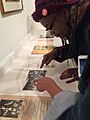
Black Lunch Table: We Wanted A Revolution Roundtable. Dindga McCannon explains her work and her archive at the Brooklyn Museum at the exhibition We Wanted a Revolution: Black Radical Women, 1965–85 after a roundtable discussion with other black women artists at the Black Lunch Table event.
-
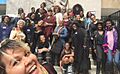
Black Lunch Table: We Wanted A Revolution Roundtable. Women visual artists of the African Diaspora meet at the Brooklyn Museum to discuss their work.
