
William H. McAvoy facts for kids
Quick facts for kids
William H. McAvoy
|
|
|---|---|
| Nationality | American |
| Occupation | Aviator |
William H. "Bill" McAvoy was a brave and skilled test pilot in the 1920s and 1930s. He worked for a special government group called the National Advisory Committee for Aeronautics (NACA). This group studied how planes fly. Bill McAvoy worked at their main lab in Langley, Virginia. Later, in 1940, he helped start a new flight center in California, the Ames Research Center.
Contents
Who Was Bill McAvoy?
Bill McAvoy served in the U.S. Army from 1917 to 1921. After that, he became a civilian pilot. By 1929, he was working for NACA. He was one of several pilots who learned special skills for flight research. These pilots, like Melvin N. Gough and Edmund T. "Eddie" Allen, learned how to fly planes very steadily and precisely. They worked closely with engineers to understand how planes handled in the air. This work was very important for making planes safer and better.
Testing New Airplanes
Bill McAvoy tested many different types of airplanes at the Langley facilities near Hampton, Virginia. He flew planes like the Grumman XF3F-1 prototype. This plane was rebuilt after an earlier version crashed.
On October 15, 1929, McAvoy was testing a Martin XT5M-1 divebomber. During a test dive, part of the wing broke off! Even with a big hole in the wing, McAvoy was able to fly the damaged plane back to the airfield. He landed it safely, saving the aircraft. This plane later went into production as the BM-1.
In July 1931, McAvoy and Melvin Gough tested America's first autogyro, the Pitcairn PCA-2. An autogyro is a type of aircraft that uses a rotor like a helicopter but also has a propeller for forward thrust. Their tests were the first to collect real information on how this new type of aircraft handled. This helped scientists understand how helicopters might work.
McAvoy also made the very first flight of the Grumman XFF-1 on December 29, 1931. He did most of the flight tests for this design in 1932.
Close Calls in the Sky
Bill McAvoy had some very dangerous moments during his career. On November 15, 1932, he was flying the first flight of a huge four-engine flying boat called the Hall XP2H-1. This plane was the largest four-engine biplane the U.S. Navy ever used. During takeoff, the plane suddenly pointed straight up because a part was set up wrong. McAvoy and the plane's designer quickly cut the engines. The plane dropped back onto the river, but luckily, it only had minor damage.
On March 30, 1936, McAvoy was testing a Pitcairn YG-2 gyrocopter. The aircraft broke apart in the air and crashed near the Back River in Virginia. McAvoy had to bail out, meaning he jumped out of the plane with a parachute. He landed safely! Because of this jump, he became a member of the "Caterpillar Club." This club is for pilots who have saved their lives by using a parachute.
Researching Icing on Planes
In the fall of 1940, McAvoy moved to the Ames Research Center in California. There, he worked on research about ice forming on planes. NACA and the military wanted to make it possible for planes to fly safely in all kinds of weather, even icy conditions.
He flew several planes for this research, including a Lockheed 12A transport. This plane was specially changed by a famous engineer named Kelly Johnson. It had engine exhaust directed through the wings to keep them from icing up. From early 1940, McAvoy flew this plane into the worst weather he could find. The information gathered from these flights showed that systems to prevent ice were practical and important for safe flying.
In 1943, Bill McAvoy received a special award called the Octave Chanute Award. He got this award for his "continuous service in the flight testing of experimental planes under hazardous conditions imposed by aeronautical research." A big reason for this award was his dangerous flights in icy conditions with the Lockheed 12.
Images for kids
-
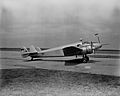
NACA's Lockheed 12A used for deicing testing.

