
Wisconsin German facts for kids
Quick facts for kids Wisconsin German |
|
|---|---|

The flag of Wisconsin.
|
|
| Native speakers | 36,443 (2013) |
| Language family | |
| Languages | |
|---|---|
| English, Wisconsin High German, Low German, Kölsch, Swiss German, Luxembourgish/Yiddish |
The term Wisconsin German describes the different types of German spoken in the state of Wisconsin. It includes both a special kind of German called Wisconsin High German and older German dialects. These dialects were brought by German immigrants.
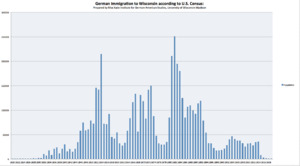
By 1853, many people in Wisconsin came from German-speaking countries. By the late 1800s, German speakers were the largest group in Wisconsin who did not speak English. Unlike some other languages, German stayed strong in Wisconsin for many generations. This was from the 1840s until the mid-1900s.
German immigrants often settled in communities with people from similar backgrounds. This helped them keep their language alive. German was also used in churches, schools, and newspapers. Over time, Wisconsin German started to mix with English. It also developed its own unique words and grammar.
However, by the mid-1900s, things began to change. More people moved to cities. Also, during World War I, there was strong pressure to speak English. These changes led to fewer people speaking German in Wisconsin.
Contents
Why Germans Came to Wisconsin
In the mid-1800s, many German immigrants moved to Wisconsin. By the late 1800s, Wisconsin was a top choice for Germans coming to America. They chose Wisconsin for several reasons. The state had good resources and plenty of land. Land agents also helped them find places to settle.
These immigrants were looking for new chances to earn a living. They also wanted religious or political freedom. For example, the town of Freistadt in Wisconsin was started by about 300 German Lutherans. They came from a region called Pomerania. They were looking for freedom from religious changes and difficulties in their homeland.
They named their new home Freistadt, which means "free city." This name likely celebrated their new religious freedom in America. Keeping their faith and their East Pomeranian dialect was very important to these settlers. Even though Freistadt was founded in 1839, people there still spoke East Pomeranian German until the late 1900s.
Different German Dialects in Wisconsin
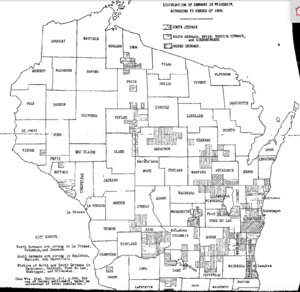
German speakers came to Wisconsin from many different places. These included regions like Mecklenburg-Schwerin, Pomerania, Rhineland, and Bavaria. Each group brought its own unique way of speaking German, called a dialect. They used these dialects at home, in their communities, and even in local shops.
What is Wisconsin High German?
Besides their local dialects, many people also used a form called Wisconsin High German. This was a mix of Standard German and features from different dialects. It was often used in churches and schools. This meant that many people in Wisconsin spoke three languages: their family's German dialect, Wisconsin High German, and English!
Over many years, this mixing of languages created something new. Wisconsin German became a language with parts of old German dialects, Standard German, and English. It also developed its own special ways of speaking.

How German Was Kept Alive
German in Schools
When German settlers first arrived, German was the main language in many rural Wisconsin schools. Teachers often came from Germany. Textbooks were first brought from Germany, then printed in the U.S.
In 1854, a Wisconsin state law said that all main subjects should be taught in English. However, the state didn't have much control over local schools. These schools were run and paid for by their own communities. So, many continued to teach in German.
By the early 1900s, schools fully switched to teaching in English. This change was one reason why fewer people spoke German over time.
How Languages Change: Wisconsin German Grammar
Languages are always changing, especially when different languages meet. Wisconsin German is a great example of this. Many people who spoke Wisconsin German learned it at home from their families. They often learned English later, when they started school around age six. This means their German was already well-developed.
Unique Grammar Features
One interesting change in Wisconsin German is how it uses grammar rules. In Standard German, there are different ways to say "the" or "a" depending on the word's role in a sentence. This is called "case marking." Over time, Wisconsin German speakers started to simplify some of these rules.
For example, some parts of German grammar, like the "dative case," became less common in Wisconsin German. Instead, speakers developed new ways to show meaning in sentences. These changes happened across different German dialects spoken in Wisconsin. It shows how a language can adapt and create its own unique rules when it's spoken in a new place and alongside another language like English.
Recording Wisconsin German
In the 1940s, a professor named Lester "Smoky" Seifert began recording Wisconsin German. He taught German at the University of Wisconsin–Madison. Professor Seifert himself spoke a type of German called East Low German.
He conducted more than 100 written interviews with people who spoke Wisconsin German. These interviews asked questions about both their language and their culture. His work helped to preserve important information about these unique dialects.
