
Yolk sac facts for kids
Quick facts for kids Yolk sac |
|
|---|---|
| Latin | vesicula umbilicalis; saccus vitellinus |
| Precursor | Endoderm |
A yolk sac is a tiny, balloon-like pouch attached to a growing embryo. In scientific terms, an embryo is the very early stage of an animal or human before it is born or hatched. Doctors and scientists sometimes call this pouch the umbilical vesicle. Most people simply call it the yolk sac.
The yolk sac is one of several important fetal membranes that protect and support new life. During the very beginning of growth, it works like a miniature life-support system. It helps build the first blood cells and moves nutrients around. In human development, a large part of this pouch actually folds inward during the fourth week of embryonic development. When it folds inside, it helps create the baby's primordial digestive tube.
How the yolk sac works in human development
During pregnancy, a tiny bubble called the gestational sac appears inside the mother. The yolk sac is usually the very first part doctors can see inside this space.
Before an embryo develops complete organs, it still needs fresh energy and oxygen. The earliest blood pathway is called the vitelline circulation. A tiny, primitive main blood vessel called the aorta pushes fresh blood right into the yolk sac wall.
Inside the sac wall, the blood travels through a network of tiny tubes called a capillary plexus. After gathering what it needs, the blood flows back through the vitelline veins. These veins lead straight into the tiny, simple tubular heart of the growing body.
In these early days, the mother's placenta is not fully ready yet. The yolk sac steps in to provide nourishment and manage gas exchange so the tiny organism can breathe and grow.
Near the end of the fourth week of growth, the yolk sac starts to shrink down. It begins to look like a small, pear-shaped balloon. It stays connected to the forming digestive system through a narrow stem known as the vitelline duct.
As weeks pass, the body grows bigger and builds newer organs to take over these jobs. Most of the time, this tiny connecting tube completely disappears around the twentieth week. The tissues are neatly gathered up to form parts of the stomach and intestines.
-
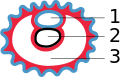
Diagram showing earliest observed stage of human ovum.
1 - Amniotic cavity
2 - Yolk-sac
3 - Chorion -
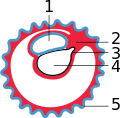
Diagram illustrating early formation of allantois and differentiation of body-stalk.
1 Amniotic cavity
2 Body-stalk
3 Allantois
4 Yolk-sac
5 Chorion -
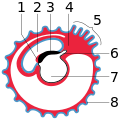
Diagram showing later stage of allantoic development with commencing constriction of the yolk-sac.
1 Heart
2 Amniotic cavity
3 Embryo
4 Body-stalk
5 Placental villi
6 Allantois
7 Yolk-sac
8 Chorion -
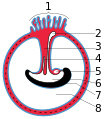
Diagram illustrating a later stage in the development of the umbilical cord.
1 Placental villi
2 Yolk-sac
3 Umbilical cord
4 Allantois
5 Heart
6 Digestive tube
7 Embryo
8 Amniotic cavity


Yolk sacs across the animal kingdom
The yolk sac is an ancient biological invention that nature has used for millions of years. Scientists know that primitive fish had yolk sacs long before land animals even existed. It was likely present in the ancient shared ancestor of all animals with backbones.
Later in history, creatures called amniote animals appeared on Earth. These animals include reptiles, birds, and mammals. To live and lay eggs on dry land, they evolved much larger yolks filled with rich food. The eggs developed tough shells to keep the moisture locked safely inside.
In birds and reptiles, the yolk sac remains huge because it holds all the food the baby animal needs until it hatches. In mammals, the yolk sac changed its main job. Instead of storing a giant ball of yellow food, it became a temporary helper that builds early blood vessels until the mother can share nutrients directly.
