
Zaire ebolavirus facts for kids
Quick facts for kids Zaire ebolavirus |
|
|---|---|
 |
|
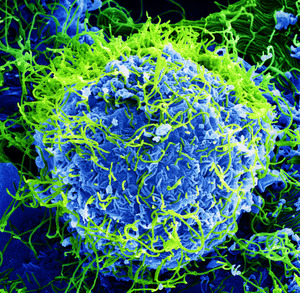
| A close-up picture of Ebola virus particles (green) taken with a powerful microscope. | |
Virus classification  |
|
| Unrecognized taxon (fix): | Ebolavirus |
| Species: |
Zaire ebolavirus
|
Zaire ebolavirus, commonly called Ebola virus (EBOV), is a germ that causes a very serious sickness called Ebola virus disease. It belongs to a group of viruses known as Ebolavirus. This virus can make humans and other animals, like monkeys, very ill. It causes a type of fever that can lead to severe bleeding inside the body.
The Ebola virus is famous because it has caused several large outbreaks in Africa. The biggest one happened between 2013 and 2016 in West Africa. During that time, many people became sick. Scientists and doctors have worked hard to study this virus and create medicines to stop it.
The virus was named after the Ebola River in the Democratic Republic of the Congo (formerly Zaire), where it was first found. It is believed that the virus lives naturally in bats, especially fruit bats. It can spread to humans if they come into contact with an infected animal or person.
Contents
What is the Ebola virus?
The Ebola virus is a tiny, microscopic germ. It is one of the most dangerous viruses known to science. Because it is so dangerous, scientists who study it must wear special protective suits and work in highly secure laboratories. This keeps the virus from escaping or making the scientists sick.
The virus is classified in the family Filoviridae. The members of this family look like twisted threads under a microscope. Ebola virus is the main member of the species Zaire ebolavirus.
Structure and genetics
Shape of the virus

.jpg)
Under a powerful microscope, the Ebola virus looks like a long tube or thread. Sometimes it curls up into shapes that look like a "U", a "6", or a shepherd's crook. The virus is about 80 nanometers wide and can be up to 1000 nanometers long.
The outside of the virus is covered in a layer called the viral envelope. Sticking out of this envelope are tiny spikes made of a glycoprotein (GP). These spikes act like keys that help the virus unlock and enter healthy cells in the body. Inside the envelope, there is a tube called the nucleocapsid that holds the virus's genetic instructions.
Genetic code
Inside the virus, there is a single strand of RNA. This RNA acts like a blueprint or instruction manual. It tells the virus how to build more copies of itself. The RNA is about 19,000 letters (nucleotides) long.
The Ebola virus has seven genes. These genes contain the code for seven different proteins. Each protein has a specific job, like protecting the RNA, building the virus's shell, or helping the virus copy itself.

| Name | Function |
|---|---|
| NP (Nucleoprotein) | Protects the virus's genetic code. |
| VP35 | Helps the virus copy itself and hide from the body's immune system. |
| VP40 | Builds the structure of the virus. |
| GP (Glycoprotein) | Forms the spikes on the outside of the virus to attach to cells. |
| sGP | A protein the virus releases into the body to confuse the immune system. |
| VP30 | Helps turn on the virus's genes. |
| VP24 | Stops the cell from sending warning signals to the rest of the body. |
| L (Polymerase) | The machine that copies the RNA. |
How the virus spreads
Animal hosts
Scientists believe that the Ebola virus lives naturally in fruit bats in Africa. The bats do not seem to get sick from the virus. However, other animals like chimpanzees, gorillas, and monkeys can catch the virus from bats. Humans can get infected if they handle sick animals or eat food that has been touched by them.
Entering cells

To make someone sick, the virus must get inside their cells. The spikes on the outside of the virus attach to the surface of a cell. The cell then swallows the virus, thinking it is something useful.
Once inside, the virus needs to escape a compartment called a macropinosome. It uses a special protein in the human body called NPC1 to do this. Without NPC1, the virus cannot infect the cell. Scientists have found that cells without NPC1 are safe from Ebola. This discovery helps researchers look for new medicines.
Making copies

Viruses cannot grow on their own. They must use a host cell to make copies of themselves. Once the Ebola virus enters a cell, it releases its RNA. The cell's own machinery reads the viral RNA and starts building new viral proteins and copying the genetic code.
These new parts assemble near the edge of the cell. They push their way out through the cell membrane, taking a piece of it with them to form their new envelope. This process is called "budding." The new viruses then go on to infect other cells.
Ebola virus disease
Ebola virus causes a severe illness known as Ebola virus disease (EVD). It is one of the most deadly viruses for humans. In past outbreaks, many people who caught the virus did not survive.
Symptoms and effects
The first symptoms usually appear a few days after infection. They feel like the flu or malaria. A person may have:
- High fever
- Headache
- Muscle and joint pain
- Weakness
- Sore throat
As the disease gets worse, it can cause vomiting, stomach pain, and severe bleeding inside and outside the body. The virus attacks many organs, making it hard for the body to function.
Major outbreaks
The first known outbreak happened in 1976 in a village called Yambuku near the Ebola River. A schoolteacher was the first person recorded to have the sickness. Doctors at the time did not know what it was and treated it like malaria.
The largest outbreak in history started in late 2013 in West Africa. It affected countries like Guinea, Liberia, and Sierra Leone. It lasted until 2016 and thousands of people became ill. This outbreak showed the world how important it is to have good healthcare systems and to respond quickly to new diseases.
Medical treatments and vaccines
Vaccine
For a long time, there was no vaccine for Ebola. Scientists worked very hard to create one. In December 2016, a study showed that a new vaccine called VSV-EBOV was very effective. It protects people from the Zaire ebolavirus.
The vaccine was approved by the U.S. Food and Drug Administration in December 2019. This was a huge achievement in medicine. It is now used to protect doctors and people living in areas where an outbreak might happen.
History and discovery

In 1976, scientists discovered a new virus that looked similar to the Marburg virus. They named it Ebola virus after the nearby river.
Over the years, the scientific name has changed a few times to be more precise. Today, the species is officially called Zaire ebolavirus. However, most people still just call it "Ebola."
Scientists also study the history of the virus's genetics. They believe the Zaire ebolavirus separated from its ancestors between 1960 and 1976. The virus changes (mutates) over time, similar to how the flu virus changes every year.
In stories and media
Because the Ebola virus is so scary and dangerous, it has appeared in many books and movies.
- The Hot Zone: A famous book by Richard Preston that tells the true story of how scientists discovered Ebola and other related viruses.
- Outbreak: Movies often use fictional viruses that are very similar to Ebola to tell dramatic stories about stopping a pandemic.
- Novels: Writers like Tom Clancy and Alex Kava have written thriller stories where characters have to stop the virus from spreading.
See also
 In Spanish: Ebolavirus Zaire para niños
