
Zimmermannia bosquella facts for kids
Zimmermannia bosquella is a tiny moth that belongs to a group of moths called Nepticulidae. You can find this moth in parts of the United States, including Virginia, Ohio, and Kentucky. This moth is now known to be the same species as the American chestnut moth, which people once thought had completely disappeared.
Quick facts for kids Zimmermannia bosquella |
|
|---|---|
 |
|
| Conservation status | |
Scientific classification  |
|
| Kingdom: | Animalia |
| Phylum: | Arthropoda |
| Class: | Insecta |
| Order: | Lepidoptera |
| Family: | Nepticulidae |
| Genus: | Zimmermannia |
| Species: |
Z. bosquella
|
| Binomial name | |
| Zimmermannia bosquella (Chambers, 1878)
|
|
| Script error: The function "autoWithCaption" does not exist. | |

Script error: No such module "Check for conflicting parameters".
Contents
What Does the Zimmermannia Moth Look Like?
This moth is quite small! Its wingspan (the distance from one wingtip to the other when spread out) is only about 9 to 10 millimeters. That's less than half an inch!
Life Cycle of the Zimmermannia Moth
The young moths, called larvae, grow to their full size around October and early November. After this, they change into adult moths. The adult moths then appear in May and June of the next year.
How the Zimmermannia Moth Lives
What Do the Larvae Eat?
The larvae of the Zimmermannia bosquella moth like to eat the leaves of a tree called the Pin Oak (Quercus palustris). They are what we call "leaf miners". This means they dig tunnels and eat inside the leaves of the plant.
How They Mine the Bark
These larvae create a special kind of tunnel, or "mine," in the bark of young pin oak branches. This mine looks like a flat, oval spiral, a bit like the inside of a watch. When the larva leaves its mine, you can often still see the empty eggshell stuck to the bark in the middle of the spiral. Over time, the bark around old mines can crack and even fall off, leaving scars on the tree that stay for many years.
The Moth and the American Chestnut Tree
The Zimmermannia bosquella moth had a very close relationship with the American chestnut tree. They helped each other in some ways. However, when a terrible disease called chestnut blight almost wiped out the American chestnut trees, the moth's population also dropped dramatically. People thought the American chestnut moth had become extinct. But later, scientists discovered that it was still alive, living within populations of Zimmermannia bosquella moths. This was great news for both the moth and the efforts to save the chestnut tree!
Images for kids
-
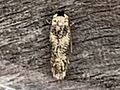
A close-up picture of the Zimmermannia bosquella moth.
