
Yarrow facts for kids
Quick facts for kids Yarrow |
|
|---|---|
.jpg) |
|
| Conservation status | |
Scientific classification  |
|
| Kingdom: | Plantae |
| Clade: | Tracheophytes |
| Clade: | Angiosperms |
| Clade: | Eudicots |
| Clade: | Asterids |
| Order: | Asterales |
| Family: | Asteraceae |
| Genus: | Achillea |
| Species: |
A. millefolium
|
| Binomial name | |
| Achillea millefolium |
|
| Script error: The function "autoWithCaption" does not exist. | |
| Synonyms | |
|
Synonymy
Achillea albida Willd.
Achillea alpicola (Rydb.) Rydb. Achillea ambigua Boiss. Achillea ambigua Pollini Achillea anethifolia Fisch. ex Herder Achillea angustissima Rydb. Achillea arenicola A.Heller Achillea bicolor Wender. Achillea borealis Bong. Achillea californica Pollard Achillea ceretanica Sennen Achillea compacta Lam. Achillea coronopifolia Willd. Achillea crassifolia Colla Achillea cristata Hort. ex DC. Achillea dentifera Rchb. Achillea eradiata Piper Achillea fusca Rydb. Achillea gigantea Pollard Achillea gracilis Raf. Achillea haenkeana Tausch Achillea intermedia Schleich. Achillea lanata Lam. Achillea lanulosa Nutt. Achillea laxiflora A.Nelson Achillea laxiflora Pollard & Cockerell Achillea magna All. Achillea magna L. Achillea magna Haenke Achillea marginata Turcz. ex Ledeb. Achillea nabelekii Heimerl Achillea occidentalis (DC.) Raf. ex Rydb. Achillea ochroleuca Eichw. Achillea ossica K.Koch Achillea pacifica Rydb. Achillea palmeri Rydb. Achillea pecten-veneris Pollard Achillea pratensis Saukel & R.Länger Achillea pseudo-tanacetifolia Wierzb. ex Rchb. Achillea puberula Rydb. Achillea pumila Schur Achillea rosea Desf. Achillea setacea Schwein. Achillea sordida (W.D.J.Koch) Dalla Torre & Sarnth. Achillea subalpina Greene Achillea submillefolium Klokov & Krytzka Achillea sylvatica Becker Achillea tanacetifolia Mill. Achillea tenuifolia Salisb. Achillea tenuis Schur |
|

Script error: No such module "Check for conflicting parameters".


Achillea millefolium, often called yarrow or common yarrow, is a beautiful flowering plant. It belongs to the Asteraceae family, which also includes daisies and sunflowers. This plant can grow up to 1 metre (3+1⁄3 feet) tall. It has small whitish flowers, fern-like leaves, and a strong, spicy smell.
Yarrow naturally grows in cool areas of Europe, Asia, and North America. People have also brought it to places like New Zealand and Australia to feed livestock. This plant has been used for different purposes, including in traditional medicine for a long time.
Contents
- Discovering Yarrow: Plant Description
- Yarrow's Place in Nature: Taxonomy
- Where Yarrow Grows: Distribution and Habitat
- Yarrow in the Ecosystem: Ecology
- Growing Yarrow: Cultivation
- Important Safety Information: Toxicity
- How People Use Yarrow: Uses
- Yarrow in History and Culture
- Images for kids
- See also
Discovering Yarrow: Plant Description


Yarrow is a plant that stands upright and comes back every year. It grows from 0.2–1 metre (8–40 inches) tall. Its roots spread out underground, helping it grow in many places. The leaves grow in a spiral pattern along the stem. The biggest leaves are found near the bottom. They are 5–20 centimetres (2–8 in) long and look like tiny ferns, divided into many small parts.
The flowers grow in flat-topped clusters. Each cluster has 4 to 9 small green leaves called phyllaries. The flowers themselves are usually white or pink. They bloom from March to October. Each cluster has a few ray flowers (like petals) and many tiny disk flowers in the center. Many different insects visit these flowers, helping the plant to reproduce. The small fruits are called cypsela.
Yarrow has a unique spicy smell. This scent stays even when the plant is dry. Some people might find the smell a bit strong.
Yarrow's Place in Nature: Taxonomy
Varieties and Subspecies
Yarrow has many different types, called varieties and subspecies. These are like different versions of the same plant. Some examples include:
- Achillea millefolium subsp. millefolium – found in Europe and Asia.
- Achillea millefolium var. alpicola – found in the western United States and Alaska.
- Achillea millefolium var. californica – found in California and the Pacific Northwest.
The Story Behind the Name: Etymology
The name Achillea comes from an ancient Greek hero, Achilles. Legend says that Achilles used this plant to treat wounds during battles. The second part of its scientific name, millefolium, means "thousand-leaves" in Latin. This name describes its finely divided, fern-like leaves.
Where Yarrow Grows: Distribution and Habitat
Yarrow is found all over the Northern Hemisphere. This includes Europe, Asia, and North America. It can grow from sea level up to 3,500 m (11,500 ft) high in mountains. You often see yarrow in grassy areas and open forests. It likes soil that has been slightly disturbed. The plant grows most actively in the spring.
In North America, you can find both native yarrow and types that were brought from other places. It grows in almost every part of California. Yarrow can produce many plants per acre, with a good dry weight.
People brought yarrow to New Zealand and Australia to feed farm animals. There, it often grows as a common plant along roadsides, in meadows, and fields.
Yarrow in the Ecosystem: Ecology

Yarrow plays a role in its environment. Some birds, like the common starling, use yarrow to build their nests. Studies suggest that adding yarrow to nests might help keep away tiny pests.
Many insects use Achillea millefolium as a food source. For example, the larvae (young) of several moth species feed on it. Some tiny mites can also cause small bumps, called galls, on yarrow plants.
Growing Yarrow: Cultivation


Many plant nurseries grow Achillea millefolium as an ornamental plant. People plant it in gardens of all kinds. It's popular in native plant gardens, gardens that don't need much water (drought-tolerant), and gardens that attract wildlife. Yarrow is a common plant in butterfly gardens. It grows best in sunny spots with soil that drains well. However, it can also grow in less perfect conditions.
Plant Reproduction and Propagation
To grow yarrow from seeds, the seeds need light to sprout. So, they should be planted very shallowly, no deeper than 6 mm (1⁄4 in). The seeds also need a warm temperature, about 18–24 °C (64–75 °F), to germinate. Yarrow plants might not live very long in some places. You can help them live longer by dividing them every other spring. Plant the divided pieces 30 to 46 cm (12–18 in) apart. Be aware that yarrow can spread easily and become an invasive plant in some areas.
Popular Cultivars
Gardeners have developed many special types of yarrow, called cultivars. These cultivars have improved qualities, like different flower colors. Some types are even used as lawns that don't need much water. Popular ornamental cultivars include 'Paprika', 'Cerise Queen', 'Red Beauty', 'Red Velvet', 'Island Pink' (pink flowers), 'Calistoga' (white flowers), and 'Sonoma Coast' (white flowers). There are also many hybrid types, like 'Appleblossom' and 'Moonshine', which are great for gardens.
Important Safety Information: Toxicity
Yarrow can sometimes cause allergic skin rashes in people who touch it.
It's also important to know that yarrow is not safe for pets. According to the American Society for the Prevention of Cruelty to Animals, yarrow is toxic to dogs, cats, and horses. If these animals eat yarrow, it can cause them to vomit, have diarrhea, and get skin problems. If cows eat yarrow, it can make their milk taste bad.
How People Use Yarrow: Uses
Traditional Medicine Uses
For many centuries, A. millefolium was used in traditional medicine. People used it because it could help tighten tissues and had a mild laxative effect. In ancient times, it was used to help heal wounds and stop bleeding. In the 16th century, people would crush the leaves and use them to stop nosebleeds.
Many Native American groups traditionally used yarrow. The Navajo called it a "life medicine." They chewed the plant for toothaches and made teas for earaches. The Miwok people in California used it to help with pain and head colds. Native American nations also used yarrow for cuts, scrapes, sore throats, and as an eyewash. Plains indigenous peoples used it to reduce pain or fever and to help with sleep. Some Ojibwe people would breathe in steam from yarrow leaves placed on hot stones to treat headaches.
Yarrow as Food
People say that the whole yarrow plant is edible and has nutrients. However, it's best not to eat too much because it has a strong, spicy taste. Both the leaves and flowers are bitter. Young leaves can be eaten raw in salads. The leaves also have a flavor like anise and grass, and can be used to make tea.
In the Middle Ages, yarrow was part of a herbal mixture called gruit. This mixture was used to flavor beer before people started using hops. Today, the flowers and leaves are still used to make some liquors and bitters.
Other Practical Uses
Yarrow is a helpful companion plant in gardens. It can attract good insects that help other plants. It also helps keep some pests away.
You can plant A. millefolium to help stop soil erosion. This is because the plant is very good at handling dry conditions. In the past, yarrow was often mixed with grass in pastures. Its deep roots and mineral-rich leaves helped keep farm animals healthy. It was brought to New Zealand for this reason.
Yarrow can also be used to dye wool. Depending on what other chemicals are used, the color can range from green to yellow.
Yarrow in History and Culture
Scientists have found yarrow with Neanderthal burials. This suggests that humans have known about and used this plant for at least 60,000 years.
Yarrow in China
In Chinese tradition, yarrow and tortoiseshell are thought to bring good luck. Dried yarrow stalks are also used in a special way for I Ching divination, which is a method of seeking wisdom.
Yarrow in the Western World
In ancient times, yarrow was known as herba militaris, meaning "soldier's herb." This was because it was used to stop bleeding from wounds. The famous Greek poet Homer wrote about the centaur Chiron teaching the hero Achilles to use yarrow on the battlefields of the Trojan War. This story is why the plant's scientific name, Achillea, honors Achilles. Other old names for yarrow, like bloodwort and soldier's woundwort, also show its historical use in healing.
The English name yarrow comes from an old Saxon word, gearwe. In some places, it was called old man's pepper because of its strong flavor. The name milfoil or thousand leaf refers to its many tiny leaf divisions. In Spanish, it is known as gordaldo. In parts of New Mexico and southern Colorado, it's called plumajillo, which means 'little feather'.
Images for kids
-

Essential oil made from yarrow.
-
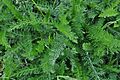
Yarrow can grow a thick mat of soft leaves.
-
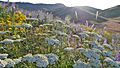
Yarrow growing in the Wenatchee Foothills, Chelan County, Washington.
-
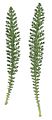
Leaves
-
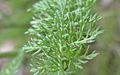
Close-up of leaf
-
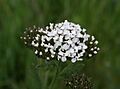
Budding flowers
-
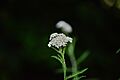
Flower by a pond, United Kingdom
-
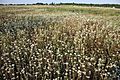
Field of yarrow in Russia
-
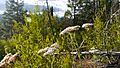
Flowers in Chelan County, Washington
-
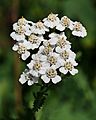
Close-up of flowers
-
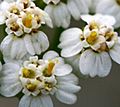
Extreme close-up of flowers
-
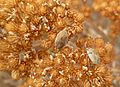
Dry flowers with Hemiptera
-
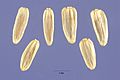
Achenes

.jpg)


.jpg)


See also
 In Spanish: Perejil bravío para niños
