
Asaphodes chionogramma facts for kids
Quick facts for kids Asaphodes chionogramma |
|
|---|---|
 |
|
| Male | |
 |
|
| Female | |
| Scientific classification | |
| Kingdom: | |
| Phylum: | |
| Subphylum: | |
| Class: | |
| Order: | |
| Family: | |
| Genus: |
Asaphodes
|
| Species: |
A. chionogramma
|
| Binomial name | |
| Asaphodes chionogramma (Meyrick, 1883)
|
|
| Synonyms | |
|
|
Asaphodes chionogramma is a type of moth that belongs to the Geometridae family. This special moth is found only in New Zealand.
Contents
Discovering the Moth's Name
This moth was first described by a scientist named Edward Meyrick in 1883. He gave it the name Larentia chionogramma. Later, in 1898, another scientist, George Hudson, wrote about this moth. He called it Xanthorhoe chionogramma in his book New Zealand Moths and Butterflies. Scientists sometimes change names as they learn more about a species.
What Does This Moth Look Like?
Scientists have described the Asaphodes chionogramma moth in detail.
Size and Color
The moth's wings can spread out to about 1 and 1/8 inches wide. Its front wings are a dark greyish-brown color.
Wing Patterns
Near the base of the front wings, you can see many faint wavy lines. These lines are a mix of lighter and darker shades. There is also a wide brown band in the middle of the wing. This band is darker towards the base and has a broken, jagged white line along its edge. Beyond this band, there are more broken lines that are both darker and lighter.
Differences Between Males and Females
The back wings of the moth are a very light greyish-yellow color. They have some cloudy grey spots near the outer edge. Female moths are usually paler than males. Their markings are also less clear or distinct.
Where Does This Moth Live?
The Asaphodes chionogramma moth is endemic to New Zealand. This means it is found nowhere else in the world.
Location in New Zealand
You can find this moth in the South Island of New Zealand. Scientists have collected specimens in areas like Mid Canterbury.
Specific Sightings
Edward Meyrick, the scientist who first described the moth, found it at Mount Hutt. George Hudson also reported seeing this moth at both Mount Arthur and Mount Hutt. They observed these moths during December and January.
Preferred Home
This moth likes to live on the lower parts of mountains. It prefers wooded valleys, which provide a good habitat for it.
Images for kids
-
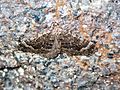
A live A. chionogramma moth.
-
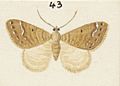
An illustration of a male A. chionogramma.
-
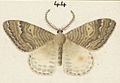
An illustration of a female A. chionogramma.

.jpg)
.jpg)
