
Battle of Leuwiliang facts for kids
Quick facts for kids Battle of Leuwiliang |
|||||||
|---|---|---|---|---|---|---|---|
| Part of Battle of Java in the Dutch East Indies campaign | |||||||
 Bridging work across the Tjianten during the battle |
|||||||
|
|||||||
| Belligerents | |||||||
 Australia Australia United Kingdom United Kingdom United States United States |
 Japan Japan |
||||||
| Commanders and leaders | |||||||
| Arthur Blackburn Blucher S. Tharp |
 Yumio Nasu Jurō Hiroyasu Yumio Nasu Jurō Hiroyasu |
||||||
| Units involved | |||||||
Blackforce
3rd Hussars 2/131st Field Artillery |
2nd Division
|
||||||
| Strength | |||||||
| : c. 1,500: 15 tanks: c. 300 |
c. 3,000 | ||||||
| Casualties and losses | |||||||
| 100 | 500 dead (Allied claim) | ||||||
The Battle of Leuwiliang was an important fight during World War II in the Pacific. It happened between March 3 and 5, 1942, in a place called Leuwiliang, West Java. Australian soldiers, with help from American big guns and British tanks, tried to stop the Japanese army. Their goal was to protect Dutch forces who were trying to escape from the Japanese invasion of Java.
Japanese forces had landed on Java, and the Dutch army was struggling. An Australian military leader, Arthur Blackburn, set up a defense line. It was near a destroyed bridge in Leuwiliang. The Australians fought hard, causing many Japanese casualties. They slowed down the Japanese for three days. But in the end, the Australians had to pull back. They moved towards Buitenzorg and later left that city too. They surrendered after the main Dutch forces gave up on March 8.
Contents
Why the Battle Happened

After winning a battle at sea, Japanese soldiers landed on the island of Java. This happened on March 1, 1942. A main Japanese group, called the Sixteenth Army, landed near Merak. One part of this group was led by Major General Yumio Nasu. Their job was to quickly take over river crossings and the city of Buitenzorg (now Bogor). This would stop the Dutch army from escaping.
About 25,000 Japanese soldiers landed on Java. They faced a similar number of Dutch soldiers. The Japanese didn't meet much resistance when they landed. They quickly captured Serang. Even though the Dutch blew up some bridges, the Japanese reached Rangkasbitung the next morning.
The Australian military group in Java was called the Blackforce. Their leader was Brigadier Arthur Blackburn. They set up their base in Buitenzorg on February 27. Blackforce was supposed to be a mobile reserve. This meant they would be ready to move and help wherever needed. They were stationed at Leuwiliang. The plan was for them to attack the Japanese from behind.
But the Dutch army didn't realize how fast the Japanese were moving. The Japanese got past the Dutch defense line. This forced the Dutch to retreat further. They moved towards Leuwiliang, near the Tjianten River. The Dutch blew up one bridge over the Tjianten River. But they missed another bridge nearby. This made it harder for Blackforce to move and attack. They were forced into a defensive battle. The Japanese knew Leuwiliang was an important spot for defense.
Who Fought in the Battle
The Blackforce had about 3,000 men. But about half of them were not combat soldiers. They were cooks, medics, and drivers. Blackburn divided his men into three groups. The first group was mainly the 2/3rd Machine Gun Battalion. The second group was mostly the 2/2nd Pioneer Battalion. The third group had engineers and soldiers who had escaped from the Battle of Singapore.
They also had help from American soldiers. Three groups of big guns from the 2nd Battalion/131st Field Artillery Regiment supported them. This was the only American ground unit in the Dutch East Indies fight. Their leader was Lt. Col. Blucher S. Tharp. The Blackforce also had fifteen small tanks. These tanks were from the British 3rd Hussars Regiment.
The Pioneer Battalion was the strongest unit in Blackforce. They were placed at the front of Leuwiliang's defenses. They were on the east side of the Tjianten River. Two companies defended the road, and two were kept in reserve. The Machine Gun Battalion was placed on the sides and in supporting spots.
The Japanese force was called the Nasu Detachment. It had two main groups: the 16th Infantry Regiment and the 2nd Reconnaissance Regiment. They also had other support units, like a big gun battalion and a tank group. The 16th Infantry Regiment had about 2,719 men. The Reconnaissance Regiment had 439 men. They used small tanks called Type 97 Te-Ke tankettes.
The Battle Begins

On the afternoon of March 3, Japanese armored cars arrived near Leuwiliang. They found the destroyed bridge. Australian defenders on the other side started firing machine guns and special rifles that could stop tanks. They destroyed the leading Japanese vehicles. The Japanese leader, Noguchi Kin'ichi, sent his soldiers forward. He planned to cross the river south of the destroyed bridge. Then, he wanted to launch a surprise night attack.
But Blackburn, the Australian leader, expected this side attack. He placed the C company from his Machine Gun battalion south of his main positions. An American big gun group supported them. Unfortunately for the Australians, their company commander and two of his four platoon leaders went missing. This happened after they went on an armored car patrol.
Soon, more Japanese soldiers arrived in Leuwiliang. These were mainly from the 16th Infantry Regiment. They made the Japanese position stronger. That afternoon, the American big guns started firing at the back of the Japanese vehicle line. The Japanese quickly fired back with their mortars and big guns. This caused some Australian injuries.
As night came, General Nasu changed Kin'ichi's plan. He decided to use the 16th Regiment for the night attack instead. Nasu thought Kin'ichi's regiment had already fought a lot. The 16th Regiment's commander ordered his 3rd battalion to cross the Tjianten River. This was three kilometers south of the bridge. An artillery company supported them. The 2nd battalion was kept in reserve.
The first Japanese soldiers from the 3rd battalion crossed the river. The rest of the battalion arrived at the crossing point after midnight. A sudden storm had made the river swell. By 5:30 a.m., only two companies had managed to cross. The Australians had seen the Japanese moving south during the night because of lights from their trucks.
As the Japanese tried to attack from the side after crossing the river, the Australian C company opened fire. This caused many Japanese casualties. One of their company commanders was killed, and the regimental commander was hurt. The Japanese sent in their reserve soldiers. They also sent two more companies into the fight. But they couldn't break through the Australian lines at first.
The B company of the Australian Machine Gun Battalion and the A company of the Pioneers also came to help the C company. After more fighting in the nearby rice fields and a lot of firing from Japanese big guns, the Japanese managed to get around the Australians. By 4 p.m., Blackburn told the C company to pull back.
As night fell, Blackburn ordered his soldiers to fire less often. He wanted to make it harder for the Japanese to notice their retreat. They also heard that the Dutch had successfully retreated from Batavia. So, Blackburn ordered a full withdrawal. The Australians finished pulling back by 2:15 a.m. on March 5.
What Happened Next
During the battle, the Blackforce had fewer than 100 casualties. But they believed they had killed 500 Japanese soldiers. The Pioneer Battalion reported killing 300, and the Machine Gun Battalion reported 200. The Japanese, however, said they had 49 casualties in their 16th regiment. This included 28 killed and 21 wounded. No American soldiers were reported injured in the Leuwiliang fight.
After leaving Leuwiliang, the Blackforce went to Buitenzorg. Then they moved further to Sukabumi. They tried to set up a strong defense there. But their units eventually broke apart. They scattered into the hills south of Bandung between March 6 and 7. Within a few days, Japanese soldiers rounded up the survivors.
By March 7, the Japanese had broken through the Dutch defense line in the north. This happened after the Battle of Tjiater Pass. Because of this, the Dutch army decided to surrender. The Dutch army surrendered on March 9. The Blackforce and the American big gun battalion also surrendered then.
Images for kids
-
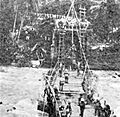
Bridging work across the Tjianten during the battle
-
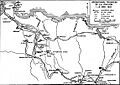
Movement of the 2nd Division during the Battle of Java
-
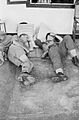
Two men of the Pioneers Battalion resting during the battle, shortly before being sent to reinforce the C company
