
Black kauri facts for kids
Quick facts for kids Black kauri |
|
|---|---|
.jpg) |
|
| Conservation status | |
Scientific classification  |
|
| Kingdom: | Plantae |
| Clade: | Tracheophytes |
| Division: | Pinophyta |
| Class: | Pinopsida |
| Order: | Pinales |
| Family: | Araucariaceae |
| Genus: | Agathis |
| Species: |
A. atropurpurea
|
| Binomial name | |
| Agathis atropurpurea B.Hyland
|
|
| Script error: The function "autoWithCaption" does not exist. | |
Script error: No such module "Check for conflicting parameters".
The black kauri or blue kauri (scientific name: Agathis atropurpurea) is a special type of conifer tree. Conifers are trees that usually have needles and cones, like pine trees. This tree belongs to the Araucariaceae family. You can only find the black kauri growing in Queensland, Australia. Sadly, it is currently facing a threat because its natural home is being lost.
What Does the Black Kauri Look Like?
When a black kauri tree grows very big, its bark turns brown and starts to peel off in loose pieces. At this stage, it can look a lot like another tree called the bull kauri (Agathis microstachya).
However, younger black kauri trees are much easier to spot! Their bark is a unique black, purple, or even navy blue color. It's also smoother and doesn't flake off as much. If the tree gets a cut or a scratch, a sticky, gooey substance called resin might ooze out from the wound.
The leaves of the black kauri are shaped like a spearhead, which is called "lanceolate." They have a pointy tip and thin lines running along them. The male cones, which help the tree reproduce, are small, about 3 centimeters (about 1 inch) long, and have a short stem. The female cones are bigger. They start out green and have many scales, usually between 90 and 150 of them.
Where Does the Black Kauri Live?
The black kauri tree is "endemic" to a specific area. This means it only grows naturally in the coastal mountains of northeastern Queensland, Australia.
You'll typically find these trees growing in rain forests. They prefer to live on mountain ridges that are made of certain types of rock, like granite and rhyolite. They grow at high elevations, usually between 750 and 1,500 meters (about 2,460 to 4,920 feet) above sea level. The area where they live stretches from a place called Mount Pieter Botte all the way south to Mount Bartle Frere.
The forests where black kauri trees live are very rich in other plants. You'll see lots of vines, ferns, mosses, and tiny plants called bryophytes. Other trees that often grow alongside the black kauri include the pimply ash (Balanops australiana), different types of quandong trees (Elaeocarpus species), the tree heath (Trochocarpa bellendenkerensis), and various myrtle trees (Uromyrtus species).
Is the Black Kauri Tree Safe?
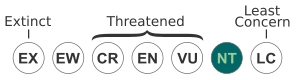
The black kauri is currently listed as "Near Threatened" on the IUCN Red List of Threatened Species. This list helps us understand which plants and animals around the world are at risk of disappearing. "Near Threatened" means that while it's not in immediate danger, its numbers could become threatened in the future if we don't protect it.
In some places where people were allowed to cut down trees, the number of black kauri trees went down. However, many parts of its habitat are now protected. This means that logging is not allowed there, which helps the trees survive. For example, you can see these amazing trees growing safely in the Wooroonooran National Park.
