
Brookesia valerieae facts for kids
Quick facts for kids Brookesia valerieae |
|
|---|---|
| Conservation status | |
Scientific classification  |
|
| Kingdom: | Animalia |
| Phylum: | Chordata |
| Class: | Reptilia |
| Order: | Squamata |
| Suborder: | Iguania |
| Family: | Chamaeleonidae |
| Genus: | Brookesia |
| Species: |
B. valerieae
|
| Binomial name | |
| Brookesia valerieae Raxworthy, 1991
|
|
 |
|
| Script error: The function "autoWithCaption" does not exist. | |
Script error: No such module "Check for conflicting parameters".
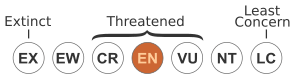
Brookesia valerieae is a tiny type of chameleon. It's a small lizard that belongs to the Chamaeleonidae family. This special chameleon lives only in Madagascar. It was first discovered and described by a scientist named Christopher John Raxworthy in 1991. Sadly, the IUCN says this chameleon is an endangered animal. Its home is disappearing because of a farming method called slash-and-burn agriculture.
Contents
What's in a Name?
The name valerieae was given to this chameleon to honor Valerie M. Raxworthy. She is likely a family member of the scientist who first described the species.
Where Does This Chameleon Live?
B. valerieae is found only in a special place called the Manongarivo Special Reserve. This reserve is in the Diana area of Madagascar. This is the only place in the world where this chameleon naturally lives.
Scientists have only seen this chameleon in the Manongarivo Reserve and near the Ramena River. These two spots are about 7 kilometers (4.3 miles) apart. If the chameleons live in the whole area between these two places, their home could be quite large. However, we don't know for sure if they live everywhere in between.
What Kind of Home Does It Like?
This chameleon prefers to live in forests. It likes to be in places that are about 500 to 700 meters (1,640 to 2,297 feet) above sea level. These forest habitats provide the perfect environment for them to hide and find food.
How Does It Have Babies?
B. valerieae is an oviparous animal. This means that the female chameleon lays eggs. The baby chameleons then hatch from these eggs.
Why Is This Chameleon Endangered?
The International Union for Conservation of Nature (IUCN) has put B. valerieae on its Red List of Threatened Species. This list shows animals that are at risk of disappearing forever. The main reason this chameleon is endangered is because its habitat is being destroyed very quickly.
A big problem is a farming method called slash-and-burn agriculture. This is when forests are cut down and burned to clear land for farming. This destroys the chameleon's home. Some B. valerieae chameleons have also been taken from their homes to be sold as pets. Even though it lives in some protected reserves, this chameleon is not officially a protected species. This means there are no specific laws to keep it safe.
How Scientists Study This Chameleon
The English scientist Christopher John Raxworthy first described B. valerieae in 1991. Since then, other scientists have studied and written about it. For example, scientists like Glaw and Vences, Nečas, and Townsend have all published information about this chameleon. The Integrated Taxonomic Information System (ITIS) confirms that Brookesia valerieae is a real and valid species.
