
Brynmawr Experiment facts for kids
The Brynmawr Experiment was a special project that tried to help people in Brynmawr, South Wales, between 1929 and 1939. It was led by a man named Peter Scott, who had big ideas about solving poverty and unemployment.
This project started as a way for the Quakers (a religious group) in South-East England to help those in need. It grew into something much bigger, first setting up small businesses and then trying to create a way for unemployed workers to grow their own food and make their own goods. This was called "subsistence agriculture," meaning they produced what they needed to live.
The projects received a lot of money from the government and from private donations. However, they almost never made a profit. They finally closed in 1939. The official reason was that many people found jobs in new factories making weapons for the Second World War. But also, the projects couldn't get more loans from banks or the government, so they had to stop.
Contents
Why Brynmawr Needed Help
The 1920s were a tough time for the economy in the South Wales Coalfield, especially in Brynmawr.
Brynmawr is located at the northern edge of the coalfield and didn't have many industries of its own. This meant people often had to travel to other towns for work. When these industries faced problems, workers from Brynmawr were often the first to lose their jobs.
In 1929, a researcher named Hilda Jennings came to Brynmawr. She found many problems. Many jobs depended on nearby coal mines and ironworks. Workers who traveled were often laid off first. Things were even worse because many people had moved away from the town between 1921 and 1931.
By 1932, 1,669 people in Brynmawr were permanently unemployed. Many had been out of work since the big General Strike five years earlier. This led to more sickness, poor housing, and a lot of pressure on the local government's money. Local shops and businesses also suffered, with many going bankrupt because people couldn't find work or pay their bills.
Helping the Community
In 1928 and 1929, a small group of Quakers moved to Brynmawr. They started helping with the most urgent needs. Their work included:
- Giving out used clothes collected from all over the country.
- Organizing clubs and social activities for men, women, and children.
- Starting a nursery school for young children.
- Getting unemployed men to clean up the area and fix buildings.
- Setting up a Community House as a place for everyone to gather.
The Quakers created a Community Council in Brynmawr. They wanted local people to be involved in making decisions about these projects.
..The Community Council does not take over the jobs of the local government or any official group. It works in new ways and in areas where official groups cannot or do not work.
Volunteers from Around the World
The Brynmawr Experiment became known to Pierre Cérésole, who started an organization called Service Civil International. Pierre learned about the project from a fellow Quaker, Jean Inebnit, who taught at the University of Leeds. Pierre and Jean suggested to Peter Scott that volunteers from other European countries could join the Brynmawr project.
An International Work Camp was organized in 1931. A total of 116 volunteers from British universities and from Europe worked together for three months in Brynmawr.

The involvement of international volunteers at Brynmawr is seen by the International Voluntary Service as the moment their organization began.
By the end of 1931, these volunteers had built a swimming pool, a children's paddling pool, and a park. The land for these was given by the Duke of Beaufort. The volunteers contributed a huge amount of work, totaling 47,000 "man-days" (one person working for one day).
The international camp also brought a lot of attention to the work in Brynmawr from newspapers and media around the world.
One of the volunteers who came to Brynmawr was Jim Forrester. He was the son of the Earl of Verulam. Jim Forrester later became very involved in the Brynmawr Experiment.
Starting Local Businesses
Peter Scott had a vision for Brynmawr. He wanted to create small workshops that would provide steady jobs for unemployed workers.
In 1930, an old, unused boot factory was bought. Money was raised to try out different ideas. Once £6,000 was collected, the factory was changed for new uses. At first, they tried weaving Welsh tweed fabric, knitting socks, making furniture, and making boots. Outside the factory, they also started a small coal mine and a chicken farm. All these projects were meant to be run as Co-operatives, where workers shared in the ownership and profits.
Eventually, they decided to focus only on making boots and furniture.
An Order of Friends
In 1934, Peter Scott reorganized a core group of people around him. He called them "An Order of friends." This group eventually separated from the main Quaker committees because they disagreed about money and funding for the projects. Scott believed that the work in Brynmawr could earn its own money. He worked to get money directly from the Government.
The Order of friends owned the projects and was meant to help them, manage money, and promote the work. When the Brynmawr Furniture Makers Ltd and Brynmawr Bootmaking Ltd were set up, they were owned by Order Holdings Ltd. This was a non-profit company run by the Order.
Brynmawr Furniture
In 1929, a talented young furniture designer named Paul Matt joined the work in Brynmawr. He started creating a special style of furniture, even though the first workshop and tools were very basic and shared with the bootmaking business. Their first big order was for 250 oak chairs for a school in Yorkshire. This encouraged them to develop the factory further.
By 1937, the furniture had its own display room in London. It was also sold in large department stores, including some in Cardiff.
Subsistence Production Societies
The final part of Peter Scott's plan for Brynmawr was called The Subsistence Production Societies (SPS). The idea was that if members volunteered their time to the project, they could buy goods and food at a much lower price than in local shops.
In 1936, an agreement was made with the government. Unemployed workers who had insurance could still receive their "dole" payments (unemployment benefits). This was allowed if they volunteered for the SPS and were ready to take a paid job if one became available.
Peter Scott was initially asked to set up several of these societies. However, he only agreed to two. One was near Wigan, and the other was near Brynmawr.
.jpg)
At first, they couldn't find suitable land close to Brynmawr. So, the SPS was set up in the "Eastern Valley." This area included towns like Cwmavon, Cwmbran, Brynmawr, and Llandegveth.
The Old Brewery at Cwmavon was bought and became the main center for activities. It had a bakery, a butcher shop, a factory for making clothes, a cafeteria, and stores where members could buy goods.
Court Perrott dairy farm at Llandegveth was taken over. By 1937, it had 100 Ayrshire cows, pigs, and sheep.
Land at Pontymoile was used to build greenhouses for growing vegetables. Fruit trees were planted at Llwyn-y-llan farm in Trevethin.
At Beili Glas, behind the old Brewery in Cwmavon, pigs were kept, and a small quarry was opened for stone.
In Griffithstown, five fields were used for chickens, pigs, and vegetables. In Pontnewydd, there were beehives and a woodworking shop.
Old buildings were fixed up, and new houses were built.
At its busiest in 1937, there were 400 men in the society. This was about 9% of the unemployed men registered at the Blaenavon and Pontpool job centers at that time. It was decided to expand and create a second SPS by buying two farms closer to Brynmawr and opening another small coal mine.
Who Was Jim Forrester?
James Grimston was the person who would inherit the title of Earl of Verulam. He first came to Brynmawr with the international volunteer camp. Later, he was chosen to lead the SPS as the Area Organizer. He also continued to work in his family's business one week a month.
In Wales, he was commonly known as "Lord Forrester" or simply Jim Forrester.
In 1934, he became the chairman of the SPS. In 1935, he became a director of the Brynmawr Bootmaker factory.
Challenges and Disagreements
Margaret Pitt, writing in 1980, remembered that there had been people who disagreed with the work in Brynmawr from the very beginning.
When she arrived in Brynmawr in 1928, Pitt found that local people didn't trust the Quakers. They didn't want to accept charity. In 1929, a town meeting was held to discuss plans for volunteer work. Some unemployed men said that working for free would make it harder for them to get paid jobs later. Because of this, the Labour party and the Miners' Federation said they were against the plans. They believed all work should be paid at union rates. This meant that those who continued to be involved in the projects risked being ignored or disliked by others.
Later, the factories and the SPS also caused anger. Peter Scott successfully got support and money from the government, the Royal Family, and wealthy business owners. This included the Prince of Wales, Prime Minister Ramsay MacDonald, and former Prime Minister David Lloyd George.
This led to arguments with local Communists, shopkeepers, co-operative stores, and trade unions.
When the Prime Minister praised the work in Brynmawr in a speech, members of the Brynmawr Urban Council wrote back. They said the praise was not deserved, that some of the experimental work had already stopped, and that the other projects weren't very helpful for the unemployed.
The Brynmawr Experiment started and stopped various businesses. This caused unhappiness among those who had lost their jobs and felt left behind. The Order of friends was seen as a "privileged" group that was distant from the community. The management, especially Jim Forrester, was seen as too focused on perfection and making too many decisions on their own.
The End of the Experiment
In 1938, the government opened a military supply depot at Glascoed. This provided jobs for many members of the Subsistence Production Societies. This made it harder for the remaining members to keep the SPS running. In the summer of 1939, most operations stopped because they couldn't get more money from banks. Twenty-eight older men were kept on as paid employees. But by December 1939, all operations stopped. The business was closed down, and its properties were sold.
The SPS had spent nearly £100,000 of government money, plus an additional £50,000 from private donations.
Images for kids
-
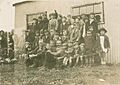
Pierre Cérésole with children at the International Work Camp in Brynmawr, 1931
-
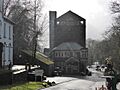
The Old Brewery, Cwmavon – a main site for the Eastern Valley SPS
