
Ceylon tree nymph facts for kids
Quick facts for kids Ceylon tree nymph |
|
|---|---|
 |
|
| Specimen collected by Robert Templeton | |
| Conservation status | |
Scientific classification  |
|
| Kingdom: | Animalia |
| Phylum: | Arthropoda |
| Class: | Insecta |
| Order: | Lepidoptera |
| Family: | Nymphalidae |
| Genus: | Idea |
| Species: |
I. iasonia
|
| Binomial name | |
| Idea iasonia (Westwood, 1848)
|
|
| Script error: The function "autoWithCaption" does not exist. | |
| Synonyms | |
|
|
Script error: No such module "Check for conflicting parameters".
The Ceylon tree nymph (Idea iasonia) is a beautiful butterfly found only in Sri Lanka. It belongs to a group of butterflies called nymphalids. This amazing butterfly was first described in 1848. You can find it in both wet and dry parts of Sri Lanka. It's the biggest butterfly of its kind in the country! Sadly, it's listed as "near threatened," meaning it needs our help to survive.
Contents
Discovering the Ceylon Tree Nymph

The Ceylon tree nymph was first officially described in 1848. An English entomologist, John O. Westwood, gave it the name Hestia iasonia. For a while, people thought it was just a type of another butterfly, I. lynceus, found in Asia.
However, scientists later found important differences. The Ceylon tree nymph has unique wing shapes. Also, the male butterflies have different reproductive parts. These differences showed it was its own special species. It is part of the Idea genus and the Danainae subfamily. Its scientific name is Idea iasonia.
What Does the Ceylon Tree Nymph Look Like?
The Ceylon tree nymph is quite large! Its wings can spread from 110 to 155 millimeters wide. This makes it the biggest butterfly of its kind in Sri Lanka. Both its front and back wings have similar patterns. They are a see-through, silvery-white color.
The front wings are almost twice as long as they are wide. Female butterflies are usually bigger than males. Males also have narrower front wings. The wings of the Ceylon tree nymph are very large compared to its body weight. This special design helps it fly easily and stay in the air for a long time. Butterflies from the dry parts of Sri Lanka are often larger and lighter in color. Those from the wet parts are usually smaller and darker.
Where Do These Butterflies Live?
The Ceylon tree nymph is endemic to Sri Lanka. This means it lives naturally only in Sri Lanka. There are two main groups of these butterflies. One group, which is smaller and darker, lives in the wet zone of Sri Lanka. You can find them from sea level up to about 1,500 meters high. They usually live under the tall trees in tropical rainforests.
The other group is larger and lighter in color. They live in the low-lying dry zone of the country. You can often spot them near rivers or other water sources.
How Do Ceylon Tree Nymphs Behave?
These butterflies are very graceful flyers. They don't need much effort to fly. Their wing beats are so slow that you can easily see each wing move! They spend most of their time flying and floating high up in the tree canopies.
However, they do come down to the ground to eat and to find a mate. They don't rest on the ground, though. Instead, they usually land on the ends of dead branches or twigs.
When it's time to mate, the male and female butterflies fly together. They can fly like this for an hour or more before mating. The male releases special chemicals called pheromones. These chemicals help to attract and stimulate the female. Some of these chemicals are poisonous. They help protect the butterfly from predators. This protection is even passed on to the eggs!
We don't know much about the early life stages of the Ceylon tree nymph. One old record from around 1900 describes the larva (caterpillar). It was said to be "velvety black" with four pairs of long, thin tentacles. Each part of its body had a pale yellow band. The record also mentioned it had twelve body parts. The sixth part had a "large oval crimson spot." Its head and legs were black.
Why Are They Threatened?
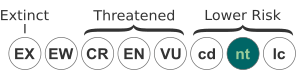
The Ceylon tree nymph is listed as "lower risk/near threatened" on the IUCN Red List. This means it's not in immediate danger, but it could be if we don't protect it. The biggest danger to these butterflies is the destruction of their homes. Their forest habitats are being lost.
Good news! People are taking steps to help save this species. Many of the areas where they live are now protected. For example, the Sinharaja Forest Reserve is a safe place for them.
