
Chickpea facts for kids
Quick facts for kids Chickpeas |
|
|---|---|
 |
|
| Sprouted chickpea | |
Scientific classification  |
|
| Kingdom: | Plantae |
| Clade: | Tracheophytes |
| Clade: | Angiosperms |
| Clade: | Eudicots |
| Clade: | Rosids |
| Order: | Fabales |
| Family: | Fabaceae |
| Genus: | Cicer |
| Species: |
C. arietinum
|
| Binomial name | |
| Cicer arietinum |
|
| Script error: The function "autoWithCaption" does not exist. | |
| Synonyms | |
|
|
Script error: No such module "Check for conflicting parameters".

The chickpea, also known as garbanzo bean, is a super cool plant from the legume family. People grow it for its yummy, edible seeds. You might also hear it called gram, Bengal gram, or chana. Chickpeas are one of the oldest plants humans have ever farmed. The earliest proof of them being grown was found in Syria.
Chickpeas are packed with protein, which is great for your body! They are a main ingredient in many tasty dishes from places like the Mediterranean and Middle Eastern cuisine. Think of creamy hummus or crispy falafel! In Indian cuisine, chickpeas are super popular in salads, soups, stews, and curries. Did you know that in 2023, India grew about 75% of all the chickpeas in the world? That's a lot of chickpeas!
Contents
- Discovering Chickpeas: A Super Bean!
- Gallery
- See also
Discovering Chickpeas: A Super Bean!
What Do Chickpea Plants Look Like?


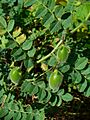
The chickpea plant usually grows to be about 20 to 50 centimeters (8 to 20 inches) tall. It has small, delicate leaves that look a bit like feathers. Its flowers can be white, blue, violet, or pink. Chickpeas are a type of pulse, which means they are edible seeds from a legume plant. Each little seedpod on the plant holds two or three peas.
Different Kinds of Chickpeas
There are two main types of chickpeas:
- Desi Chickpeas: These are very common in places like South Asia, Ethiopia, Mexico, and Iran. They usually grow in warmer, drier areas. Desi chickpeas have small, dark seeds with a rough outer coat. They can be black, green, or speckled. In Hindi, they are sometimes called desi chana ('native chickpea') or kala chana ('black chickpea'). If you remove their outer coat and split them, you get something called chana dal.
- Kabuli Chickpeas: You'll find these more often in the Mediterranean and in the Middle East. They like cooler weather. Kabuli chickpeas are bigger than Desi ones and are usually a light tan color with a smooth coat. They were brought to India in the 1700s from Afghanistan.
The Story Behind the Name: Chickpea Taxonomy
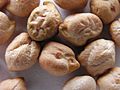
The chickpea's scientific name is Cicer arietinum. It belongs to a group of plants called Cicer and is part of the big legume family, Fabaceae. A famous scientist named Carl Linnaeus gave it this name in 1753. The word Cicer was the old Latin term for chickpeas. The second part, arietinum, means "like a ram" because the seeds look a bit like a ram's head!
Scientists believe that today's farmed chickpeas came from a wild plant called C. reticulatum. This wild plant grows in a small area in what is now Turkey and Syria.
How Chickpeas Became a Farm Favorite: History
Chickpeas have a really long history! They were first grown by humans about 10,000 years ago. This happened around the same time people started farming wheat, barley, peas, and lentils. This was a huge step for early humans, often called the First Agricultural Revolution.
From Wild Plant to Farm Crop
The wild relatives of chickpeas grew in a small area in what is now southeastern Turkey and nearby Syria. Early humans, who used to hunt and gather food, started to notice and then plant these wild chickpeas. We've found evidence of cultivated chickpeas from as far back as 7500 BCE in places like Tell El-Kerkh in Syria.
Over thousands of years, people carefully chose chickpea plants that had bigger, tastier seeds. They also picked plants whose seeds were easy to get out of their pods. They also chose plants that ripened at the same time. This careful selection helped create the different kinds of chickpeas we enjoy today. By the time of the Hellenistic period and the Roman Empire, people were already growing chickpeas in the summer. This helped them avoid plant diseases that often happened in winter.
Where Did the Word "Chickpea" Come From?
The word "chickpea" has a cool history too! It comes from very old words that meant "pea" or "oat." The Latin word for chickpea was cicer, which eventually led to the French pois chiche. This then became chich-pease in Old English.
Another old Greek word, erebinthos, also meant pea. This word eventually became the Spanish garbanzo. This is another common name for chickpeas, especially in American English since the 1700s.
Growing Chickpeas Around the World: Production
 India India |
12.3 |
 Australia Australia |
0.94 |
 Turkey Turkey |
0.58 |
 Russia Russia |
0.53 |
 Ethiopia Ethiopia |
0.45 |
 Myanmar Myanmar |
0.41 |
| World | 16.5 |
| Source: FAOSTAT of the United Nations |
|
Chickpeas are grown all over the world! In 2023, farmers produced about 16.5 million tonnes of chickpeas globally. India was the biggest producer by far, growing about 75% of the world's chickpeas. Australia was another important country for chickpea production.
Helping Chickpeas Grow Strong
To help chickpea plants grow big and strong, farmers pay attention to things like heat and important macronutrients in the soil. These nutrients include phosphorus and nitrogen, which are like food for the plants. For example, giving chickpea seeds enough phosphorus helps the plants grow taller.
However, too much nitrogen can sometimes slow down chickpea growth. Also, just like any other plant, chickpeas can face challenges from tiny organisms like fungi or bacteria. These can make the plants sick. Scientists are always working to find ways to help chickpeas resist these plant diseases and grow even better!
Delicious Ways to Enjoy Chickpeas: Culinary Uses
Chickpeas are super versatile in the kitchen!
- In Spain, they are used in small dishes called tapas, often cooked with spinach. They are also found in hearty stews like cocido madrileño.
- Hummus is a famous dip made from cooked and mashed chickpeas. It's mixed with tahini (sesame paste) and lemon juice. It became very popular in American homes by 2010.
- In the Middle East, roasted and spiced chickpeas are a popular snack called leblebi.
- As one of the most common vegetarian foods in the Indian subcontinent, chickpeas are used in many curries. They are served with bread or steamed rice. Chickpea flour is also used to make treats like mirchi bajji and besan halwa.
- Burmese tofu is made from chickpea flour, especially by the Shan people in Myanmar.
- In South Asian cuisine, chickpea flour (called besan) is used as a batter to coat vegetables before deep-frying to make pakoras. The flour is also used for making the sweet dish Mysore pak.
- Chickpea flour is used as a batter to coat vegetables and meats before frying. It can also be fried alone, such as in panelle, a chickpea fritter from Sicily.
- Chickpea flour is used to make the Italian flatbread farinata (or socca).
- Ashkenazi Jews traditionally serve whole chickpeas, called arbes, at the Shalom Zachar celebration for baby boys. They are boiled until soft and served hot with salt and lots of ground black pepper.
- Guasanas or garbanza is a Mexican chickpea street snack. The beans, while still green, are cooked in water and salt.
- A liquid from chickpeas, called aquafaba, can even be used instead of egg whites to make things like meringue or ice cream!
- Believe it or not, roasted and ground chickpeas were used as a coffee substitute in Europe as far back as 1793. They are still sometimes brewed instead of coffee today.
Chickpeas: A Powerhouse of Nutrition
| Nutritional value per 100 g (3.5 oz) | |
|---|---|
| Energy | 690 kJ (160 kcal) |
|
27.42 g
|
|
| Sugars | 4.8 g |
| Dietary fibre | 7.6 g |
|
2.59 g
|
|
| Saturated | 0.27 g |
| Monounsaturated | 0.58 g |
| Polyunsaturated | 1.16 g |
|
Protein
|
8.86 g
|
| Vitamins | Quantity
%DV†
|
| Vitamin A equiv. |
0%
1 μg |
| Thiamine (B1) |
10%
0.12 mg |
| Riboflavin (B2) |
5%
0.06 mg |
| Niacin (B3) |
3%
0.53 mg |
| Pantothenic acid (B5) |
6%
0.29 mg |
| Vitamin B6 |
11%
0.14 mg |
| Folate (B9) |
43%
172 μg |
| Vitamin C |
2%
1.3 mg |
| Vitamin E |
2%
0.35 mg |
| Vitamin K |
4%
4 μg |
| Minerals | Quantity
%DV†
|
| Calcium |
5%
49 mg |
| Iron |
22%
2.89 mg |
| Magnesium |
14%
48 mg |
| Manganese |
49%
1.03 mg |
| Phosphorus |
24%
168 mg |
| Potassium |
10%
291 mg |
| Sodium |
0%
7 mg |
| Zinc |
16%
1.53 mg |
| Other constituents | Quantity |
| Water | 60.21 g |
|
Link to USDA Database entry
|
|
| †Percentages estimated using US recommendations for adults. | |
Cooked chickpeas are mostly water (60%), with lots of carbohydrates (27%), protein (9%), and a little fat (3%). A 100-gram serving of cooked chickpeas gives you about 690 kilojoules of energy. They are a rich source of important nutrients like folate (43% of your Daily Value) and manganese (45% DV). Cooked chickpeas also provide a good amount of thiamine and several other dietary minerals.
Scientists are studying how eating chickpeas might help improve our nutrition and keep us healthy.
What Happens When We Cook Chickpeas?
When you cook chickpeas, their total protein and carbohydrate content stays about the same. Cooking actually helps your body digest the protein better! Some sugars and minerals can move from the chickpeas into the cooking water. Cooking also reduces the fat content a bit.
Chickpeas contain certain sugars called oligosaccharides. These are hard for humans to digest. They can sometimes cause gas in some people. You can help prevent this by removing the outer skins (husks) from the chickpeas before eating them.
In some parts of the world, young chickpea leaves are consumed as cooked green vegetables. This helps to add extra nutrients to meals.
Chickpeas for Animal Friends
Chickpeas are also a good source of energy and protein for animals. They can be added to the diets of birds and pigs to help them grow and produce eggs. Raw chickpeas have fewer natural inhibitors than other beans. This means they are easier for non-ruminants (animals like pigs and chickens) to digest.
Gallery
-
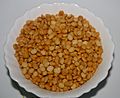
Chana Dal, which are split Bengal gram chickpeas
-
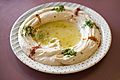
Hummus with olive oil
-
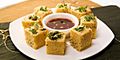
Dhokla, a steamed snack made from chickpea flour
-
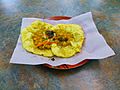
Doubles, a popular street food in Trinidad and Tobago
-
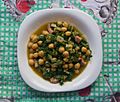
A chickpea and Silene vulgaris stew from Manchego cuisine
-
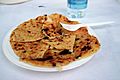
Farinata di ceci, a traditional Italian chickpea snack
-
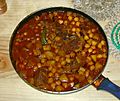
Chakhchoukha in Algerian cuisine; freshly cooked marqa before mixing with rougag
-
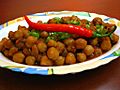
Chana masala, a dish from India
-
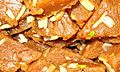
Halua made from chickpeas, from Bangladesh
-
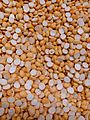
Fried chickpea
-
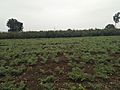
A farm growing chickpeas
-
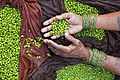
Lime green chickpeas
-
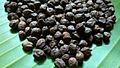
Black chickpeas
-
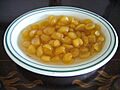
Chickpeas in a honey sauce, a Guatemalan dessert.
-
-
.JPG)


See also
 In Spanish: Garbanzo para niños
- Chickpeas in Nepal
