
Commodore (Royal Navy) facts for kids
Quick facts for kids Commodore |
|
|---|---|

Insignia shoulder board and sleeve lace for commodore
|
|

Flag of a commodore, Royal Navy
|
|
| Country |  United Kingdom United Kingdom |
| Service branch | |
| Abbreviation | Cdre |
| Rank | One-star |
| NATO rank | OF-6 |
| Formation | 1674 |
| Next higher rank | Rear admiral |
| Next lower rank | Captain |
| Equivalent ranks |
|

A Commodore (often shortened to Cdre) is an important officer rank in the Royal Navy, the United Kingdom's navy. This rank is higher than a Captain but lower than a Rear Admiral. In the NATO military alliance, the Commodore rank is known as an OF-6, which helps compare ranks across different countries. This rank is similar to a Brigadier in the British Army and the Royal Marines, and an Air Commodore in the Royal Air Force.
For many years, "Commodore" was more of a job title than a permanent rank. It was given to a senior officer who was in charge of a group of at least two naval ships for a temporary mission. This meant an officer could be a Commodore for a specific task, even if their permanent rank was lower. However, since 1997, Commodore has become a permanent, official rank in the Royal Navy.
Contents
A Look at Commodore History
The rank of Commodore was first used in November 1674. However, it didn't become a legally recognized rank until 1806. In 1684, the navy started using two types of commodores: "Commodore Distinction" and "Commodore Ordinary." These later became known as commodores of the first and second class. In 1734, the title of commodore was officially approved.
By 1826, these two classes were formally separated. First-class commodores were those who had other captains working under them. Second-class commodores were those who commanded their own ships.
Before 1864, the Royal Navy used different coloured flags for its squadrons. These flags were also used by commodores. In 1864, these coloured flags were removed. The white broad pennant with the Cross of St George became the command flag for first-class commodores. They wore the same sleeve lace as rear admirals. A white broad pennant with a red ball was introduced for second-class commodores.
Since 1958, the role of commodore first class has not been used. Now, all Royal Navy commodores use the pennant with a single red ball. Modern commodores wear the sleeve lace that was previously worn by second-class commodores.
As mentioned, Commodore became a permanent rank in the Royal Navy only in 1997. Before this, it was a special appointment given to senior captains for specific jobs. For example, the senior officer in charge of destroyers in a fleet might be called "Commodore (D)." Similarly, the senior officer leading submarines could be called "Commodore (S)." These were important roles, but they were temporary titles, not permanent ranks. During World War I, the officer commanding torpedo boat groups was known as "Commodore (T)."
How to Identify a Commodore: Insignia and Flags
Commodores in the Royal Navy have special insignia to show their rank. Their sleeve lace consists of a 45-millimetre-wide band of gold lace. Above this, there is a circle of 13-millimetre-wide lace, also 45 millimetres in diameter.
They also have a unique command flag. This flag helps other ships and personnel identify that a commodore is in command.
-
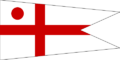
This is the command flag used by a Commodore.
-

This image shows the sleeve lace worn by a Commodore.
_OF-6.svg)
Related Ranks and Further Reading
If you're interested in learning more about military ranks, here are some related topics:
- British and U.S. military ranks compared
- Air commodore
- Commodore-in-Chief
- Comparative military ranks
- Royal Navy officer rank insignia
- United States one-star rank
