
Royal Marines facts for kids
Quick facts for kids Royal Marines |
|
|---|---|

|
|
| Active | 28 October 1664 – present (361 years, 11 months) |
| Country |  United Kingdom United Kingdom |
| Type | Marines |
| Role | Amphibious warfare Special operations |
| Size | 5,820 as of 1 April 2022[update]
|
| Part of |  His Majesty's Naval Service His Majesty's Naval Service |
| Nickname(s) | "Royals" "Bootnecks" "The Commandos" "Jollies" |
| Motto(s) | Per Mare, Per Terram (Latin) (English: "By Sea, By Land") |
| Colours | Royal Navy Blue Old Gold Light Infantry Green Drummer Red |
| March | Quick: "A Life on the Ocean Wave" Slow: "Preobrajensky" |
| Engagements |
See list
Second Anglo-Dutch War
Third Anglo-Dutch War Williamite War in Ireland War of the Spanish Succession War of Jenkins' Ear Seven Years' War American Revolutionary War French Revolutionary Wars War of 1812 Battle of Berbera Napoleonic Wars Crimean War First Opium War Second Opium War Indian Rebellion Māori Wars Anglo-Satsuma War Expedition to Abyssinia Anglo-Ashanti wars Anglo-Egyptian War Mahdist War Second Boer War Boxer Rebellion First World War Russian Civil War Second World War
|
| Commanders | |
| Head of the Armed Forces and Captain General |  King Charles III King Charles III |
| First Sea Lord and Chief of the Naval Staff |  General Sir Gwyn Jenkins General Sir Gwyn Jenkins |
| Second Sea Lord and Deputy Chief of the Naval Staff |  Vice Admiral Paul Beattie Vice Admiral Paul Beattie |
| Commandant General |  General Sir Gwyn Jenkins General Sir Gwyn Jenkins |
| Insignia | |
| Non‑ceremonial flag |
 |
| Identification symbol |
 |
The Royal Marines are a special military force in the United Kingdom. They are part of the Royal Navy and are experts at fighting on both land and sea. Their main job is to carry out special operations and lead attacks from the water. They also provide skilled teams for landing craft and military bands. This brave group started way back on October 28, 1664. The first Royal Marines commando unit was formed in 1942.
The Royal Marines have fought in many conflicts around the world. Instead of listing individual battle honors, they were given the "Great Globe Itself" in 1827. This award recognized their service in battles all over the world. Today, the Royal Marines include the United Kingdom Commando Force, the Royal Marines Band Service, their training center, and four reserve units.
Contents
History of the Royal Marines
How the Royal Marines Started
The Royal Marines began on October 28, 1664. They were first known as the "Duke of York and Albany's Maritime Regiment of Foot." This unit was created to help fight in the Second Anglo-Dutch War. It was one of the first marine units in Europe.
In 1690, two more marine regiments were formed. They helped with a landing in Cork, Ireland. Later, from 1702 to 1713, they fought in the War of the Spanish Succession. A very important moment was their help in the capture of Gibraltar in 1704.
Serving the British Empire
In 1755, His Majesty's Marine Forces were officially formed. They had fifty companies and were controlled by the Admiralty. These Marines served in many landings across the globe. A famous landing was at Belle Île in 1761. They also fought in the American Revolutionary War, including the Battle of Bunker Hill.

In 1788, a group of Marines traveled with the First Fleet to start a new colony in Botany Bay in Australia.

In 1802, King George III gave them the title "Royal Marines." This was to honor their excellent service. In 1804, a special unit called the Royal Marines Artillery (RMA) was created to handle cannons. They wore blue uniforms. The infantry Marines wore red uniforms and were sometimes called "Red Marines."
During the Napoleonic Wars, Royal Marines were on almost every Royal Navy ship. They helped keep order and fought in battles at sea. They also took part in many land attacks. They fought in the War of 1812 in America, including the Battle of Bladensburg and the Battle of New Orleans.
In 1855, the infantry Marines were renamed the Royal Marines Light Infantry (RMLI). They were known for being quick and agile in battle. They fought in the Crimean War and earned three Victoria Cross medals for their bravery. They also served in the First Opium War and Second Opium War against China. Royal Marines played a big part in the Boxer Rebellion in China in 1900, where another Marine earned a Victoria Cross.
Royal Marines in World Wars
First World War Service
During the First World War, Royal Marines served on ships as usual. They also joined the Royal Naval Division and fought in Belgium in 1914. They took part in the Battle of Gallipoli in 1915, where they were among the last to leave. They also helped in the Zeebrugge Raid in 1918. Five Royal Marines earned the Victoria Cross during this war.
Between the Wars
After the First World War, the Royal Marines helped in Russia. In 1923, the Royal Marine Artillery and Royal Marine Light Infantry units joined together. This made the Corps smaller but stronger. The title "Royal Marines" was then used for the entire group.
Second World War Efforts

In Second World War, Royal Marines were among the first to land in Norway in 1940. They also formed the Royal Marines Division, which was trained for amphibious attacks. This division helped capture Madagascar.
Many Royal Marines units were reorganized into Commandos in 1942. These Commandos joined other British Army Commandos. They played a huge role in the D-Day invasion in June 1944. Royal Marines Commandos fought in places like Tunisia, Sicily, the Rhineland, and Burma. They were also key in the Battle of the Scheldt.


After the war, the Royal Marines continued their commando role. One Marine, Corporal Thomas Peck Hunter, earned the Victoria Cross in Italy during the war.
Modern Royal Marines Operations
After 1945, the Royal Marines became the main force for commando training in Britain. They have been involved in operations around the world almost every year since 1942. In 1956, they were the first military unit to use helicopters to land troops during an attack in the Suez Crisis.

During the Cold War, Royal Marines were ready to help NATO in northern Norway. They trained there every year.
Royal Marines also fought in the Korean War in the 1950s. They received a special award from the United States for their bravery. They also served in the Malayan Emergency and the Indonesia–Malaysia confrontation in Borneo. In 1964, they helped stop a mutiny in the Tanzanian Army.

From 1969 onwards, Royal Marine units regularly served in Northern Ireland during The Troubles. In 1982, they played a central role in the Falklands War. They landed on the islands and marched across to the capital, Stanley, helping to retake them.

In the 1991 Gulf War, Royal Marines served as boarding parties on ships. They also helped Iraqi Kurds in northern Iraq. Since 2000, the Royal Marines have updated their methods with the "Commando 21" concept. They now use armored vehicles like the Viking.
Current Status and Deployment
Royal Marines Personnel

The Royal Marines are part of His Majesty's Naval Service. They follow the same rank structure as the British Army. Officers and other recruits train together at the Commando Training Centre Royal Marines (CTCRM).
Each year, about 26,000 people apply to join the Royal Marines. However, only around 400 successfully complete the tough training.

At their largest during the Second World War, over 70,000 men served. After the war, the number dropped to 13,000. When national service ended in 1960, they became an all-commando-trained force of 9,000. As of January 1, 2021, there were 5,968 regular Royal Marines. Including reserves, the total was about 6,500. They are the only British force that can carry out large-scale amphibious operations.
Royal Marines Equipment
Light Weapons
The main rifle for the Future Commando Force is the KS-1 (L403). Some special units use the MCX. Other Royal Marines still use the 5.56 mm L85A2 rifle. For heavier fire, they use the L7A2 General Purpose Machine Gun.
Snipers use the Accuracy International L96 rifle. The L129A2 is used as a designated marksman rifle. Other weapons include Javelin anti-tank missiles, NLAW anti-tank missiles, the L131A1 pistol, and the Fairbairn–Sykes fighting knife.
Vehicles
The Royal Marines do not have heavy tanks. Instead, they use light, fast vehicles for landing and quick deployment. Their main armored vehicle is the BvS 10 Viking All Terrain Armoured Vehicle. They also use Land Rover Wolf and Jackal 2 patrol vehicles.
Artillery
Artillery support comes from the British Army's 29th Commando Regiment Royal Artillery. They use the L118 Light Gun, which is a 105 mm cannon. This regiment is also commando-trained.
Aviation Support
The Commando Helicopter Force helps the Royal Marines with transport. They use Merlin HC4/4A helicopters for medium-lift transport and Wildcat AH1 helicopters for light transport and scouting. The Royal Air Force provides Chinook heavy-lift and Puma HC2 medium-lift helicopters. The British Army provides Apache AH-64E attack helicopters.
Vessels
The Royal Marines use many types of boats to move troops and supplies from ships to shore. They also use them for river patrols. These include the Mk10 Landing Craft Utility and the Mk5b Landing Craft Vehicle Personnel. The Special Boat Service uses fast interceptor craft and shallow water combat submersibles. Smaller boats like the Offshore Raiding Craft and Rigid Raider are also used.
Organisation of the Royal Marines
Command Structure
King Charles III is the overall head of the Royal Marines. He is also the Captain General Royal Marines. King Charles was announced as the new Captain General in October 2022. The Fleet Commander is in charge of the Royal Marines' daily operations.
The Royal Marines have several large units, with seven called "commandos":
- Commando Units
- Maritime Security
- 42 Commando (known as Four Two Commando) based in Plymouth, England.
- Nuclear Deterrent Protection
- 43 Commando Fleet Protection Group based at HM Naval Base Clyde, Scotland.
- Intelligence, Surveillance and Target Acquisition
- 30 Commando Information Exploitation Group based in Plymouth.
- Surveillance and Reconnaissance Squadron (SRS)
- Brigade Patrol Troop
- Surveillance and Reconnaissance Squadron (SRS)
- 30 Commando Information Exploitation Group based in Plymouth.
- Raiding
- 47 Commando (Raiding Group) based in Devonport.
- Logistic Support
- 48 Commando Support Group based in Devon.
- Viking Squadron operates the BvS 10 All Terrain Vehicle. It is based in Dorset.
- 48 Commando Support Group based in Devon.
Most of these units are led by a lieutenant-colonel.
UK Commando Force
The United Kingdom Commando Force oversees the five commandos and the 48 Commando Support Group. This headquarters manages operations as directed by higher command.
Other Important Elements
Other parts of the Royal Marines include:
_board_the_destroyer_USS_O%27Bannon_(DD_987)_during_a_Maritime_Interdiction_Operation_(MIO)_training_evolution.jpg)
- Commando Training Centre: This is where all Royal Marines get their training. It has sections for basic commando training, specialist skills, and leadership training for officers and non-commissioned officers.
- Royal Marines Band Service: These bands play music for the Royal Navy. Their members also have important roles as medics or other support staff. Until 2017, the band service was the only part of the Royal Marines that accepted women.

How a Commando Unit is Organized
A commando unit, like 40 or 45 Commando, is divided into six companies. These companies are then split into smaller teams called troops.
- A Command company handles headquarters, scouting, and heavy weapons.
- Two Close Combat Companies focus on direct fighting.
- Two Stand Off Companies also have heavy weapons and close combat teams.
- A Logistic Company provides support like repairs and medical help.
Royal Marines usually work in four-person "fire teams." These small teams are the basic building blocks of commando operations.
Royal Marines and Flying
Royal Marines officers and non-commissioned officers can also become pilots in the Fleet Air Arm. This includes flying helicopters for the Commando Helicopter Force (CHF) and even fast jets.
The CHF has three helicopter squadrons. It includes both Royal Navy and Royal Marines personnel. The CHF supports Commando units when needed. They use Merlin HC4/4A and Wildcat AH1 helicopters.
Future Commando Force Programme

In 2017, the Royal Marines began a new plan called the Future Commando Force (FCF) Programme. This program aims to make the Royal Marines even more capable of special operations. Under the FCF, the Royal Marines Commandos are taking on many tasks traditionally done by the SAS and SBS.
As part of this program, two Littoral Response Groups have been established. One is based East of Suez and the other in the High North. In June 2020, the Royal Marines adopted a new uniform with MultiCam camouflage.
Becoming a Royal Marine
The Selection Process

Becoming a Royal Marine Commando involves one of the longest and toughest infantry training courses in the world. Recruit training lasts 36 weeks for regular Marines and 64 weeks for officers. Applicants must be between 16 and 32 years old (18 to 25 for officers). They go through interviews, medical checks, fitness tests, and a candidate preparation course. If successful, they begin training at the Commando Training Centre Royal Marines (CTCRM) in Lympstone, UK. Much of the training takes place on tough terrains like Dartmoor.

Intensive Training
During training, recruits learn many skills. These include handling weapons, shooting, close combat, demolition, scouting, small team tactics, and boat operations. They also develop incredible physical fitness and mental strength. Other skills include survival, mountaineering, fast-roping from helicopters, first aid, navigation, and amphibious landings.
The best recruit in each group can earn the King's Badge. This special badge is given only if a recruit meets very high standards.
After training, Royal Marines can specialize in different roles. These include mountain leader, sniper, medical assistant, pilot, and many others. They also train regularly in mountain, arctic, jungle, and desert warfare. They sometimes train with forces from other countries, like the United States Marine Corps and the Netherlands Marine Corps.
Royal Marines Museum
The Royal Marines Museum was started in 1958. It tells the story of the Royal Marines. In 2011, it became part of the National Museum of the Royal Navy. The museum is moving to the Portsmouth Historic Dockyard.
Royal Marines Customs
Proud Traditions
The Royal Marines have a rich history and special traditions. Unlike many army regiments, their flags do not show individual battle honors. Instead, they have the "globe itself" as their symbol. This globe represents their service in battles all over the world. It also inspired the globe in the United States Marine Corps' insignia.
The Royal Marines' badge shows a Lion and Crown, meaning they are a Royal regiment. King George III gave them this honor in 1802. The globe was chosen in 1827 by King George IV. The laurels honor their bravery during the capture of Belle Île in 1761. The word Gibraltar refers to their capture of Gibraltar in 1704 and its defense during a long siege. Their motto, "Per Mare Per Terram," means "By Sea By Land" in Latin. This motto describes their ability to fight both on ships and on land. The fouled anchor on their emblem shows they are part of the Naval Service.
The Royal Marines' quick march is "A Life on the Ocean Wave." Their slow march is the march of the Preobrazhensky Regiment.
.jpg)
Royal Marines Uniforms
Royal Marines uniforms are similar to those of the British Army. However, they have unique items. These include the green "Lovat" service dress and the green beret for those who passed commando training. Those who haven't wear a navy blue beret with a scarlet patch. Their parade uniform is dark blue, worn with a white helmet or peaked cap. Officers and senior non-commissioned officers wear scarlet and blue mess dress.
Ranks and Insignia
The Royal Marines use the same ranks as the British Army. However, when they are part of a Navy ship or base, they follow Naval rules. Officers wear the same rank badges as the Army, but they are slightly smaller. Officers below the rank of colonel also wear "RM" below their badges.
The lowest rank for a Royal Marine is simply "Marine."
| Rank group | General officers | Field officers | Junior officers | Officer cadets | |||||||
|---|---|---|---|---|---|---|---|---|---|---|---|
| NATO code | OF-9 | OF-8 | OF-7 | OF-6 | OF-5 | OF-4 | OF-3 | OF-2 | OF-1 | N/A | |
| Insignia |  |
 |
 |
 |
 |
 |
 |
 |
 |
 |
.svg) |
| Rank | General | Lieutenant-general | Major-general | Brigadier | Colonel | Lieutenant colonel | Major | Captain | Lieutenant | Second lieutenant | Officer cadet |
| Abbreviation | Gen | Lt Gen | Maj Gen | Brig | Col | Lt Col | Maj | Capt | Lt | 2Lt | OCdt |
| Rank group | Warrant officers | Senior NCOs | Junior NCOs | Marines | |||||
|---|---|---|---|---|---|---|---|---|---|
| NATO code | OR-9 | OR-8 | OR-7 | OR-6 | OR-5 | OR-4 | OR-3 | OR-2 | |
| Insignia |  |
_OR-9.svg) |
_OR-8.svg) |
 |
 |
 |
 |
No insignia | |
| Typical appointment | Corps regimental sergeant major | Regimental sergeant major | Regimental quartermaster sergeant / company sergeant major |
Company quartermaster sergeant | |||||
| Rank | Warrant officer class 1 | Warrant officer class 2 | Colour sergeant | Sergeant | Corporal | Lance corporal | Marine | ||
| Abbreviation | WO1 | WO2 | CSgt | Sgt | Cpl | LCpl | Mne | ||
Captain General
The Captain General Royal Marines is a special ceremonial role. King Charles III currently holds this position. The Captain General wears the uniform and badges of a field marshal.
| Rank | Insignia |
|---|---|
| Captain General Royal Marines |  |
Friends and Allies
Argyll and Sutherland Highlanders
The Royal Marines have a long friendship with the Argyll and Sutherland Highlanders regiment. This connection grew stronger during the Second World War. When two battleships were sunk in 1941, the surviving Marines and Highlanders formed a group called 'The Plymouth Argylls'.
Princess of Wales's Royal Regiment
The Princess of Wales's Royal Regiment also has ties to the Royal Marines. One officer from each group serves with the other. All ranks in the PWRR wear the Royal Marine Lanyard on some uniforms.
United States Marine Corps
The Royal Marines and the United States Marine Corps are very close. They train and fight together often. They even have an exchange program where Marines from each country serve with the other's training units.
Netherlands Marine Corps
The Royal Marines also have strong links with the Royal Netherlands Marine Corps. They train together in NATO exercises. Units from the Netherlands Marine Corps are fully integrated into the Royal Marines' 3 Commando Brigade. This creates a powerful combined force.
Images for kids
-
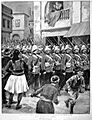
Royal Marines marching through the streets of Chania, Crete, in 1897.
-

Royal Marines equipped for Arctic warfare during an exercise in Norway
-
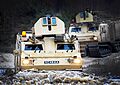
BvS 10 Vikings of the Viking Squadron on exercise
-

Royal Marines Landing Craft Utility (LCU) Mk10
-

A Royal Marines Landing Craft Vehicle Personnel (LCVP) Mk5
-

Royal Marines Landing Craft Air Cushion (LCAC)


_Hovercraft_MOD_45154442.jpg)
See also
- Royal Marines selection and training
- Royal Marines Reserve
- Royal Marines Museum
- Royal Marines Cadets
- Royal Marines Volunteer Cadet Corps
- List of active Royal Marines military watercraft
- List of serving senior officers of the Royal Marines
