
Battle of Bunker Hill facts for kids
Quick facts for kids Battle of Bunker Hill |
|||||||||
|---|---|---|---|---|---|---|---|---|---|
| Part of the American Revolutionary War | |||||||||
 The Death of General Warren at the Battle of Bunker's Hill, June 17, 1775 John Trumbull, 1786 |
|||||||||
|
|||||||||
| Belligerents | |||||||||
 Great Britain Great Britain |
|||||||||
| Commanders and leaders | |||||||||
|
|
||||||||
| Strength | |||||||||
| c. 2,400 | 3,000+ | ||||||||
| Casualties and losses | |||||||||
|
|
||||||||

The Battle of Bunker Hill was a major fight during the early days of the American Revolutionary War. It happened on June 17, 1775, near Boston, Massachusetts. Even though it's called Bunker Hill, most of the fighting actually took place on a nearby spot called Breed's Hill.
American colonists were trying to surround and control Boston, where British soldiers were stationed. On June 13, 1775, the American leaders found out that the British planned to take over the hills around Boston Harbor. These hills were important because they offered a good view and control of the harbor.
To stop this, about 1,200 American soldiers, led by William Prescott, secretly moved onto Bunker Hill and Breed's Hill. Overnight, they quickly built a strong fort, called a redoubt, on Breed's Hill. They also made smaller defense lines across the Charlestown Peninsula.
When the sun rose on June 17, the British saw the new American defenses. They quickly launched an attack. The British tried to storm the American positions twice, but the colonists fought them off, causing many British casualties. On their third try, the British finally captured the fort. The American soldiers then had to retreat.
The British won the battle, but it was a very expensive victory for them. They lost many more soldiers than the Americans, including many officers. This battle showed that ordinary American militia could bravely fight against experienced British regular soldiers. It also made the British more careful about attacking strong enemy positions head-on in the future. The Americans lost fewer soldiers, but among them was a respected leader, General Joseph Warren.
Contents
Understanding the Battleground: Boston's Geography

In 1775, Boston was mostly surrounded by water, like an island connected by a narrow strip of land. British warships controlled the waters, making it hard for American forces to get close. After the battles of Lexington and Concord, about 15,000 American militia surrounded Boston. They controlled the land entrance but couldn't challenge the British navy.
About 6,000 British soldiers, led by General Thomas Gage, occupied Boston. They could easily get supplies and more soldiers by sea. However, there were hills across the water from Boston. These hills were perfect for placing artillery (cannons) to fire at the city. This is why Henry Knox later brought cannons from Fort Ticonderoga to Boston.
North of Boston was the Charlestown Peninsula. It was connected to the mainland by a thin strip of land called the Charlestown Neck. Bunker Hill was about 110 feet (34 meters) high, at the northern end of this peninsula. Breed's Hill, which was 62 feet (19 meters) high, was closer to Boston. The town of Charlestown was at the southern tip of the peninsula.
The height of Breed's Hill and Bunker Hill gave the American soldiers a good defensive position. However, it also meant they could easily get trapped there. After retreating from Concord, the British had left the Charlestown Peninsula undefended. This made it a "no man's land" before the battle.
British Plans and American Response
By May 1775, the British forces in Boston grew to about 6,000 soldiers. Important generals like William Howe, John Burgoyne, and Henry Clinton arrived to help General Gage. They made a plan on June 12 to break out of Boston. Their idea was to first secure areas south of Boston, then take the Charlestown hills, and finally push back American forces in Cambridge. The attack was scheduled for June 18.
However, American leaders got a tip-off! On June 13, the Committee of Safety in New Hampshire heard about the British plans. They quickly warned the Massachusetts leaders. Knowing the British wanted to take the Charlestown hills, the Americans decided they needed to act first. On June 15, General Ward ordered General Israel Putnam to build defenses on the Charlestown Peninsula, especially on Bunker Hill.
Preparing for Battle: Fortifications and Reinforcements
Building Defenses on Breed's Hill

On the night of June 16, Colonel William Prescott led about 1,200 American soldiers onto the Charlestown Peninsula. Their goal was to set up cannons that could fire into Boston. After some discussion, they decided to build their main fort, a square redoubt, on Breed's Hill because it was closer to Boston and easier to defend.
Prescott's men worked all night, digging ditches and building earthen walls about 6 feet (1.8 meters) high. Inside the fort, they built wooden platforms so soldiers could stand and shoot over the walls.
The British quickly noticed the new fort at dawn on June 17. A British ship, the Lively, started firing, briefly stopping the American work. General Gage then ordered all 128 British cannons in the harbor and on Copp's Hill to fire at the American position. However, the American fort was high enough that most of the shots missed or did little damage. Still, one American soldier was killed, and their water supply was destroyed.
Prescott realized his fort could be easily attacked from the sides. He quickly ordered his men to build a long dirt wall, called a breastwork, extending down the hill to the east.
British Prepare for Attack
The British generals met to plan their response. General Clinton wanted to cut off the American retreat by attacking the narrow Charlestown Neck. But the other generals disagreed. General Howe, who was in charge, believed the hill was "open and easy" to capture. General Burgoyne agreed, thinking the "untrained rabble" (American militia) would be no match for their "trained troops."
General Gage watched the American defenses from Boston. A Loyalist (someone loyal to Britain) recognized Colonel Prescott and told Gage that Prescott was a fierce fighter.
It took the British six hours to get their soldiers ready. General Howe would lead the main attack, trying to go around the American left side. Brigadier General Sir Robert Pigot would lead a direct attack on the fort. Major John Pitcairn would lead a reserve force.
About 1,500 British soldiers were transported by boats to Moulton's Point on the peninsula. By 2 p.m., they had landed. Howe saw many American troops on Bunker Hill and asked for more British soldiers. He then ordered some light infantry to move forward, showing the Americans where they planned to attack. The British soldiers then rested and ate while waiting for reinforcements.
Americans Strengthen Their Positions

Colonel Prescott saw the British getting ready and called for more American soldiers. Important leaders like Joseph Warren and Seth Pomeroy arrived, choosing to fight as regular soldiers. Prescott ordered the Connecticut troops, led by Captain Thomas Knowlton, to defend the left side. They used a simple dirt wall, reinforced with fence rails and hay, as a defense.
More soldiers from New Hampshire, led by Colonels John Stark and James Reed, arrived. Stark's men quickly extended the defenses to the water's edge. Colonel Stark gave a famous order: "Don't fire until you see the whites of their eyes!" This meant they should wait until the British were very close to make every shot count.
Behind the American lines, there was some confusion. Many units struggled to cross the Charlestown Neck because it was under constant British fire. General Putnam tried to organize things, but some commanders misunderstood or ignored orders. Despite this, more American troops arrived just before the battle began.
The British Assault

By 3 p.m., British reinforcements had arrived, including the 47th Regiment and the 1st Marines. General Pigot's forces were gathering near Charlestown village, taking fire from American snipers. General Howe asked Admiral Graves to clear out the snipers. Graves ordered a special cannonball to be fired into the village, then sent a landing party to set the town on fire. The smoke from Charlestown created a dramatic backdrop to the battle.
First Attack
General Howe led his light infantry and grenadiers against the American left flank, expecting an easy victory. His soldiers marched in columns along the narrow beach and in the center. General Pigot's forces were to pretend to attack the main fort.
The British faced several challenges. Their cannons had the wrong ammunition, delaying the attack. They had to march through tall grass and over fences, which broke up their formations. The soldiers wore heavy wool uniforms in the hot afternoon sun, and the burning town nearby made it even hotter.
The American colonists waited until the British were very close, about 50 paces away, before firing. Their shots caused heavy casualties. The British light infantry quickly retreated. General James Abercrombie, leading the Grenadiers, was fatally wounded. Pigot's attacks on the fort also failed, and he ordered a retreat. The first British attack resulted in 96 soldiers killed.
Second Attack
The British soldiers regrouped and attacked again. This time, Pigot's forces directly attacked the fort. Howe again advanced against the American left flank.
The second attack ended much like the first. British soldiers faced intense fire and suffered huge losses. One British observer wrote that many companies lost "three-fourths, and many nine-tenths, of their men." Pigot's attack also failed, and he ordered another retreat after about 30 minutes.
Meanwhile, confusion continued among the American forces. They were running low on gunpowder and ammunition. Many soldiers started to leave. By the time of the third attack, only about 700-800 men remained on Breed's Hill, with only 150 inside the main fort.
Third and Final Attack

Howe asked General Clinton for more troops. Clinton sent about 400 men and joined the battle himself to help rally the soldiers. He also convinced about 200 wounded soldiers who could still walk to join the third attack.
For this final assault, Howe ordered his men to remove their heavy packs and unnecessary gear. He arranged his forces in a tighter column formation, which meant fewer men were exposed to American fire at the front. This third attack focused directly on the main fort, with only a small diversion on the American flank.
The British charged with bayonets fixed. The Americans, having run out of ammunition, were forced into hand-to-hand combat. The British had an advantage because most of their muskets had bayonets, while most American soldiers did not. Colonel Prescott, one of the last to leave the fort, used his ceremonial sword to defend himself.
The British captured the fort, killing about thirty American defenders. During the retreat, General Joseph Warren was shot and killed. British ships fired cannons at the Charlestown Neck, killing more Americans, including Major Andrew McClary.
The American forces along the rail fence, led by John Stark and Thomas Knowlton, managed an organized withdrawal. This prevented the British from completely surrounding the hill. Most of the wounded Americans were saved. General Putnam tried to regroup the troops on Bunker Hill, but the retreat was too fast. Cannons and digging tools were left behind. By 5 p.m., the Americans had retreated to Cambridge, and the British controlled the peninsula.
Aftermath of the Battle

The British won the battle, but it came at a very high cost. They suffered 1,054 casualties (226 dead and 828 wounded), which was about 40% of their fighting force. Many of these were elite soldiers and 19 officers were killed. This was the highest number of casualties the British faced in any single battle during the entire war. General Clinton famously said that "A few more such victories would have shortly put an end to British dominion in America," meaning such costly wins would quickly defeat them.
American losses were about 450 in total, with 138 killed. Most of these casualties happened during the retreat. Major Andrew McClary was the highest-ranking American officer to die in the battle, hit by cannon fire on Charlestown Neck. The death of General Joseph Warren was a significant loss for the American cause. He was a respected leader who fought as a volunteer. The Americans also lost most of their cannons and tools.
Political Impact
When news of the battle reached the American colonies, it was seen as a loss because the British had taken the land. However, the high number of British casualties gave Americans hope. George Washington, on his way to become the new commander of the Continental Army, heard the news in New York City. He realized that his army could stand up to the British.
The British military was alarmed by their heavy losses. This battle made many British leaders rethink their opinion of the American soldiers. King George III became even more determined against the colonies. The news may have influenced his rejection of the Olive Branch Petition, which was a final attempt by the Americans to make peace. This made many Americans, especially in the southern colonies, more supportive of independence.
General Gage's report on the battle also affected his career. He was removed from his position shortly after. He had warned the British government that a "large army must at length be employed to reduce these people" and that they would need to hire "foreign troops" (like the Hessians).
"The Whites of Their Eyes"
The famous order, "Don't fire until you see the whites of their eyes," is often linked to the Battle of Bunker Hill. It's not clear who exactly said it first, as different accounts mention Putnam, Stark, Prescott, or Gridley. Modern historians believe it might be a legend, or at least not said by just one person.
This idea wasn't new. The Swedish King Gustavus Adolphus (1594–1632) gave similar orders to his soldiers. The saying was also used by General James Wolfe in 1759 and by others before the American Revolution. Whether or not it was said at Bunker Hill, American leaders often told their troops to hold their fire. This was important because they had limited ammunition and needed every shot to be effective.
Notable Participants
Many important Americans fought in this battle. Henry Dearborn and William Eustis later had successful careers in politics and the military. Others, like John Brooks, Henry Burbeck, Christian Febiger, Thomas Knowlton, and John Stark, became famous for their actions later in the war. John Stark became known as the "Hero of Bennington."
Free African-Americans also fought bravely, including Barzillai Lew, Salem Poor, and Peter Salem. Daniel Shays, who later led Shays's Rebellion, was also a participant.
Important British participants included Lt. Col. Samuel Birch, Major John Small, Lord Rawdon, General William Howe, Major John Pitcairn, and General Henry Clinton.
Commemorations
John Trumbull's famous painting, The Death of General Warren at the Battle of Bunker Hill, shows an artistic view of the battle, not an exact photograph. It depicts a British officer, John Small, holding the wounded Warren.
The Bunker Hill Monument is a tall obelisk that stands 221 feet (67 meters) high on Breed's Hill. On June 17, 1825, the 50th anniversary of the battle, the cornerstone was laid by the Marquis de Lafayette. The Leonard P. Zakim Bunker Hill Memorial Bridge was designed to look like this monument. There is also a statue of William Prescott showing him calming his men.

The National Park Service has a museum near the monument, which is part of the Boston National Historical Park. A cyclorama (a large circular painting) of the battle was added in 2007.
In Cambridge, a small granite monument marks where 1,200 American troops gathered on June 16, 1775, before marching to Bunker Hill. Another monument marks the location of the Committee of Safety, the Patriots' temporary government.

Bunker Hill Day, celebrated every June 17, is a holiday in Suffolk County, Massachusetts (which includes Boston) and Somerville.
The 100th, 150th, and 200th anniversaries of the battle were celebrated with parades and speeches. In June 2025, many events were held to mark the 250th anniversary of the Battle of Bunker Hill.
Images for kids
-
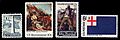
Issue of 1959, 1975, and two from 1968.

See also
 In Spanish: Batalla de Bunker Hill para niños
- American Revolutionary War §Early Engagements. The Battle of Bunker Hill placed in sequence and strategic context.
- John Hart, Regimental Surgeon of Col Prescott's Regiment who treated the wounded at Bunker Hill
- List of American Revolutionary War battles
- List of British Forces in the American Revolutionary War
- List of Continental Forces in the American Revolutionary War
- Royal Welch Fusiliers
- USS Bunker Hill
