
Conus mappa facts for kids
Quick facts for kids Conus mappa |
|
|---|---|
 |
|
| Apertural and abapertural views of shell of Conus mappa Lightfoot, J. in Solander, 1786 | |
 |
|
Scientific classification  |
|
| Kingdom: | Animalia |
| Phylum: | Mollusca |
| Class: | Gastropoda |
| Subclass: | Caenogastropoda |
| Order: | Neogastropoda |
| Superfamily: | Conoidea |
| Family: | Conidae |
| Genus: | Conus |
| Species: |
C. mappa
|
| Binomial name | |
| Conus mappa Lightfoot, 1786
|
|
| Script error: The function "autoWithCaption" does not exist. | |
| Synonyms | |
|
|
Script error: No such module "Check for conflicting parameters".
Conus mappa is a fascinating type of sea snail. It is a marine gastropod mollusk, which means it's a snail that lives in the ocean and has a shell. This snail belongs to the family Conidae, commonly known as cone snails.
There are a few different types of Conus mappa. These are called subspecies. For example, Conus mappa jesusramirezi and Conus mappa trinitarius are two recognized subspecies.
Like all species in the Conus group, these snails are predatory. This means they hunt and eat other small sea creatures. They are also venomous. This means they can sting using a special harpoon-like tooth. Because of their venom, it's very important to be careful. You should never touch or handle live cone snails.
Contents
What Does the Map Cone Snail Look Like?
The shell of the Conus mappa is quite wide. It can be anywhere from about 36 mm to 67 mm long. That's roughly the size of a small to medium-sized candy bar!
Shell Features
The top part of the shell, called the spire, has small bumps. The main part of the shell, known as the body whorl, is smooth. It has a very cool pattern. The colors can range from milky white to pinkish white.
Unique Patterns
The shell often has two spiral bands. These bands can be greenish-yellow or even darker brown. They are usually broken up into irregular patches, making each shell look unique. The spiral parts of the shell also have very fine lines running along them. The opening of the shell, called the aperture, is usually whitish inside.
Where Do Map Cone Snails Live?
Conus mappa snails live in the warm waters of the Caribbean Sea. You can find them near countries like Venezuela, Trinidad, and Barbados.
Deep Sea Homes
These snails prefer deeper parts of the ocean. They are often found at depths of about 85 fathoms, which is around 155 meters (or 500 feet) deep! That's much deeper than most people swim.
Gallery
-
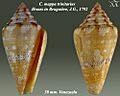
Conus mappa trinitarius Hwass in Bruguière, J.G., 1792
-
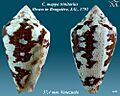
Conus mappa trinitarius Hwass in Bruguière, J.G., 1792


