
Conus varius facts for kids
Quick facts for kids Conus varius |
|
|---|---|
 |
|
| The shell of a Freckled Cone snail | |
 |
|
| Conservation status | |
Scientific classification  |
|
| Kingdom: | Animalia |
| Phylum: | Mollusca |
| Class: | Gastropoda |
| Subclass: | Caenogastropoda |
| Order: | Neogastropoda |
| Superfamily: | Conoidea |
| Family: | Conidae |
| Genus: | Conus |
| Species: |
C. varius
|
| Binomial name | |
| Conus varius Linnaeus, 1758
|
|
| Script error: The function "autoWithCaption" does not exist. | |

Script error: No such module "Check for conflicting parameters".
The Conus varius, often called the Freckled Cone, is a type of sea snail. It's a marine gastropod mollusk and belongs to the family Conidae, which includes all the amazing cone snails.
Like all cone snails, the Freckled Cone is a predatory animal. This means it hunts other creatures for food. These snails are also venomous. They can "sting" humans, so it's very important to be careful. Never touch a live cone snail!
Contents
Meet the Freckled Cone Snail!
The Freckled Cone snail is a fascinating creature of the sea. It was first described by the famous scientist Carl Linnaeus in 1758. This snail gets its common name, "Freckled Cone," from the unique patterns on its shell.
What Does Its Shell Look Like?
The shell of a Freckled Cone snail can be anywhere from about 30 mm to 61 mm long. That's roughly the size of a small to medium-sized candy bar! The shell is usually white. It has beautiful marbled patterns in colors like orange, pink, brown, or chocolate. Sometimes, you can see lines of spots going around the shell.
The top part of the shell, called the spire, has small bumps or "tubercles." The main part of the shell, known as the body whorl, has grooves near the bottom. The upper part of the body whorl also has rows of these small bumps, which become clearer as they get closer to the spire.
Where Does the Freckled Cone Live?
You can find the Freckled Cone snail in the warm waters of the Indian Ocean. They live near East Africa, around the Mascarene Islands, and near Aldabra. You can also spot them off the coasts of Fiji and Australia. In Australia, they are found in the Northern Territory and Queensland.
Be Careful: It's Venomous!
It's super important to remember that all cone snails, including the Freckled Cone, are venomous. They use their venom to catch their prey. While they don't usually attack humans, they can sting if they feel threatened. A sting can be very painful and dangerous. So, if you ever see a cone snail, admire its beauty from a safe distance! Never pick one up.
Images for kids
-
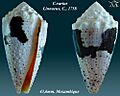
A close-up view of the Freckled Cone shell.
-
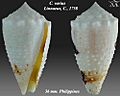
Another view of the Freckled Cone shell.
