
Conus ventricosus facts for kids
Quick facts for kids Conus ventricosus |
|
|---|---|
 |
|
| Apertural and abapertural views of shell of Conus ventricosus Gmelin, J.F., 1791 | |
 |
|
| Conservation status | |
Scientific classification  |
|
| Kingdom: | Animalia |
| Phylum: | Mollusca |
| Class: | Gastropoda |
| Subclass: | Caenogastropoda |
| Order: | Neogastropoda |
| Superfamily: | Conoidea |
| Family: | Conidae |
| Genus: | Conus |
| Species: |
C. ventricosus
|
| Binomial name | |
| Conus ventricosus Gmelin, 1791
|
|
| Script error: The function "autoWithCaption" does not exist. | |
| Synonyms | |
|
See "List of synonyms" |
|

Script error: No such module "Check for conflicting parameters".
The Conus ventricosus, often called the Mediterranean cone snail, is a type of sea snail. It is a marine gastropod mollusk belonging to the family Conidae. This family includes all the amazing cone snails and their relatives.
One special kind of this snail is Conus ventricosus mediterraneus Hwass in Bruguière, 1792. It is a recognized subspecies.
Just like all other cone snails, these creatures are predatory. This means they hunt and eat other animals. They are also venomous, which means they can sting. Because of their venom, it's very important to be careful. Never touch or handle live cone snails.
Contents
Discover the Mediterranean Cone Snail's Appearance
The shell of the Mediterranean cone snail can be different sizes. It usually measures between 13 mm and 63 mm long.
The shell's color can vary a lot. You might see them in yellowish-brown, pink-brown, or olive green. Some shells are even chocolate-brown. These darker shells often have cool patterns. They might have blurry spots or look like a net. Sometimes, they have broken lines of chestnut color. There is often a thin, light band just below the middle of the shell.
The top part of the shell, called the spire, is raised. It has a rough, stepped look and often has colored spots. The inside of the shell's opening, known as the aperture, is usually a light chocolate color with a lighter band.
How the Snail Uses Venom
These snails use their venom to hunt. Their venom contains many different poisonous compounds. One of these special compounds is called Contryphan-Vn. Scientists have taken this peptide from the snail's venom. This powerful mix helps the snail catch its prey, like worms.
Where the Mediterranean Cone Snail Lives
This sea snail lives in many places. You can find it in the shallow waters of the Mediterranean Sea.
Scientists have also found fossils of this snail. These fossils show that Conus ventricosus lived a very long time ago. They have been found in rocks from the Pliocene and Miocene periods.
Images for kids
-
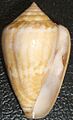
A Conus hanley shell.
-
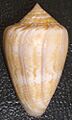
Another view of a Conus hanley shell.
_-_AZRC_547_34a.JPG)
_-_AZRC_547_34b.JPG)
