
County Fermanagh War Memorial facts for kids
Quick facts for kids County Fermanagh War Memorial |
|
|---|---|
| United Kingdom | |

Front of the war memorial. At the back left is the Orange Hall and at right the Clinton Centre.
|
|
| For British military dead of the First and Second World Wars. Also those civilians killed in the 1987 IRA bombing at this site. | |
| Unveiled | 24 October 1922 |
| Location | 54°20′40″N 7°38′03″W / 54.34433°N 7.63420°W Enniskillen, County Fermanagh, Northern Ireland
|
|
"Our Glorious Dead"
|
|
The County Fermanagh War Memorial, also called the Enniskillen War Memorial, is a special monument in Enniskillen, County Fermanagh, Northern Ireland. It was first built to remember the brave soldiers from the town who died in the First World War. These soldiers often served in local groups like the 6th (Inniskilling) Dragoons and the Royal Inniskilling Fusiliers. Later, the memorial was updated to also honor those who died in the Second World War.
Sadly, this memorial was also the site of a terrible event. On 8 November 1987, during a special ceremony called Remembrance Sunday, a bomb exploded here. This event was a sad part of a period known as The Troubles. The memorial was later fixed up, and a new part was added to remember the people who died in the bombing. Since 2012, the leader of Ireland, called the Taoiseach, visits the memorial every year on Remembrance Sunday.
Contents
Building the Enniskillen Memorial
After the First World War, a group called the County Fermanagh War Memorial Committee was formed. In 1920, they asked for designs for a new war memorial. They hoped it would cost around £1,500.
A winning design was chosen by early 1921. The memorial was built by a company called Gaffin & Co. from London.
The Soldier's Statue
The main part of the memorial is a bronze statue of a British soldier from the First World War. He wears a peaked cap and holds his rifle pointed downwards, a sign of respect. A Northern Irish artist created this sculpture.
The artist based the soldier on a painting. This painting showed a soldier named Thomas McNeilly. He was standing at a temporary memorial in Belfast in 1919.
Inscriptions and Symbols
The soldier's statue stands on a stone base. This base is carved with the words "OUR GLORIOUS DEAD" and the years "1914-1918". It also lists the names of 612 local men who died in the war.
The base also features a coat of arms. This symbol shows Enniskillen Castle. It is linked to the local regiments, the 6th (Inniskilling) Dragoons and the Royal Inniskilling Fusiliers. At the very bottom, there is a bronze image of a crossed sword and rifle. This represents the two types of soldiers: cavalry (horseback soldiers) and infantry (foot soldiers).
The memorial was officially revealed on 24 October 1922. Important people attended, and children laid wreaths. Soldiers from local regiments stood guard during the ceremony.
After the Second World War, the years "1939-1945" were added to the base. Names of those who died in that war, including sailors from the Merchant Navy, were also added.
A Sad Day: The 1987 Bombing
Standing at the war memorial, children hand in hand,
Another year is over - perhaps we understand,
That words of love are stronger than the words of hate.
Let us not forget what happened on Remembrance Day.
What ever you believe in, what ever flag you wave,
Let us not forget what happened on Remembrance Day
During a difficult time in Northern Ireland known as The Troubles, some war memorials were targeted. On 8 November 1987, a bomb exploded at the County Fermanagh War Memorial. This happened during a Remembrance Sunday ceremony.
The explosion caused great sadness. Eleven people attending the ceremony died, and many others were hurt. One person who was injured never woke up and passed away years later. The memorial itself was damaged by flying pieces from the blast.
Impact of the Bombing
Pictures of the damaged memorial appeared in newspapers. These images became a powerful symbol of that period. The bombing, and news of another planned attack, shocked many people. It led to less support for the group responsible.
In response, the British Prime Minister, Margaret Thatcher, visited the memorial. She attended a special remembrance ceremony there later that month. The bombing also led to more people attending remembrance ceremonies across Ireland. The Royal British Legion started selling remembrance poppies again in the Republic of Ireland. The singer Chris de Burgh wrote a song called "At the War Memorial" about the attack.
Renovations and Recent History
_(geograph_5558021).jpg)
The County Fermanagh War Memorial was repaired and updated in 1990-91. The old carvings were recut. A new section, about 1 meter (3 feet) high, was added to the stone base.
This new section has 11 unique dove sculptures. These doves remember the people who died in the 1987 bombing. Their names were also added to the memorial. After these updates, the memorial stands about 6 meters (20 feet) tall.
Annual Visits
In 2012, the Irish leader, Enda Kenny (the Taoiseach), visited the memorial. He laid a green wreath on behalf of the Irish government. This started a new tradition. His successor, Leo Varadkar, has continued this annual visit.
A separate memorial was unveiled in 2017. It remembers the 12 people whose deaths were linked to the 1987 bombing. This new memorial is now planned to be installed at The Clinton Centre. This center stands where a building was destroyed by the bombing. There are plans to connect the new memorial visually with the existing war memorial.
Gallery
-
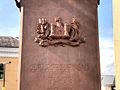
Detail of the main inscription and coat of arms
-
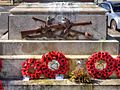
Detail of crossed rifle and sword at the base of the plinth
-
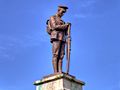
Detail of the sculpture atop the plinth
-
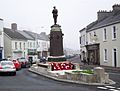
The rear of the memorial
_(geograph_5557994).jpg)
.jpg)
.jpg)

