
Black crowberry facts for kids
Quick facts for kids Black crowberry |
|
|---|---|
 |
|
Scientific classification  |
|
| Kingdom: | Plantae |
| Clade: | Tracheophytes |
| Clade: | Angiosperms |
| Clade: | Eudicots |
| Clade: | Asterids |
| Order: | Ericales |
| Family: | Ericaceae |
| Genus: | Empetrum |
| Species: |
E. nigrum
|
| Binomial name | |
| Empetrum nigrum |
|
| Script error: The function "autoWithCaption" does not exist. | |
Script error: No such module "Check for conflicting parameters".
The black crowberry (scientific name: Empetrum nigrum) is a cool little plant. It's also known as crowberry, mossberry, or rockberry. In some places like Alaska, people even call it "blackberry." This plant is part of the heather family, called Ericaceae. You can find it all around the northern parts of the world.
Its scientific name, Empetrum nigrum, tells us a bit about it. "Empetrum" comes from ancient Greek words meaning "upon a rock." "Nigrum" is Latin for "black," referring to its dark berries. Many Indigenous groups in North America have their own names for this plant. For example, the Iñupiaq call it asiavik, and the Gwichʼin call it dineechʼúh.
Contents
Meet the Black Crowberry!
What Does it Look Like?
The black crowberry is a small, evergreen shrub. It grows low to the ground and spreads out. Its leaves are tiny, about 3 to 6 millimeters long. They grow one after another along the stem. Young stems are red, then turn brown as they get older. These plants grow slowly, only about 7 to 15 centimeters (3 to 6 inches) each year. They can form thick, spreading mats. These mats help stop other plants from growing too much around them.
How Does it Grow and Reproduce?
Most black crowberry plants are either male or female. This means a plant will have either male flowers or female flowers. Sometimes, a few plants have both male and female parts on the same flower. Since these plants spread a lot, a whole patch might be all male or all female.
The flower buds start growing in the summer. They open the next year, usually between May and June. The flowers are very small, only 3 to 6 millimeters. They don't have much smell and are hard to spot. Each flower has three greenish-pink parts called sepals. These turn reddish-purple. They also have three petals. Male flowers have three stamens, which make pollen. Female flowers have a pistil with an ovary. This ovary holds 6 to 9 tiny seeds.
After the flowers, the plant grows small, round berries. These berries are about 4 to 6 millimeters wide. They are usually black or purplish-black. Sometimes, you might find red ones. Each berry has about 7 or 8 seeds inside. These berries are tough and can stay on the plant all winter. They are mostly water (about 86.5%). Their dry parts have lots of carbohydrates and lipids (fats). In fact, they might have the most fat of any fleshy fruit in Europe!
Where Does it Live?
You can find the black crowberry across many northern parts of the world. It grows in places like bogs. It likes acidic soils that are shady and moist. You can also spot it in high mountain areas, like the Pacific Northwest. This plant can grow in very acidic soil, even with a pH of 2.5. But it doesn't like soils that are too basic (pH higher than 8).
Crowberry's Role in Nature
Black crowberry flowers get pollinated in a few ways. Small insects like flies and beetles help. The wind also carries pollen from plant to plant. Many animals eat the berries. These animals include rodents, foxes, bears, and caribou. Lots of bird species also enjoy them. When animals eat the berries, they help spread the seeds.
The berries stay on the plant all winter and into spring. This makes them a very important food source. Animals like red-backed voles rely on them when other foods are scarce. Some types of moths also like to feed on the crowberry plant. These include the Glacies coracina, Zygaena exulans, and Hadula melanopa moths.
Crowberries have a special ability called allelopathy. This means they can release chemicals into the soil. These chemicals can stop other plants' seeds from growing or their roots from spreading too much. This helps the crowberry compete for space. The strength of this effect depends on the type of soil.
The roots of the black crowberry also have tiny helpers. These are special fungi called ericoid mycorrhizal fungi. They live with the roots and help the plant get more nutrients. These nutrients include nitrogen and phosphorus, which are important for growth.
How People Use Crowberries
The black crowberry fruit is safe to eat! It can taste a bit acidic. In places like the Alaskan tundra, people describe it as sweet and slightly tart. These berries are often mixed with other fruits. They are used in yummy dishes like pies and puddings.
Crowberries are very common in Scandinavia. People there use them to make juice, jelly, and even special drinks. In cold subarctic regions, crowberries have been a super important food. They are a key part of the diet for the Inuit and the Sami. People even use them to make a treat called Alaskan ice cream. The Dena'ina people gather these berries for food. They sometimes store many for winter. They might mix them with lard or oil.
In Newfoundland and Labrador, Canada, these berries are called "blackberries." People use them in jams, jellies, and baked goods. You can find them in buns and puddings. In some northern areas, people even harvest the whole plant. They use the plant's roots and soil to add flavor to smoked fish.
Beyond food, crowberries are also useful in gardens. They can be grown as a ground cover plant. This means they spread out and cover the soil. They are also pretty ornamental plants for rock gardens. One special type, 'Lucia', has bright yellow leaves. The berries have a lot of anthocyanin. This is a natural color pigment. It can be used to make natural dyes.
Crowberries in Culture
The black crowberry has a place in history too. In the Scottish Highlands, the Clan Maclean has a special badge. Many believe this badge features the black crowberry.
Images for kids
-
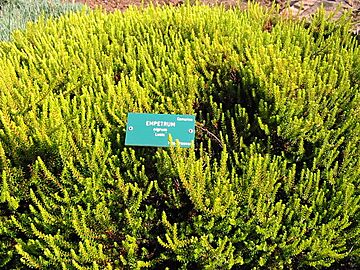
The yellow-leaved cultivar Empetrum nigrum 'Lucia'
-
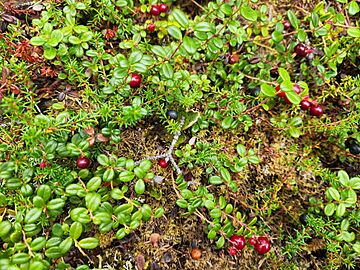
Vaccinium vitis-idaea and Empetrum nigrum in Denali
-
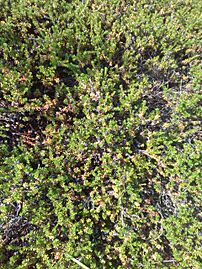
Alaskan crowberry


See also
 In Spanish: Camarina negra para niños
