
Cuban nightjar facts for kids
Quick facts for kids Cuban nightjar |
|
|---|---|
 |
|
| Conservation status | |
Scientific classification  |
|
| Kingdom: | Animalia |
| Phylum: | Chordata |
| Class: | Aves |
| Order: | Caprimulgiformes |
| Family: | Caprimulgidae |
| Genus: | Antrostomus |
| Species: |
A. cubanensis
|
| Binomial name | |
| Antrostomus cubanensis (Lawrence, 1860)
|
|
 |
|
| Script error: The function "autoWithCaption" does not exist. | |
| Synonyms | |
|
Caprimulgus cubanensis |
|

Script error: No such module "Check for conflicting parameters".
The Cuban nightjar is a special bird found only in Cuba. It's also sometimes called the Greater Antillean nightjar. This bird belongs to a family called nightjars, known for being active at night. Its scientific name is Antrostomus cubanensis.
Contents
About the Cuban Nightjar
Scientists give every animal a unique name. The Cuban nightjar was first named Antrostomus cubanensis. Later, it was grouped with other birds in the Caprimulgus family. But now, most scientists agree it should be back in its own group, Antrostomus.
There are two main types, or subspecies, of the Cuban nightjar. One is called A. c. cubanensis, which lives on the main island of Cuba. The other is A. c. insulaepinorum, found only on a smaller island nearby.
What Does It Look Like?
The Cuban nightjar is about 25 to 29.5 centimeters (10 to 11.5 inches) long. That's about the length of a ruler! Males usually weigh around 76 grams (2.7 ounces), and females are a bit lighter at 70 grams (2.5 ounces).
Their feathers are mostly dark brown. They have cool speckles of gray, light brown, and grayish-brown all over their bodies. Their tails are brown, and the outer feathers have white tips for males and buff-colored tips for females. Their wings are also brown with lighter spots and patterns.
The face of the nightjar is a yellowish-brown color with dark brown speckles. Their throat and chin are dark brown with cinnamon-colored spots. The chest is dark brown with bigger buffy-white spots. Their belly and sides are dark brown with gray speckles. The A. c. insulaepinorum subspecies is smaller and has darker feathers.
Where Does It Live?
The main type of Cuban nightjar, A. c. cubanensis, lives on the big island of Cuba. You can also find it on many of the small islands close by. The other type, A. c. insulaepinorum, lives only on an island called Isla de la Juventud. This island used to be known as the Isle of Pines.
These birds like to live in different kinds of places. Some people say they live in thick bushes, while others see them in open forests or near the edges of swampy areas. They also like fairly dense forests.
How Does It Behave?
What It Eats
The Cuban nightjar is a crepuscular and nocturnal bird. This means it is most active during twilight (dawn and dusk) and at night. It loves to eat insects! It catches them while flying through the air. Scientists are still learning if it catches insects while flying continuously or if it waits on a branch or the ground and then flies out to grab them.
How It Raises Its Young
Cuban nightjars lay their eggs between March and July. They usually lay two eggs. They don't build a fancy nest. Instead, they lay their eggs right on the ground! Both the male and female birds help to keep the eggs warm until they hatch.
What Its Song Sounds Like
The song of the Cuban nightjar is quite unique. It's described as a "harsh, buzzy call" that has only one sound. The pitch of the sound goes up and down, but overall, it ends on a lower note.
Is It Safe?
The IUCN (International Union for Conservation of Nature) has looked at the Cuban nightjar. They say it is a species of "Least Concern." This means it's not in immediate danger of disappearing. However, its total number of birds is not known, and scientists believe the population might be getting smaller.
There are no big, immediate threats to the Cuban nightjar right now. But if their homes (habitats) are destroyed, it would definitely affect them. Also, animals that are not native to Cuba and hunt birds could be a problem for them.
See also
 In Spanish: Chotacabras cubano para niños
Images for kids
-
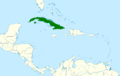
Map showing where the Cuban nightjar lives.
