
Cue sports facts for kids

Engraving of an early billiards game with obstacles, targets, and pockets, from Charles Cotton's 1674 book The Compleat Gamester
|
|
| Highest governing body | World Confederation of Billiards Sports |
|---|---|
| First played | 15th-century Europe, with roots in ground billiards |
| Characteristics | |
| Contact | No |
| Team members | Single opponents, doubles or teams |
| Mixed-sex | Sometimes in separate leagues/divisions |
| Type | Indoor, table |
| Equipment | Billiard balls, billiard table, cue sticks |
| Venue | Billiard hall or home billiard room |
| Presence | |
| Olympic | No |
| World Games | 2001 – present |
Cue sports are exciting games played on a special table. Players use a long stick called a cue stick to hit billiard balls. The goal is to make the balls move around a cloth-covered table. This table has bouncy edges called cushions. Cue sports are also known as billiards.

There are three main types of cue sports:
- Carom billiards: These games are played on tables that do not have pockets. They are usually long tables. Examples include three-cushion billiards.
- Pool: These games are played on tables with six pockets. Tables come in different sizes. Popular pool games include eight-ball and nine-ball.
- Snooker: This game is played on a very large table with six pockets. Snooker has its own unique rules and history. English billiards and Russian pyramid are also in this group.
Contents
History of Cue Sports

Cue sports started as outdoor games played on the ground. They were similar to games like croquet and golf. Over time, people moved these games indoors onto tables.
The word billiard might come from French words meaning 'stick' or 'ball'. Early players used a tool called a mace, which was like a golf putter. Later, they started using the thinner end of the mace. This led to the modern cue. The word cue comes from the French word for 'tail'.

The first known indoor billiard table belonged to King Louis XI of France in the 1400s. The game became very popular among French nobles. Other European royals, like Mary, Queen of Scots, also enjoyed playing. By the 1700s, billiards was played in many cafes in Paris and was popular with the wealthy in England.
Around 1670, players started using the thin end of the mace more often. This led to the development of the straight cue stick we know today, around 1800. Cushions on the table were also improved to make balls bounce better.
Early billiard balls were made from wood or clay. Rich players used ivory. Later, people looked for other materials. John Wesley Hyatt invented celluloid in 1868 as a substitute. Today, balls are made from special plastics.
Some early games had obstacles like arches and pins on the table. But soon, games focused on hitting balls into pockets or making them bounce off cushions. This led to the different types of billiards we play today.

In the United States, cue sports became very popular between 1878 and 1956. Soldiers often played to relax. After World War II, interest faded a bit. However, a movie called The Hustler in 1961 brought new excitement to the game. Now, many people of all skill levels enjoy cue sports.
Cue Sports as a Competitive Activity
Cue sports are not just games; they are also competitive "sports." Professional competitions have been held since at least 1893. Many different cue sports are played professionally, especially nine-ball, snooker, three-cushion, and eight-ball.
Snooker is a very popular professional sport, especially in the United Kingdom and parts of Asia. It has its own international rules and tournaments.
Cue sports, including pool, snooker, and carom, have been part of the World Games since 2001.
Equipment for Cue Sports
Billiard Balls

Billiard balls come in different sizes, designs, and quantities depending on the game.
- Russian pyramid and kaisa use large balls, about 68 mm (2.6 inches) in diameter.
- Carom billiards balls are larger than pool balls, about 61.5 mm (2.4 inches).
- Standard pool balls are 57.15 mm (2.25 inches). A set usually has 15 numbered balls (seven solid, seven striped, and an 8-ball) plus a cue ball.
- Snooker balls are smaller, about 52.5 mm (2.06 inches). A set has 15 red balls, 6 colored balls, and a cue ball.
Historically, billiard balls were made from clay, wood, or ivory. Today, most are made from special plastics like phenolic resin.
Billiard Tables

Billiard tables come in many sizes and styles. They are usually twice as long as they are wide.
- Full-size snooker tables are about 12 feet long.
- Carom billiards tables are typically 10 feet long.
- Regulation pool tables are 9 feet long. Smaller 7-foot tables are common in places like pubs.
High-quality tables have a playing surface made of thick slate. This slate is often in three pieces to prevent warping. Most pocket billiards tables have six pockets: four in the corners and two in the middle of the long sides.
Table Cloth

All billiard tables are covered with a special cloth, often called "felt." This cloth is usually made of wool or a wool/nylon mix. It has been used since the 1400s.
The cloth affects how the balls roll. "Faster" cloth allows balls to roll farther. Snooker cloth often has a "nap," which means the fibers lie in one direction, affecting ball movement.
The cloth is traditionally green, like the grass of the old outdoor games. However, it can also be blue or red. Blue cloth is often used for TV broadcasts because it makes the balls easier to see.
Racks

A rack is a frame used to arrange the billiard balls at the start of a game. The most common shape is a triangle, used for eight-ball. A diamond-shaped rack is used for nine-ball. There are also flat plastic "template" racks that hold balls tightly together. The rack is removed after the first shot, called the "break."
Cue Sticks
Most cue sports are played with a cue stick. A cue is usually a long, tapered stick. It can be one piece or two pieces that screw together. Good quality cues are often made from hardwood like maple or ash.
The wider end of the cue is called the butt, where you hold it. The thinner part is the shaft. At the very end of the shaft is a small leather tip. Players put chalk on this tip. The tip helps you hit the ball with spin.
Expensive cues can be made from fancy woods and materials. Some modern cues use high-tech materials like carbon fiber. Skilled players might use different cues for different shots, like a special cue for the opening break or for "jump shots."
Mechanical Bridge
The mechanical bridge, also called a "rest" or "rake," helps players reach balls that are too far away. It's a stick with a special head that supports the cue stick. This allows players to make shots they couldn't reach with their hand.
Chalk

Players put chalk on the cue tip before almost every shot. This increases the friction between the tip and the ball. It helps prevent the cue from slipping off the ball, especially when trying to put spin on it.
Billiard chalk is not like blackboard chalk. It's made from special compounds, often with silica. It comes in many colors, usually green or blue. Hand chalk (like talcum powder) can also be used to make your bridge hand slide smoothly on the cue. Some players prefer a special glove instead of hand chalk.
Major Cue Sports Games
There are two main types of billiard games: carom and pocket.
Carom Billiards Games
Carom games are played on tables without pockets. They use three balls: two cue balls and one object ball. The goal is usually to hit your cue ball so it touches both other balls.
Straight Rail
In straight rail, you score a point each time your cue ball hits both other balls. Skilled players could keep the balls very close together. This allowed them to score many points in a row. This made the game less exciting for viewers.
Balkline
Balkline was created to make the game harder. Lines were drawn on the table. Players could not keep the balls in one section for too long. This stopped players from scoring endless points easily.
Cushion Billiards
Another way to make carom games more challenging was to require the cue ball to hit the table's cushions. In three-cushion billiards, your cue ball must hit the cushions three times before touching the other balls. This is a very difficult game, even for experts!

Pocket Billiards Games (Pool)
Many different games are played on a standard pool table with pockets. Some popular ones include eight-ball, nine-ball, straight pool, and one-pocket. Rules can vary a bit, especially in casual play.
- Eight-ball: The most popular pool game. Players try to pocket all their assigned balls (either solid or striped). Then, they must pocket the 8-ball into a specific pocket to win.
- Nine-ball: The goal is to pocket the 9-ball. You must hit the lowest-numbered ball on the table first. However, you can pocket any ball (even the 9-ball) if you hit the lowest one first.
- Straight pool (also called 14.1 continuous pool): Players try to score a set number of points by pocketing any called ball into a called pocket. They can keep shooting as long as they keep pocketing balls.
- Bank pool: Players must pocket a set number of balls by "banking" them. This means the ball must hit one or more cushions before going into a pocket.
Speed Pool
Speed pool is a fun variation where players try to pocket balls as fast as possible. The fastest player wins!
Games Played on a Snooker Table
English Billiards
English billiards started around 1800 in the UK. It combines features of carom and pocket games. Players score points by hitting both other balls (a "cannon") or by pocketing balls. It uses two cue balls and one red object ball.
Snooker
Snooker was invented by British officers in India in the 1800s. The name "snooker" also describes a key strategy: making it hard for your opponent to hit their next shot.
Snooker is very popular in the United Kingdom and many Commonwealth countries. It's also growing fast in China. The first World Snooker Championship was held in 1927. The World Professional Billiards and Snooker Association (WPBSA) manages the professional game.
See also
 In Spanish: Billar para niños
- Glossary of cue sports terms
- BCA Hall of Fame
- Hustling
- Cue sports techniques
Images for kids
-
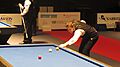
A professional carom billiards player during a competition.
-
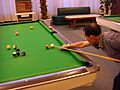
People playing pool in North Korea.
-
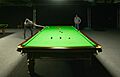
A snooker table ready for a game.

.jpg)

