
Dagestan facts for kids
Quick facts for kids Republic of DagestanРеспублика Дагестан (Russian) Name in other languages
|
|||||||||||||||||||||||||||
|---|---|---|---|---|---|---|---|---|---|---|---|---|---|---|---|---|---|---|---|---|---|---|---|---|---|---|---|
| — Republic — | |||||||||||||||||||||||||||
 The Sulak river flowing through the Sulak Canyon |
|||||||||||||||||||||||||||
|
|||||||||||||||||||||||||||
|
|
|||||||||||||||||||||||||||
|
|||||||||||||||||||||||||||
| Political status | |||||||||||||||||||||||||||
| Country | Russia | ||||||||||||||||||||||||||
| Federal district | North Caucasian | ||||||||||||||||||||||||||
| Economic region | North Caucasus | ||||||||||||||||||||||||||
| Established | January 20, 1921 | ||||||||||||||||||||||||||
| Capital | Makhachkala | ||||||||||||||||||||||||||
| Government | |||||||||||||||||||||||||||
| • Head | Sergey Melikov | ||||||||||||||||||||||||||
| • Legislature | People's Assembly | ||||||||||||||||||||||||||
| Statistics | |||||||||||||||||||||||||||
| Area (as of the 2002 Census) | |||||||||||||||||||||||||||
| • Total | 50,270 km2 (19,410 sq mi) | ||||||||||||||||||||||||||
| Area rank | 52nd | ||||||||||||||||||||||||||
| Time zone(s) | MSK (UTC+04:00) | ||||||||||||||||||||||||||
| ISO 3166-2 | RU-DA | ||||||||||||||||||||||||||
| License plates | 05 | ||||||||||||||||||||||||||
| Official languages | Russian;
|
||||||||||||||||||||||||||
| Official website: http://www.e-dag.ru/ | |||||||||||||||||||||||||||


.svg)


Dagestan, officially known as the Republic of Dagestan, is a special region in Russia. It is located in the North Caucasus mountains, right next to the Caspian Sea. This makes it the southernmost part of Russia. Dagestan shares borders with Azerbaijan and Georgia. It also borders other Russian regions like Chechnya, Kalmykia, and Stavropol Krai.
The capital and largest city is Makhachkala. Other important cities include Derbent and Kaspiysk. Dagestan is about 50,300 square kilometers in size. More than 3.1 million people live here. It is famous for being one of the most diverse places in Russia. People from over 30 different ethnic groups and 81 nationalities call Dagestan home. They speak 14 official languages!
Many people in Dagestan speak Northeast Caucasian languages or Turkic languages. However, Russian is the main language used by everyone. Dagestan is also well-known for its amazing athletes. Many champions in combat sambo and mixed martial arts come from this region.
Contents
Understanding the Name: Dagestan
The word Dagestan tells us something special about the region. It comes from Turkish and Persian words. Dağ in Turkish means "mountain," and -stan in Persian means "land." So, Dagestan means "land of the mountains."
In the past, different parts of Dagestan had other names. These included Lekia and Avaria. The borders of Dagestan as we know them today were set in 1921. This happened when the Dagestan Autonomous Soviet Socialist Republic was formed.
Names in Official Languages
Here are the names for Dagestan in its many official languages:
- Russian – Республика Дагестан (Respublika Dagestan)
- Avar – Дагъистан Республика (Daġistan Respublika)
- Dargin – Дагъистан Республика (Daġistan Respublika)
- Kumyk – Дагъыстан Жумгьурият (Республика) (Dağıstan Cumhuriyat / Respublika)
- Lezgian – Республика Дагъустан (Respublika Daġustan)
- Lak – Дагъусттаннал Республика (Daġusttannal Respublika)
- Tabasaran – Дагъустан Республика (Daġustan Respublika)
- Rutulian – Республика Дагъустан (Respublika Daġustan)
- Aghul – Республика Дагъустан (Respublika Daġustan)
- Tsakhur – Республика Дагъустан (Respublika Daġustan)
- Nogai – Дагыстан Республикасы (Dağıstan Respublikası)
- Chechen – Дегӏестан Республика (Deġestan Respublika)
- Azerbaijani – Дағыстан Республикасы (Dağıstan Respublikası)
- Tat – Республикей Догъисту (Respublikei Doġistu)
Exploring Dagestan's Geography
Dagestan is nestled in the North Caucasus mountains. It is the most southern part of Russia. To its east, it has a long coastline along the Caspian Sea.
Land Area and Neighbors
Dagestan covers about 50,300 square kilometers. It shares land borders with several places:
- Inside Russia: Kalmykia (to the north), Chechnya (to the west), and Stavropol Krai (to the northwest).
- Other countries: Azerbaijan (to the south) and Georgia (to the southwest).
The Caspian Sea forms its eastern water border.
Mountains and Rivers
Most of Dagestan is mountainous. The Greater Caucasus Mountains stretch across the southern part. The highest point is Mount Bazardüzü, which is 4,446 meters tall. It sits on the border with Azerbaijan.
Dagestan has over 1,800 rivers! Some of the major ones are:
- Sulak River
- Samur River
- Terek River
Natural Riches
Dagestan is rich in natural resources. It has oil, natural gas, and coal. Many other valuable minerals are found here too.
Climate and Weather
The climate in Dagestan is mostly continental. This means it has hot summers and cold winters. It doesn't get a lot of rain. It is one of the warmest places in Russia. In the high mountains, the weather is much colder, like a subarctic region.
- In January, the average temperature is around 2°C.
- In July, the average temperature is about 26°C.
How Dagestan is Organized
Dagestan is divided into 41 main areas called districts, or raions. It also has ten important cities and towns. These districts are further split into smaller parts. These include 19 urban-type settlements and 363 rural areas.
A Look at Dagestan's Past
Dagestan has a very long and interesting history. Many different empires and cultures have influenced this region over thousands of years.
Ancient Times and Early Empires
Long ago, in the first centuries AD, the area that is now southern Dagestan was part of a kingdom called Caucasian Albania. It was often connected to powerful empires like the Parthian Empire and later the Sasanian Empire. The Sasanians built a strong fortress in Derbent in the 6th century. This fortress became known as the Caspian Gates. During these times, people in Dagestan followed religions like Christianity and Zoroastrianism.

The Spread of Islam
In the 7th century, Arab armies arrived in the region. They brought the religion of Islam. Dagestan was one of the first places in what is now Russia to adopt Islam. Over time, Islam slowly spread from the cities into the mountain areas. By the 15th century, Islam was widely practiced.
Mongol and Timurid Influence
Later, in the 13th century, the Mongols invaded Dagestan. They conquered Derbent and the surrounding lands. After the Mongols, the Timurids also ruled parts of the region.

Persian and Russian Control
For many centuries, Dagestan was often caught between the powerful Persian Empire and the growing Russian Empire. Control of the region changed hands several times. In the early 18th century, Russia briefly took control of the coastal areas. However, these lands were returned to Persia.
.jpg)
Finally, after a war between Russia and Persia, Russia gained full control of Dagestan in 1813. This was confirmed by the Treaty of Gulistan.
Mountain Uprisings
Many mountain people in Dagestan were unhappy with Russian rule. They faced new taxes and changes to their lands. This led to a major conflict called the Caucasian War. Leaders like Imam Shamil led the resistance from 1834 to 1859. The fighting lasted for many years.


The Soviet Era
After the Bolshevik Revolution in 1917, Dagestan became part of the new Soviet Union. On January 20, 1921, it was officially named the Dagestan Autonomous Soviet Socialist Republic.
Modern Dagestan
After the Soviet Union ended, Dagestan became a republic within the Russian Federation. In 1999, there was a period of unrest and fighting in the region. After some fighting, the Russian military helped restore peace. Today, Dagestan continues to develop and grow.
How Dagestan is Governed
Dagestan is a republic within Russia. It has its own government structure.


The People's Assembly
The main law-making body is the People's Assembly of Dagestan. It has 72 members who are elected for four years. The People's Assembly makes important decisions for the republic.
The Head of the Republic
The highest leader in Dagestan is called the Head of the Republic. This person is chosen by the People's Assembly. The current Head of Dagestan is Sergey Melikov.
Representing Diverse Groups
Dagestan's government is designed to include its many ethnic groups. The State Council, for example, has representatives from 14 different ethnic communities. This helps ensure that many voices are heard in the government.
People and Population
Dagestan is known for its incredible diversity. Its mountains made travel difficult in the past. This helped many different groups keep their unique cultures.


Population Growth
Dagestan's population has been growing steadily. In 2021, over 3.1 million people lived there.
Life Expectancy
People in Dagestan tend to live long lives. It has one of the highest life expectancies in Russia.
| 2019 | 2021 | |
|---|---|---|
| Average: | 79.1 years | 76.6 years |
| Male: | 76.6 years | 74.1 years |
| Female: | 81.4 years | 79.0 years |
-
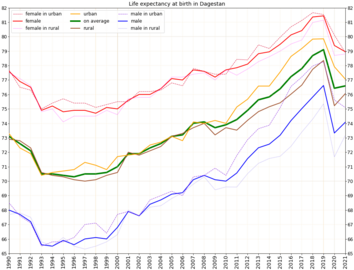
Life expectancy at birth in Dagestan
-
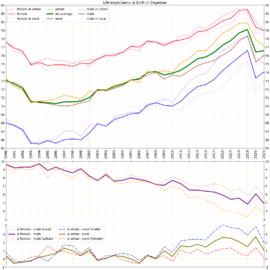
Life expectancy with calculated differences
-
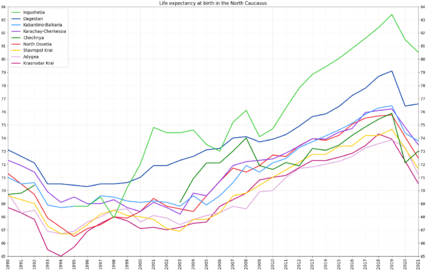
Life expectancy in Dagestan in comparison with other regions of the North Caucasus
-
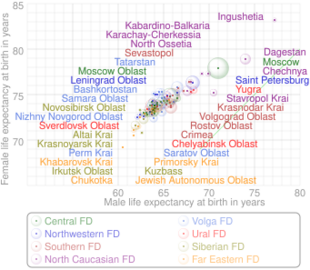
Interactive chart of comparison of male and female life expectancy for 2021.
-
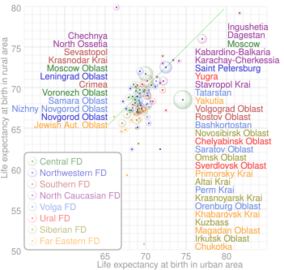
Analogious interactive chart of comparison of urban and rural life expectancy.


Major Cities and Towns
Here are some of the largest settlements in Dagestan:
|
Largest cities or towns in Dagestan
2021 Russian Census |
||
|---|---|---|
| Rank | Pop. | |
| 1 | Makhachkala | 623,254 |
| 2 | Khasavyurt | 155,144 |
| 3 | Derbent | 124,953 |
| 4 | Kaspiysk | 121,140 |
| 5 | Buynaksk | 68,121 |
| 6 | Izberbash | 55,996 |
| 7 | Kizlyar | 49,999 |
| 8 | Kizilyurt | 38,335 |
| 9 | Dagestanskiye Ogni | 31,412 |
| 10 | Karabudakhkent | 20,710 |
Diverse Ethnic Groups
Dagestan is home to many different ethnic groups. The largest groups are:
- Avars (about 30.5% of the population)
- Dargins (about 16.6%)
- Kumyks (about 15.8%)
- Lezgins (about 13.3%)
Other groups include Laks, Tabasarans, Azerbaijanis, Russians, Chechens, and Rutulians. This mix of cultures makes Dagestan very special.
Many Languages Spoken
More than 30 local languages are spoken in Dagestan. Most of these belong to the Nakh-Daghestanian family. Russian is the main language for communication among all these groups. Some of these languages are rare and are being protected.

Religions in Dagestan
Most people in Dagestan follow Islam. About 83% of the population are Muslims, mainly Sunni Muslims. There are also some Shia Muslims, especially near the Caspian Sea.


There is also a small number of Christians in Dagestan. About 2.4% of people belong to the Russian Orthodox Church. There are also some other Christian groups.

.jpg)
In the past, there were also communities of Mountain Jews who spoke the Tati language. Many of them have moved to other countries.
Religion in Dagestan (2012) Islam (83%) Russian Orthodox Church (2.4%) Nondenominational Christianity (1%) Folk religion (2%) Spiritual but not religious (9%) Atheist (2%) Others (0.6%)
Dagestan's Economy
Dagestan has several important industries. These include oil production, engineering, and chemicals. They also have machine building, textile manufacturing, and food processing.
Resources and Energy
Oil deposits are found along the coast. Dagestan also produces natural gas, mostly for local use. The republic has a fast-growing hydroelectric power industry. There are five power plants on the Sulak River that create electricity.
Farming and Transportation
Agriculture is also very important. Farmers grow grains, grapes for wine-making, and raise sheep. Dagestan has a good transportation system. Railways connect Makhachkala to Moscow and Baku. Major highways also pass through the region, and there are air links to big cities.
Economic Challenges
While Dagestan has good potential for economic growth, it faces challenges in developing its economy.
Culture and Traditions
Dagestan has a rich and vibrant culture, shaped by its many ethnic groups.
Literature and Poetry
Epic songs about historical events are popular, especially among the Avars. Famous poets like Rasul Gamzatov have created beautiful works. His poem "Zhuravli" even became a well-known Russian song.
Music and Dance
Dagestan has its own Philharmonic Orchestra and a State Academic Dance Ensemble. The first Dagestani opera, Khochbar, was written by Gotfrid Hasanov. A famous folk dance is the lezginka. Many different groups in the Caucasus have their own versions of this energetic dance.
Delicious Cuisine
Khingal-bat is a national dish of Dagestan. It consists of small dumplings boiled in ram's broth. These dumplings can be filled with meat or cheese. They are often served with garlic or sour cream sauce. Dairy products and meat are common in mountain diets. In the valleys, people eat more vegetables, fruits, and grains.
Martial Arts Champions
Dagestan is world-famous for producing incredible athletes in combat sports. Many champions in mixed martial arts (MMA) come from here.
- Khabib Nurmagomedov was a UFC lightweight champion who retired undefeated.
- His training partner, Islam Makhachev, is also a champion.
- Other famous fighters include Umar Nurmagomedov, Usman Nurmagomedov, and Magomed Ankalaev.
Dagestan has also produced many Olympic and world champions in freestyle wrestling.
- Buvaisar Saitiev won three Olympic gold medals.
- Abdulrashid Sadulaev won gold at the 2016 and 2021 Olympics.
- Magomed Ramazanov won gold at the 2024 Paris Olympics.
In boxing, Artur Beterbiev is a world champion. Many Dagestani athletes also represent other countries, like Akhmed Tazhudinov for Bahrain.
See also
 In Spanish: Daguestán para niños
- Former countries in Europe after 1815
- List of clashes in the North Caucasus
- Notable people from Dagestan
