
Darling's golden-backed frog facts for kids
Quick facts for kids Darling's golden-backed frog |
|
|---|---|
 |
|
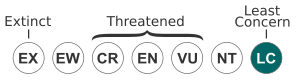
| Conservation status | |
Scientific classification  |
|
| Kingdom: | Animalia |
| Phylum: | Chordata |
| Class: | Amphibia |
| Order: | Anura |
| Family: | Ranidae |
| Genus: | Amnirana |
| Species: |
A. darlingi
|
| Binomial name | |
| Amnirana darlingi (Boulenger, 1902)
|
|
| Script error: The function "autoWithCaption" does not exist. | |
| Synonyms | |
|
|
Script error: No such module "Check for conflicting parameters".
The Amnirana darlingi, also known as Darling's golden-backed frog, is a type of frog. It belongs to the Ranidae family, which includes many common frogs. This frog was first described by George Albert Boulenger in 1902.
You can find Darling's golden-backed frog in several parts of Africa. It lives in eastern Angola, Namibia (in the Caprivi Strip), northern Botswana, and southern Democratic Republic of the Congo. It is also found in Zambia, Zimbabwe, southern Malawi, and west-central Mozambique.
Where Darling's Golden-backed Frog Lives
This frog likes many different kinds of places to live. Its natural habitats include warm, dry, or moist forests. It also lives in moist savanna areas, which are like grasslands with scattered trees.
You might find these frogs in wet shrublands or grasslands that get flooded during certain seasons. They also live near water, such as rivers, swamps, and freshwater lakes. They can be found in marshes, on arable land (farmland), in pastures, and near ponds. They even adapt to places where humans store water.
Protecting Darling's Golden-backed Frog
Even though Darling's golden-backed frog is currently not in great danger, it faces some challenges. The number of people living in these areas is growing. This means more land is being used for farming.
People also take water from rivers for their own use. Another issue is "slash-and-burn" farming. This is when people cut down and burn trees to clear land for crops. These activities can harm the frog's home. They can also break up its habitat into smaller, separate areas.
