


_Erebia_triarius_-_Etang_d%27%C3%89vol_-_male_dorsal.jpg)
_Erebia_triarius_-_Etang_d%27%C3%89vol_-_male_ventral.jpg)
- This page was last modified on 5 February 2026, at 15:01. Suggest an edit.
de Prunner's ringlet facts for kids
| de Prunner's ringlet | |
|---|---|
 |
|
| Erebia triarius | |
| Conservation status | |
Scientific classification  |
|
| Kingdom: | Animalia |
| Phylum: | Arthropoda |
| Class: | Insecta |
| Order: | Lepidoptera |
| Family: | Nymphalidae |
| Genus: | Erebia |
| Species: |
E. triarius
|
| Binomial name | |
| Erebia triarius (de Prunner, 1798)
|
|
| Script error: The function "autoWithCaption" does not exist. | |
Script error: No such module "Check for conflicting parameters".
The de Prunner's ringlet (Erebia triarius) is a type of butterfly. It belongs to a group of butterflies called the Satyrinae subfamily. These butterflies are part of the larger Nymphalidae family, which includes many well-known butterflies.
Contents
Where Does the De Prunner's Ringlet Live?
This mountain butterfly makes its home in several countries across Europe. You can find it in places like Albania, Andorra, Austria, Switzerland, France, Italy, Spain, and Portugal. It also lives in areas that were once part of Yugoslavia.
What Does This Butterfly Look Like?
The de Prunner's ringlet is a beautiful butterfly with distinct markings. Its wings are usually a dark black-brown color on the top.
Forewings and Hindwings
On its front wings (forewings), you'll see a reddish or yellowish band. This band often has five black spots, called "ocelli," which look like small eyes. Each spot has a white center. Some of these spots might be joined together.
The back wings (hindwings) also have spots. These are usually 4 to 5 oval-shaped brown spots. Each of these spots also has a black ocellus with a white center.
Underside of the Wings
The underside of the wings looks a bit different. The male butterfly's hindwings are mostly black with some grey dust. They have a dark band in the middle. The female's hindwings are more brownish-grey underneath.
When and Where Can You See Them?
These butterflies are often found on grassy slopes in mountain areas. In warmer places, they can appear as early as mid-May. At higher mountain altitudes, they usually fly from June to August. They are quite common in many of the places they live.
Images for kids
-
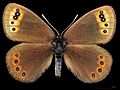
Erebia triarius male, top view
-
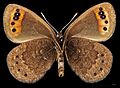
Erebia triarius male, bottom view