
Esther Rantzen facts for kids
Quick facts for kids
Esther Rantzen
DBE MStJ
|
|
|---|---|

Rantzen in 2022
|
|
| Born |
Esther Louise Rantzen
22 June 1940 Berkhamsted, Hertfordshire, England
|
| Died | 30 September 2026 (aged 86) New Forest, England
|
| Education |
|
| Occupation |
|
| Years active | 1968–2026 |
| Spouse(s) |
Desmond Wilcox
(m. 1977; died 2000) |
| Children | 3, including Rebecca |
Dame Esther Louise Rantzen was a famous English journalist and television presenter. She was best known for hosting the popular BBC television show That's Life! for twenty-one years. She also used her fame to start important charities that helped millions of people. She created Childline in 1986 so children would always have someone to talk to when in trouble. Later, she founded The Silver Line in 2012 to help older people who felt lonely.
Because of her hard work, she received royal honours from Queen Elizabeth II. She was made an OBE in 1991, a CBE in 2006, and became a Dame in the 2015 New Year Honours. She was an active campaigner who cared about kindness, safety, and health care. Her daughter, Rebecca Wilcox, followed in her footsteps by working with Childline too. Esther Rantzen showed how television could make the world a safer and happier place.
Contents
Early Life and Education
Esther Louise Rantzen was born in Berkhamsted, Hertfordshire, on 22 June 1940. Her father, Henry Barnato Rantzen, was an electrical engineer, and her mother was Katherine Flora Leverson. Her family had Jewish roots that stretched back to Warsaw in Poland. Her great-great-grandfather moved to London in the 1850s to make caps in Spitalfields, which was then a poor slum area in the East End. Her family later prospered with help from Barney Barnato, who owned the famous Kimberley Diamond Mine.
Her family also had cultural connections. Her great-grandfather, Montague Leverson, helped found the West London Synagogue and was the grandfather of composer Gerald Finzi. Another relative was the writer Ada Leverson, an author and close friend of Oscar Wilde, who was later played by Zoë Wanamaker in the film Wilde. She was also related to translator Michael Meyer. Her family history was even explored on the popular BBC family tree programme Who Do You Think You Are?.
As a girl, Esther lived in the United States for a while. She attended Buckley Country Day School in New York until 1952. Returning to England, she attended North London Collegiate School, a well-known independent school located in Edgware. She loved literature and went on to study English at Somerville College, Oxford. During her university years, the college principal was the noted scientist Dame Janet Vaughan, and one of her teachers was Mary Lascelles.
While at Oxford, Esther discovered her love for acting and theatre. She joined the Oxford University Dramatic Society, also known as OUDS. She served as secretary for the Experimental Theatre Club and performed at theatre festivals in both Oxford and Edinburgh. Her university years gave her great confidence in public speaking, which prepared her for a long career in television.
Working in Television
Starting at the BBC
After university, Esther learned secretarial skills and joined BBC Radio to work with sound effects. She quickly moved over to television, working as an office clerk in programme planning. Her first big step into programme production was as a researcher for a late-night programme called BBC-3. She enjoyed finding facts and stories, so she joined the team of the respected BBC2 documentary series Man Alive.
In 1968, she became a researcher on a consumer show called Braden's Week, presented by Bernard Braden. The show's producer decided that the researchers should share their findings on camera. This gave Esther her first chance to appear on screen. Viewers enjoyed her warm, clear style of presenting facts. When Braden returned to Canada in 1972, the BBC wanted to create a brand-new show to replace it.
The Great Success of That's Life!
In 1973, Esther became the main host of the new BBC1 show That's Life!. The show ran for 21 years until 1994, becoming one of the most watched shows in the country. More than 18 million people tuned in every week to watch Esther and her co-presenters. The show mixed funny stories, odd vegetables, and singing pets with serious investigative journalism that helped ordinary citizens.
The programme warned viewers about unfair salespeople and faulty gadgets. Soon, it began tackling serious real-world issues. It ran a famous appeal for organ donors to help sick children. This campaign featured Ben Hardwick, a brave two-year-old boy in need of a liver transplant. The show also investigated bad conditions at a boarding school near Newbury. When a newspaper called The People published untrue claims about her reporting, she won £110,000 in damages in court.
Esther used the show's huge popularity to change the law and protect young people. Her work led to courts allowing children to give evidence over video links so they felt safe. In 1976, she also created the documentary series The Big Time. That show launched the career of pop singer Sheena Easton, proving Esther's talent for finding inspiring people.
Helping Others Through Charities
Founding Childline
In 1986, Esther hosted a special show called Childwatch on BBC1, approved by controller Michael Grade. The programme aimed to protect young people from harm and neglect. Esther suggested opening a telephone helpline after the broadcast so young viewers could ring up for advice and help. The phone lines were open for 48 hours and received thousands of calls from children who had nowhere else to turn.
Esther realised that boys and girls needed a permanent helpline that was open day and night. Experts thought it would be too difficult to run, but Esther did not give up. She secured start-up money from the Department of Health and the Variety Club of Great Britain. Philanthropist Ian Skipper helped pay the running costs. She asked BT to provide free office space and a special freephone number: 0800 1111.
On 30 October 1986, Childline was officially launched with a catchy theme tune composed by B. A. Robertson. On that single night, 50,000 calls were attempted by children across the United Kingdom. Childline grew quickly, opening twelve centres in England, Scotland, Wales, and Northern Ireland. In 2006, Childline joined the NSPCC to help even more young people. Similar helplines inspired by Childline were created in around 150 countries worldwide.
The Silver Line
Later in life, Esther realised that many older citizens spent days without speaking to anyone. In 2012, she founded The Silver Line, a free and confidential helpline for older adults. The service was officially launched in 2013 to combat loneliness.
Volunteers made regular friendly phone calls to lonely older people to keep their spirits up. The service gave advice and offered comfort to people living alone. In October 2019, The Silver Line joined forces with the charity Age UK to continue its important support work across the country.
Later Television Work and Other Causes

In 1988, Esther launched Hearts of Gold on BBC One, giving awards to unsung heroes who performed brave deeds. After That's Life! finished, she hosted a daily discussion show named Esther on BBC Two from 1994 until 2002. She also took part in entertaining shows, dancing with Anton Du Beke on the second series of Strictly Come Dancing in 2004.
She joined the adventure show I'm a Celebrity...Get Me Out of Here! in 2008. She took part in Excuse My French and appeared on Celebrity First Dates. She paired up with Lynn Faulds Wood, a reporter from Watchdog, to present Old Dogs New Tricks. On Channel 5, she made Esther Rantzen's House Trap, warning people about dishonest home repairs.
She also made touching documentaries for ITV. One famous film told the story of Sir Nicholas Winton, who saved hundreds of Czech children from The Holocaust before World War II. He was later nominated for the Nobel Peace Prize. Esther also raised awareness for ME/CFS, also known as chronic fatigue syndrome, a health condition affecting her daughter. She created the inspiring 'Children of Courage' awards for the BBC's charity telethon Children in Need.
She served as vice-president for Revitalise, a charity that gave respite holidays to disabled people and their carers. In 2016, she was made an Honorary Fellow of Somerville College, University of Oxford. In 2012, when broadcaster Jimmy Savile was shown to be dishonest in the documentary Exposure: The Other Side of Jimmy Savile, Esther spoke on Channel 4 News. She supported those who spoke out, while answering questions raised by campaigners like Shy Keenan and journalist Katy Brand in The Daily Telegraph and The Sun.
Politics and Opinions

In May 2009, Esther announced on Stephen Rhodes's radio show that she wanted to run for Parliament. She was upset by the United Kingdom parliamentary expenses scandal, where politicians used public money improperly. Member of Parliament Margaret Moran had claimed public funds for home repairs. Moran decided to step down, but Esther chose to run for the Luton South seat in the 2010 United Kingdom general election.
She ran as an independent candidate, meaning she did not belong to any political party. During the election, Labour Party candidate Gavin Shuker won the seat. Esther finished fourth with 4.4 percent of the vote. Because she did not reach 5 percent, she lost her deposit under UK election rules. In 2014, she wrote a public letter with other figures to The Guardian, encouraging voters to stay united during the 2014 Scottish independence referendum.
Personal Life and Honours
In her early career, Esther dated politician Nicholas Fairbairn. In 1968, she fell in love with documentary producer Desmond Wilcox. They worked together at the BBC and married in December 1977. When coworkers felt it was unfair for a married couple to work in the same department, Wilcox resigned. He started his own company and won the prestigious Grierson Lifetime Achievement Award in 2001. They had three children, including television presenter Rebecca Wilcox.
Later in life, Esther faced major health challenges. In early 2023, she announced that she had been diagnosed with lung cancer that had reached stage IV. She spoke openly in The Times about living with a serious illness. She joined the group Dignity in Dying and supported the Swiss charity Dignitas, sharing her thoughts on healthcare choices for the terminally ill. Esther died on 30 September 2026 at the age of 86.

Esther received many awards for her kindness and broadcasting skills. She was named an Officer of the Order of the British Empire in 1991, and a Commander of the Order of the British Empire in 2006. She was appointed Dame Commander of the Order of the British Empire in 2015. She was also made a Member of the Order of St John in 1991. The television industry praised her with a special journalism award from the Royal Television Society and a Dimbleby Award from BAFTA.
In 2018, she received an official coat of arms from the historic College of Arms. Her shield featured candles, a trumpet, and red roses, along with her personal motto: "IF NOT NOW WHEN". Her life was dedicated to speaking up for people who needed help most.
 |
|
Images for kids
-

Dame Esther Rantzen during the Platinum Pageant in 2022
-

Esther Rantzen at the British Academy Television Awards
-
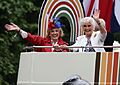
Esther Rantzen smiling at the Queen Elizabeth II Platinum Jubilee
-
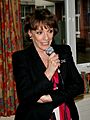
Esther Rantzen visiting Nightingale House in California
