
First Bank of Vale facts for kids
Quick facts for kids |
|
|
First Bank of Vale
|
|

The building's exterior in 2012
|
|

 First Bank of Vale
Location in Oregon

First Bank of Vale
Location in the United States
|
|
| Location | 148 Main St. S., Vale, Oregon |
|---|---|
| Area | 0.1 acres (0.040 ha) |
| Built | 1901 |
| Built by | Milton G. Hope, Isiah W. Hope |
| Architectural style | Richardson Romanesque |
| NRHP reference No. | 92000132 |
| Added to NRHP | 5 March 1992 |
The First Bank of Vale is a historic building located in Vale, Oregon. It was built in 1901 using stone found right in the local area. Two brothers, Milton and Isiah Hope, who were early settlers, built this two-story building. Its design is a simple version of the Richardson Romanesque style. The building was added to the National Register of Historic Places on March 5, 1992, which means it's recognized as an important historical site.
Contents
History of the First Bank of Vale
Vale, Oregon, was the very first permanent settlement in Malheur County along the famous Oregon Trail. Many of the early buildings in Vale, including the First Bank of Vale, were made from local sandstone around the year 1900. Later, after 1906, builders started using bricks more often.
The town of Vale really started to grow after a stone hotel, now called the Old Stone House, was built in 1872. Vale also became the permanent county seat for Malheur County in 1902, after a few elections. The First Bank of Vale building was finished and opened in 1901, around the same time the county courthouse was being built. It was the first bank in Vale to have its own permanent building.
Who Built the Bank?
The bank was built by Milton and Isiah Hope, two brothers who owned some of the first land in Vale. The Hope brothers were skilled stone masons, meaning they were experts at working with stone. They also owned a store and were active businessmen. They even helped pay for the courthouse to be built. It's very likely that one of the Hope brothers was the main builder or architect for the First Bank of Vale building.
The First Bank of Vale officially started on June 17, 1901, with a lot of money to begin with (US$50,000). The bank did very well over the next few years, even doing better than another bank that opened in town. In 1908, the First Bank of Vale moved into a new, larger building, which is now known as the Drexel Hotel. This new building is also on the National Register of Historic Places. After the bank moved, the original First Bank of Vale building was sold back to the Hope brothers.
What Happened to the Building Later?
Around 1906, the First Bank of Vale building was changed inside when it got new owners and was used for different things. It was used for offices and shops until the 1930s or 1940s. After that, it was turned into apartments for families. The building changed owners many times. At one point, a person named Fred Burgess tried to turn it into a museum, and it was known as the Burgess Building.
After being a private home for a while, the building was left empty. When it was listed on the National Register of Historic Places, it was owned by a private person. Even with all the changes, the building still looks a lot like it did when it was first built.
Where is the Bank Located?
After the Old Stone House was built in 1872, other buildings like a stable and blacksmith shop were added. The Hope Brothers Mercantile (their store) was built in 1893. These buildings, along with the First Bank of Vale, were all very close together on the Oregon Trail. They formed the main part of downtown Vale.
The bank building is at 148 Main Street South. It faces west, looking out onto Main Street. The First Bank of Vale is a great example of the Richardson Romanesque style in the area. It's part of a group of buildings that were all built around the same time (1895–1907). They also use similar building materials and have a Romanesque or Italianate architectural style. Even though the bank building is small, it has a strong and important look.
How the Building Looks
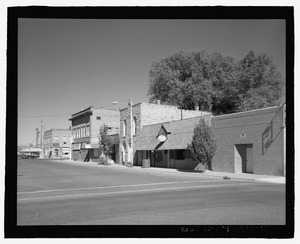
The First Bank of Vale is a two-story building made entirely of local stone. The only parts made of brick are the four chimneys. The Hope Brothers built it, and their stonework was very good, even though they built it in less than three months. The building is about 22 feet (6.7 m) wide and 40 feet (12.2 m) long. The main walls are made of rough, cut sandstone over a base of smaller, rougher stones. The outside walls are thick, about 16 inches (40.6 cm), held together with lime and sand mortar.
The front of the building has smoothly cut stone and strong Romanesque design elements. The walls on the sides go up higher than the flat roof, hiding it. The stone used for the bank came from a quarry just south of Vale. This stone was also sent to other towns for building.
The Front of the Building
The front wall goes straight up and has a decorative top edge. In the center, there's a triangular shape with a round decoration on top. The windows are placed evenly. On the second floor, there are two large windows with rounded tops, like Roman arches. On the first floor, there's a set of three arched openings, with the main door at one end and two large storefront windows. All these openings are connected by decorative stone arches.
All the windows have large, rough-cut stone sills at the bottom. The door has a window above it with a rounded top. The windows on the first floor also have stained glass fan shapes above their main panes. The windows on the upper floor are double-hung (they slide up and down) and have small panes. They also have rounded windows above them. A unique pointed decoration with a ball design sits at the very top of the front. All these features give the bank a grand and traditional look.
Other Sides of the Building
On the south side of the building, a stairway that used to be there was removed, and the upstairs doorway was changed into a window around 1906. This side of the building hasn't changed much otherwise. It has a wall made of rough stone with granite pieces above the windows. The north side of the building is built the same way. The first floor of this side is hidden by the building next to it, but the upper floor has two windows. These windows, which are steel-framed and have many panes, are probably not the original ones.
The back of the ground floor is hidden by a large cinder block addition that was built in 1980. The original back door on the ground floor now opens into this addition. There used to be a large freight door with a granite top piece, but it was filled in and covered by the cinder block addition. On the second story, an original door opens onto the roof of the addition, which suggests there was also a back stairway when the building was first built. A window on the second floor of this back wall has been filled with cement. The walls on the north and south sides extend a bit above the roof. The original roof is covered, and the current roof is made of asphalt.
Inside the Bank
The inside of the building was changed a lot around 1906. A new stairway was built inside, and it's likely that plumbing and electricity were added at this time. Old outdoor toilets were removed, and a bathroom was built inside under the new stairs. A sewer pipe was also installed from the second floor. A small, opaque window was cut into one wall to let light from the front room into another area. On the second floor, a bathroom was built, and a wall was moved.
More changes were made possibly in the 1930s or 1940s. The upstairs rooms were divided even more. Windows were added to the north wall, and the back second-floor window was filled with cement, as was the large opening at the back. A room at the back of the second floor was turned into a kitchen with a concrete chimney. Some rough changes were made in the 1970s. The wooden beams on the second floor had some fire damage and were strengthened. While these changes covered some original features, they didn't remove them completely.
When someone tried to create a museum in the building, wire mesh was put on the windows, and the cinder block addition was built. The original floor was covered in 1980 when a concrete slab was poured for the museum project. Later, when it was used as a private home, someone tried to remodel it again, removing many of the previous changes, but the work was not finished. When the building was listed on the National Register of Historic Places, the inside had a lot of debris, and the roof needed repairs.
Even with all these changes and the need for repairs, the inside of the building still has many of its original designs and details.
Saving the Building
In 2018, the Malheur County Historical Society started talking about buying the First Bank of Vale from Steven Reynolds. Reynolds owned the property when it was listed on the National Register of Historic Places and helped with the application. They agreed on a price of US$20,000. The society plans to fix up the building and use it as their office. Bob Butler, who gave US$2,000 as a down payment, thought the repairs might cost as much as US$250,000. As of December 2019, the society was working to raise money to pay for an engineering report. This report will help them figure out the best way to restore the building.
