
Flamethrower facts for kids
A flamethrower is a special device that shoots a controlled stream of fire. People have used similar fire-projecting tools since ancient times. Modern flamethrowers became important during World War I and were used even more in World War II. They were often used to clear out enemy hiding spots.
Most military flamethrowers use liquid fuel, like oil or diesel. However, flamethrowers used for peaceful jobs often use gases like propane. Gas flames are usually safer for everyday tasks because they are smaller and easier to put out.
Besides military uses, flamethrowers help with controlled burning in places like sugarcane fields. This helps manage land and clear away unwanted plants. Some flamethrowers are small enough for a person to carry, while others are mounted on vehicles.
Contents
Flamethrowers in Battle

Modern flamethrowers first appeared during the trench warfare of World War I. Their use grew a lot in World War II. They can be carried by soldiers or attached to vehicles like tanks.
A soldier-carried flamethrower has two main parts: a backpack and a gun. The backpack usually has two or three cylinders. One cylinder holds a gas, like nitrogen, which pushes the fuel. The other cylinders hold the flammable liquid fuel, often a type of oil. This gas pushes the liquid fuel through a hose to the gun.
The gun has a small tank, a valve, and a way to start the fire. When a soldier pulls the trigger, the valve opens. This lets the pressurized fuel flow past a spark or a small pilot flame, igniting it as it leaves the nozzle.
Flamethrowers were mostly used against strong enemy defenses, like bunkers and fortified positions. They shoot a stream of flammable liquid, not just fire. This stream can bounce off walls and reach hidden areas inside bunkers. While movies often show flamethrowers as short-ranged, real military ones can reach targets up to 50 to 100 meters away. Sometimes, an unlit stream of fuel was fired first, then ignited by another flame inside the target area.
Using a flamethrower has some challenges for the soldier. The weapon is heavy and long, making it harder to move quickly. It also uses fuel very fast, so it can only fire for a few seconds at a time. This means operators need to be very careful and precise. Flamethrower operators were also very noticeable on the battlefield, making them easy targets for enemy shooters.
The range of a flamethrower is shorter compared to many other weapons. Soldiers using them had to get close to their targets, which put them at risk. Even flamethrowers on vehicles, while having a longer range than handheld ones, still had a shorter reach than other vehicle-mounted weapons.

The idea that flamethrower tanks explode easily if hit by enemy fire is often exaggerated in movies. While it was possible for the pressure tanks to rupture and harm the operator if hit by bullets or shrapnel, the fuel itself is not always easy to ignite. The pressurizer holds a non-flammable gas. The fuel mixture needs a special igniter to catch fire. If a fuel tank is pierced by a bullet, it usually just leaks, unless the bullet itself is designed to start fires.
To make flamethrowers safer and more effective, they were often mounted on armored vehicles. Countries like Britain and the United States used many vehicle-mounted flamethrowers. These "flame tanks" were very useful against enemy defenses.
How Flamethrowers Operate
In a propane-operated flamethrower, the gas is pushed out through the gun by its own pressure. A special spark, called piezo ignition, lights the gas as it leaves the barrel.
Liquid-operated flamethrowers use a smaller tank with pressurized gas to push out the flammable liquid fuel. This gas goes into two tubes. The first tube creates pressure in the fuel tanks, forcing the liquid out. The other tube goes to a small chamber near the gun's exit. Here, the gas mixes with air and is ignited by a spark. This small flame is what you often see in front of the gun in movies. As the main fuel stream passes through this flame, it catches fire and shoots towards the target.
The History of Fire Weapons
The idea of using fire as a weapon is very old. People have tried to project fire since ancient times.
Early Fire Projectors
.jpg)
During the Peloponnesian War in ancient Greece, people called Boeotians used a type of fire projector. They used it to try and burn down the walls of enemy cities. An ancient admiral named Pausistratus also used a device to throw fire onto enemy ships. It was a funnel filled with burning material, hung from a pole.
The Roman Empire also used fire weapons. In 107 AD, they used a flamethrower-like device against the Dacians. Later, the Byzantine Empire developed "Greek fire," a secret weapon used mainly on ships. It was shot from hand-held pumps and was very effective in naval battles.
Chinese Fire Devices

In China, around 919 AD, a "fire spraying device" called the Pen Huo Qi was invented. It was a piston flamethrower that used a fuel similar to petrol. This device was important in naval battles. Later, Chinese engineers improved it by using double-piston bellows to create a continuous stream of flame. These inventions helped the Song dynasty defend itself against invaders.
Medieval and Early Modern Uses
During the Great Siege of Malta, defenders used a weapon called a "Trump." It was a tube filled with burning materials that shot out a long flame. In the 1700s, engineers in Prussia and Russia also experimented with fire-spraying devices for military use.
In the 1800s, American inventor Uriah Brown built a steam-powered flamethrower. French chemists also suggested using flaming petroleum against enemy troops during a siege in Paris.
Flamethrowers in World War I
.jpg)
Before World War I, German pioneers used a simple fire weapon called the Brandröhre M.95. It was a tube filled with burning material that shot a short stream of fire.
The modern flamethrower, as we know it, was invented in Germany by Richard Fiedler around 1901. His device used pressurized gas to push flammable oil through a nozzle, where it was ignited. It could project a jet of fire and smoke.
The German Army first used flamethrowers in a major way during World War I in 1915. They were used against enemy trenches, often to force soldiers out into the open. While effective at close range, these early flamethrowers were heavy, hard to use, and had limited fuel. Other countries, like Britain and France, also developed and used their own flamethrowers during the war.
Flamethrowers in World War II

Flamethrowers were used a lot during World War II. Germany used them against strong defenses in countries like the Netherlands and France. They also used them in city battles.
Many countries developed "flame tanks" by putting flamethrowers on armored vehicles. These tanks were very good at attacking enemy bunkers and fortifications.
Axis Powers' Use
Germany used various types of flamethrowers, including handheld ones and those mounted on vehicles. They even created "flame mines" that could be buried and triggered to spray fire. Finland and Italy also used flamethrowers, including flame tanks. Japan used handheld flamethrowers to clear out enemy positions on islands in the Pacific.
Allied Powers' Use

British soldiers used "Ack Packs," which had a unique doughnut-shaped fuel tank. They also used powerful Churchill Crocodile flame tanks, which could shoot fire over 150 meters. These tanks were very effective against German defenses. Australian forces used similar flame tanks called Matilda Frogs.

In the Pacific, the United States Army and Marines used M-1 and M-2 flamethrowers. They were crucial for clearing out Japanese bunkers, caves, and trenches. Flamethrower teams were often part of combat engineer units. The U.S. also developed flame tanks based on Sherman tanks. Many Japanese soldiers later said they were very scared of flamethrowers.
The Soviet Union also used flamethrowers, including stationary ones for defense. They even tried to hide their handheld flamethrowers by making them look like regular rifles to protect the operators.
Later Military Uses

After World War II, flamethrowers continued to be used in some conflicts. The United States Marines used them in the Korean War and Vietnam War. Armored flamethrowers, like the M132, were also used. However, the U.S. military stopped using infantry flamethrowers in 1978, finding them less effective in modern combat.
Other countries, like China and Iraq, used flamethrowers in conflicts during the late 20th century. Even in more recent times, flamethrowers or similar incendiary weapons have appeared. For example, in 1988, a flamethrower was used to neutralize a machine gun position during a rescue operation in New Caledonia. Some military forces, like the Chinese Army, still use flamethrowers today. In 2017, a rocket-assisted flamethrower was used in Ukraine. In 2022, during the conflict in Ukraine, Russian sources mentioned using "heavy flamethrowers," which refers to powerful thermobaric rocket launchers.
International Rules for Flamethrowers
The use of flamethrowers in war is not completely banned. However, there are international rules, like the United Nations Protocol on Incendiary Weapons. These rules forbid using incendiary weapons, including flamethrowers, against civilians. They also restrict their use against forests, unless those areas are hiding enemy fighters or military targets.
Personal Flamethrowers and Laws
In the United States, owning a flamethrower is generally not restricted by federal law. This is because they are considered tools, not firearms. They are legal in most states, but California and Maryland have some restrictions. In California, owning a flamethrower that can shoot fire at least 10 feet without a license is a misdemeanor.
In the United Kingdom, flamethrowers are considered "prohibited weapons." Owning one can lead to a prison sentence.
In 1998, a South African inventor created a "Blaster" flamethrower that could be mounted on a car for security against carjackers. It is no longer sold.
More recently, Elon Musk's company, The Boring Company, sold a device called "not a flamethrower." This device uses liquid propane gas, making it more like a large torch than a traditional military flamethrower.
Other Uses for Flamethrowers
Flamethrowers are sometimes used for peaceful purposes. For example, they can help start controlled burns to manage land or in agriculture. In sugarcane fields, they burn away dry leaves, which helps with harvesting and removes dangerous snakes. However, simpler tools like driptorches are more commonly used for this.
There are also stories of flamethrowers being used to clear large amounts of snow in Washington, D.C., before a presidential inauguration. In 2008, U.S. combat engineers used flamethrowers in Iraq War to clear brush and remove hiding spots for insurgents.
Flamethrowers were even part of the 2012 Summer Paralympics closing ceremony, where performers used them to create impressive flame effects.
Police have also been known to use modified flamethrowers filled with tear gas and water for riot control, instead of flammable liquids.
Images for kids
-
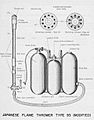
A Type 93 flamethrower used by the Imperial Japanese Army, drawing made for the US Military Intelligence Service
-
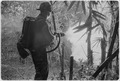
A U.S. Soldier firing a flamethrower during the Vietnam War
-
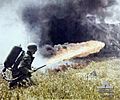
A German soldier using a flamethrower in Russia
-
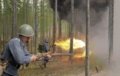
Swedish volunteers in the Finnish Army using a flamethrower in exercises in the Reserve Officer School, 1942.
-
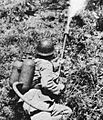
A Japanese soldier firing a Type 93 flamethrower
-
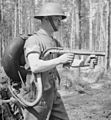
A British World War II–type "lifebuoy" flamethrower in 1944
-
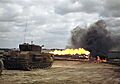
A Churchill tank fitted with a Crocodile flamethrower in action.
-
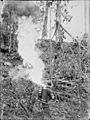
An Australian soldier fires a flamethrower at a Japanese bunker
-
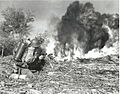
A soldier from the 33rd Infantry Division uses an M2 flamethrower
-
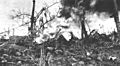
Soldiers engaging Japanese positions on Okinawa with a flamethrower.
-
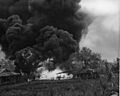
An M3A1 from the USMC 2nd Tank Battalion incinerates Japanese pillbox on Saipan.
-
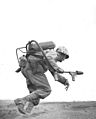
An American flamethrower operator runs under fire
-
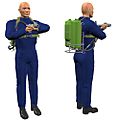
Front and rear views of a man with an M2A1-7 United States Army flamethrower
-
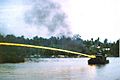
A riverboat of the U.S. Brownwater Navy shooting ignited napalm from its mounted flamethrower during the Vietnam war
-
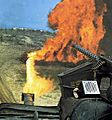
An M67 "Zippo" tank of the USMC during the Vietnam War
-
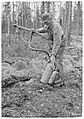
A Finnish soldier with a captured Soviet ROKS-3 flamethrower, June 1943. The flame projector has been designed to resemble a standard infantry rifle.
-
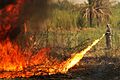
A sergeant of the 66th Engineers torching brush with a flamethrower in Iraq in 2008


.png)


.jpg)

.jpg)


See also
 In Spanish: Lanzallamas para niños
- Dragon's breath
- Early thermal weapons
- Flame gun
- Huo Long Jing
- Le Prieur rocket
- List of flamethrowers
- M202A1 FLASH
- Meng Huo You
- Molotov cocktail
- Petroleum Warfare Department
- Technology of Song dynasty
