
Fungus-eating Ladybird facts for kids
Quick facts for kids Fungus-eating Ladybird |
|
|---|---|
 |
|
| Scientific classification | |
| Kingdom: | |
| Phylum: | |
| Class: | |
| Order: | |
| Family: | |
| Subfamily: |
Coccinellinae
|
| Tribe: |
Coccinellini
|
| Genus: |
Illeis
|
| Species: |
I. galbula
|
| Binomial name | |
| Illeis galbula (Mulsant, 1850)
|
|
| Synonyms | |
|
|
The Fungus-eating Ladybird (Illeis galbula) is a special type of beetle. It belongs to the same family as other ladybirds. This small insect is known for eating powdery mildew, a common plant disease. You can often find these ladybirds in gardens, especially on plants like pumpkins.
Contents
What Does the Fungus-eating Ladybird Look Like?
Adult Fungus-eating Ladybirds are quite small, about 4 to 5 millimeters long. They are black with bright yellow markings.
Their young, called larvae, are a bit bigger, growing to about 8 to 10 millimeters. Larvae are grey and have black bumps, called tubercles. These bumps are covered with short spines.
When the larva changes into a pupa, it looks pale yellow. The pupa also has black tubercles and small spurs on its sides.
How It Behaves and What It Eats
During the day, the Fungus-eating Ladybird moves very quickly. If something disturbs it, it will quickly fly away or drop to the ground. Even the pupa can be active and often stands on its end.
Both adult and larval Fungus-eating Ladybirds are often found in gardens. They love to eat powdery mildew, which is a type of fungus. This fungus grows on plants like pumpkin and zucchini.
In Australia, adult ladybirds that are overwintering (spending the winter) will eat pollen. They feed on pollen from plants like wattles and privet during the spring.
Where the Fungus-eating Ladybird Lives
This ladybird species is originally from Eastern Australia. However, it is not native to the North Island of New Zealand. It was first brought to Auckland in New Zealand in 1985. You can also find the Fungus-eating Ladybird in New Guinea.
Gallery
-
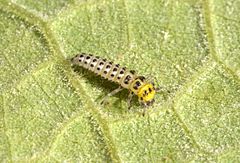
Larval form.
-
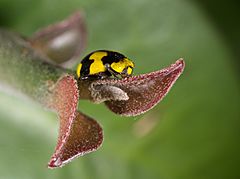
Fungus-eating Ladybird, Binalong Bay, Australia.
-
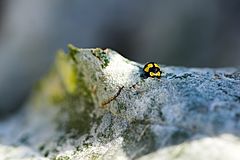
Fungus-eating ladybird eating powdery mildew on zuchinni leaf.

.jpg)
.jpg)
