
Georges Seurat facts for kids
Quick facts for kids
Georges Seurat
|
|
|---|---|

Seurat in 1888
|
|
| Born |
Georges-Pierre Seurat
2 December 1859 Paris, France
|
| Died | 29 March 1891 (aged 31) Paris, France
|
| Known for | Painting |
|
Notable work
|
A Sunday Afternoon on the Island of La Grande Jatte Bathers at Asnières Parade de cirque |
| Movement | Post-Impressionism, Neo-Impressionism, Pointillism |
| Partner(s) | Madeleine Knobloch |
| Signature | |
 |
|
Georges Pierre Seurat (pronounced SUR-ah) was a talented French artist. He lived from December 2, 1859, to March 29, 1891. Seurat created special painting methods called chromoluminarism and pointillism. He also made beautiful drawings using conté crayon on textured paper.
Seurat was a unique artist. He combined a very sensitive artistic feeling with a love for clear, logical ideas. He even used an almost mathematical way of thinking in his art. His most famous painting, A Sunday Afternoon on the Island of La Grande Jatte (painted from 1884 to 1886), changed the art world. It started a new art style called Neo-Impressionism and is a key artwork from the late 1800s.
Contents
Who Was Georges Seurat?
Early Life and Art Training
Georges Seurat was born in Paris, France, on December 2, 1859. His family moved homes a few times when he was very young. His father, Antoine Chrysostome Seurat, was a successful businessman. His mother, Ernestine Faivre, was from Paris. Georges had an older brother, Émile Augustin, and an older sister, Marie-Berthe. His father often lived in another town but visited his family weekly.
Georges first learned art at a local school for sculpture and drawing. In 1878, he went to the École des Beaux-Arts, a famous art school. There, he learned traditional art skills, like drawing from old sculptures and copying master drawings. Seurat's studies helped him develop his own ideas about how colors and shapes work together. His formal art education ended in November 1879 when he joined the military for a year.
After serving in the infantry in Brest, France, he returned to Paris. He shared a studio with his friend Edmond Aman-Jean. For the next two years, Seurat focused on mastering drawing with a single color. His first artwork shown in public was a drawing of Aman-Jean in 1883. He also carefully studied the works of artist Eugène Delacroix, especially how he used color.
Painting "Bathers at Asnières"

In 1883, Seurat started his first big painting, Bathers at Asnières. This large artwork shows young men relaxing by the Seine River in a working-class area near Paris. While it used bright colors and light like Impressionism, the painting also showed his traditional training. Its smooth textures and carefully drawn figures looked almost like sculptures.
Seurat prepared for this painting with many drawings and oil sketches. This was different from Impressionist painters, who often painted directly onto the canvas. The Paris Salon, a major art exhibition, rejected Bathers at Asnières. Instead, Seurat showed it at a group exhibition in May 1884.
Seurat and some other artists were not happy with how the exhibition was organized. So, they created a new group called the Société des Artistes Indépendants. This group included artists like Charles Angrand, Henri-Edmond Cross, Albert Dubois-Pillet, and Paul Signac. Seurat's new ideas about pointillism greatly influenced Signac, who then began painting in a similar style.
Creating "A Sunday Afternoon on the Island of La Grande Jatte"

In the summer of 1884, Seurat began working on his most famous painting, A Sunday Afternoon on the Island of La Grande Jatte.
This painting shows people from different social classes enjoying a park. Seurat used tiny, side-by-side dots of many colors. When you look at the painting from a distance, your eyes blend these colors together. This creates a vibrant and unique effect. Seurat spent two years finishing this large painting, which is about 10 feet wide. He spent much of that time sketching in the park to prepare. There are about 60 studies for this artwork. A smaller version, Study for A Sunday Afternoon on the Island of La Grande Jatte, is also at The Art Institute of Chicago. The main painting is a permanent part of their collection.
This famous artwork inspired the musical Sunday in the Park with George by James Lapine and Stephen Sondheim. It also played an important role in the movie Ferris Bueller's Day Off.
Later Years and Family Life
,_oil_on_canvas,_95.5_x_79.5_cm,_Courtauld_Institute_of_Art.jpg)
Seurat lived with Madeleine Knobloch, an artist's model. She appeared in his painting Jeune femme se poudrant. In 1889, she moved into his studio.
Seurat and Madeleine had a son named Pierre-Georges, born on February 16, 1890. They moved to a new studio around this time.
In the summer of 1890, Seurat worked on the coast in Gravelines. There, he painted four canvases, including The Channel of Gravelines, Petit Fort Philippe. He also created eight oil panels and several drawings.
Seurat's Passing
Seurat passed away in Paris at his parents' home on March 29, 1891. He was only 31 years old. The exact cause of his death is not fully known, but it was likely a serious illness. Sadly, his young son also passed away shortly after.
His last major artwork, The Circus, was not finished when he died. A funeral service was held on March 30, 1891. Seurat was buried on March 31, 1891, at Cimetière du Père-Lachaise.
Understanding Seurat's Color Ideas

How Artists Thought About Color
During the 1800s, scientists and writers studied color, how light affects what we see, and how our eyes perceive things. They made scientific discoveries easier for artists to understand. Artists were very interested in these new ideas about perception.
One important influence was Michel Eugène Chevreul, a French chemist. He worked on restoring old tapestries. Chevreul noticed that colors looked different depending on the colors next to them. He found that two colors placed very close together would blend in the viewer's eye when seen from a distance. This discovery became the basis for the pointillist technique.
Chevreul also realized that after looking at a color, you might see a "halo" of the opposite color (called a complementary color). For example, after seeing red, you might see a cyan (blue-green) echo. Artists like Seurat used these complementary colors a lot in their paintings. Chevreul advised artists to think about all the surrounding colors to create a harmonious artwork.
Another writer, Ogden Rood, also studied how colors mix. He noted that placing primary colors (red, green, blue-violet) next to each other creates a more intense and pleasing color when seen from a distance than mixing paints directly. Rood explained the difference between mixing light (additive) and mixing paints (subtractive):
- Mixing light: Red + Green + Blue = White
- Mixing paints: Red + Yellow + Blue = a dark color (though Magenta, Yellow, and Cyan make a true black)
Seurat also learned from other thinkers about the emotional meanings of lines and colors.
Seurat's "Language of Color"

Seurat strongly believed in a scientific approach to painting. He thought that artists could use color to create harmony and emotion, just like musicians use notes to create music. He wanted to prove that using color scientifically was like following a natural law. He called this new art language Chromoluminarism.
In a letter from 1890, Seurat wrote that art is about harmony. He said harmony comes from balancing opposite and similar elements of tone, color, and line. For example, light against dark, or complementary colors like red-green. Lines that form a right angle also create harmony.
Seurat's ideas about emotion in art can be summed up:
- Joy comes from bright, warm colors and lines that point upwards.
- Calm comes from a balance of light and dark, warm and cool colors, and horizontal lines.
- Sadness comes from dark, cool colors and lines that point downwards.
Seurat's Lasting Impact

Seurat's work had a big influence on other artists, especially the Cubists around 1911. His paintings, with their flatter and more structured look, caught their attention. Seurat, in his short career, used his observations about light and color to create a whole new art system. He developed a new way of painting that perfectly matched his artistic ideas.
Art historians note that Seurat's paintings and drawings were easy to see in Paris. Copies of his main works were shared widely among Cubist artists. His painting The Chahut was even called "one of the great icons of the new devotion."
French artists believed that painting could be expressed using mathematics, both in color and form. This mathematical approach led to an "objective truth" in art. The Neo-Impressionists, like Seurat, successfully created a scientific basis for color in art. Later, the Cubists did the same for form and movement.
On December 2, 2021, Google honored Seurat with a Google Doodle for his 162nd birthday.
Famous Paintings by Seurat
-
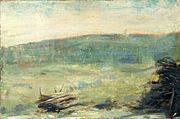
Landscape at Saint-Ouen, 1879–80, oil on panel, Metropolitan Museum of Art
-
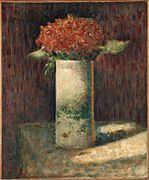
Flowers in a Vase, 1879, oil on canvas, Fogg Museum
-
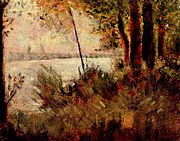
Overgrown Slope, 1881, oil on canvas, Dallas Museum of Art
-
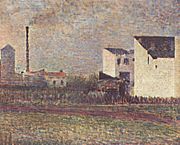
The Suburbs, 1882–83, Musée d'art moderne de Troyes
-
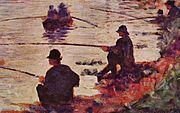
Fishing in the Seine, 1883, Musée d'art moderne de Troyes
-
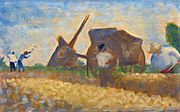
The Laborers, 1883, National Gallery of Art Washington, DC.
-
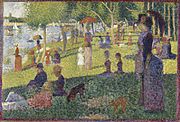
Study for A Sunday Afternoon on the Island of La Grande Jatte, 1884–85, Art Institute of Chicago, Chicago
-
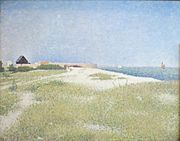
View of Fort Samson, 1885, Hermitage Museum, St. Petersburg
-
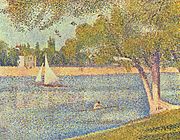
The Seine and la Grande Jatte – Springtime, 1888, Royal Museums of Fine Arts of Belgium
-
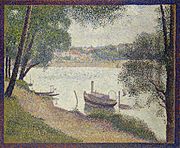
Gray weather, Grande Jatte, 1888, Philadelphia Museum of Art
-
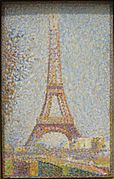
The Eiffel Tower, 1889, California Palace of the Legion of Honor, San Francisco


Seurat's Drawings
-
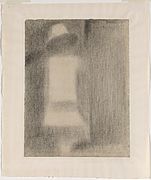
Child in White, 1884–85, Solomon R. Guggenheim Museum
-
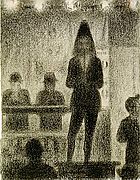
Joueur de trombone (Study for Parade de cirque), 1887, private collection


Where Seurat's Art Was Shown

From 1883 until his death, Seurat showed his artwork in many exhibitions. These included the Salon, the Salon des Indépendants, and shows in Brussels and other cities.
Some notable exhibitions included:
- Salon, Paris, 1883: Seurat's drawing of Edmond Aman-Jean was shown.
- Salon des Indépendants, Paris, 1884: Seurat's painting Une Baignade, Asnières was shown after being rejected by the official Salon. This was his first time showing a painting.
- Impressionist exhibition, Paris, 1886: Un dimanche après-midi à l'Île de la Grande Jatte was shown for the very first time.
- Les XX, Brussels, 1887, 1889, 1891: Seurat showed several paintings, including Le Chahut.
- Salon des Indépendants, Paris, 1890: He showed Le Chahut, Jeune femme se poudrant, and other works.
- Salon des Indépendants, Paris, 1891: His unfinished work Le Cirque and paintings from Gravelines were displayed.
After his death, Seurat's art continued to be exhibited:
- Solomon R. Guggenheim Collection of Non-Objective Paintings, South Carolina, 1938.
- Seurat’s Circus Sideshow, Metropolitan Museum of Art, 2017.
- Seurat and the Sea, Courtauld Gallery, 2026.
See also
 In Spanish: Georges Pierre Seurat para niños
