
Glaucous shears facts for kids
Quick facts for kids Glaucous shears |
|
|---|---|
 |
|
 |
|
| Scientific classification | |
| Synonyms | |
|
The Glaucous Shears (scientific name: Papestra biren) is a type of moth. It belongs to the Noctuidae family, which includes many night-flying moths. A scientist named Johann August Ephraim Goeze first described this species in 1781.
You can find the Glaucous Shears moth in most parts of Europe, but it's not common in southern Spain, Italy, or Greece. Outside of Europe, it lives across a large area called the Palearctic region. This includes places like Kashmir, Siberia, Central Asia, and Japan.
In 1935, this moth was brought to Newfoundland in North America. Since then, it has spread further south. It can live in high places, even up to 2,200 meters (about 7,200 feet) above sea level in the Alps mountains.
Contents
About the Glaucous Shears Moth
The Glaucous Shears moth is usually purplish-grey with some blackish areas. It has special markings on its wings that are pale grey with white edges. These markings help identify it. The moth's wingspan, which is the distance from one wingtip to the other, is usually between 30 and 38 millimeters (about 1.2 to 1.5 inches).
Some Glaucous Shears moths can look a bit different. For example, some from northern areas like Lapland might be more ash-grey. Others can be very dark, or even a uniform reddish-grey color.
Life Cycle of the Glaucous Shears
Adult Glaucous Shears moths are active for a short time each year. They usually fly from May to July. During this period, they complete one full generation.
Caterpillar Stage
The young stage of the moth is a caterpillar. These caterpillars are often reddish-brown. They have darker patterns on their backs. You might notice a lighter line running down their back. They also have yellowish-white lines along their sides.
The caterpillars mostly eat low-growing plants found in mountainous areas. Their favorite foods include Vaccinium uliginosum (also known as bog bilberry) and Vaccinium myrtillus (the common bilberry). They have also been seen eating leaves from Salix caprea (goat willow) and Sorbus aucuparia (rowan tree).
Images for kids
-
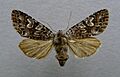
A Glaucous Shears moth.
-
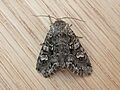
Another view of the Glaucous Shears moth.
-
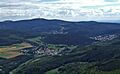
The natural home of the Glaucous Shears moth in the Taunus Mountains, Germany.
-
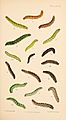
Caterpillars of the Glaucous Shears moth at different stages.


